- Why it matters: Most patients start their healthcare journey online – searching symptoms, reading reviews, and comparing providers. If your practice isn’t visible, you’re missing potential patients.
- Key strategies:
- PPC advertising: Targets patients actively searching for care.
- SEO: Boosts your website’s visibility on search engines.
- Social media ads: Builds awareness and educates potential patients.
- Data & AI: Tracks performance metrics and predicts patient behavior.
- Goals & ROI: Set measurable goals like adding new patients or increasing conversions. Calculate ROI to ensure marketing spend translates to revenue.
This guide covers how to use digital tools like PPC, social media, and SEO to grow your practice while staying compliant with healthcare advertising rules.
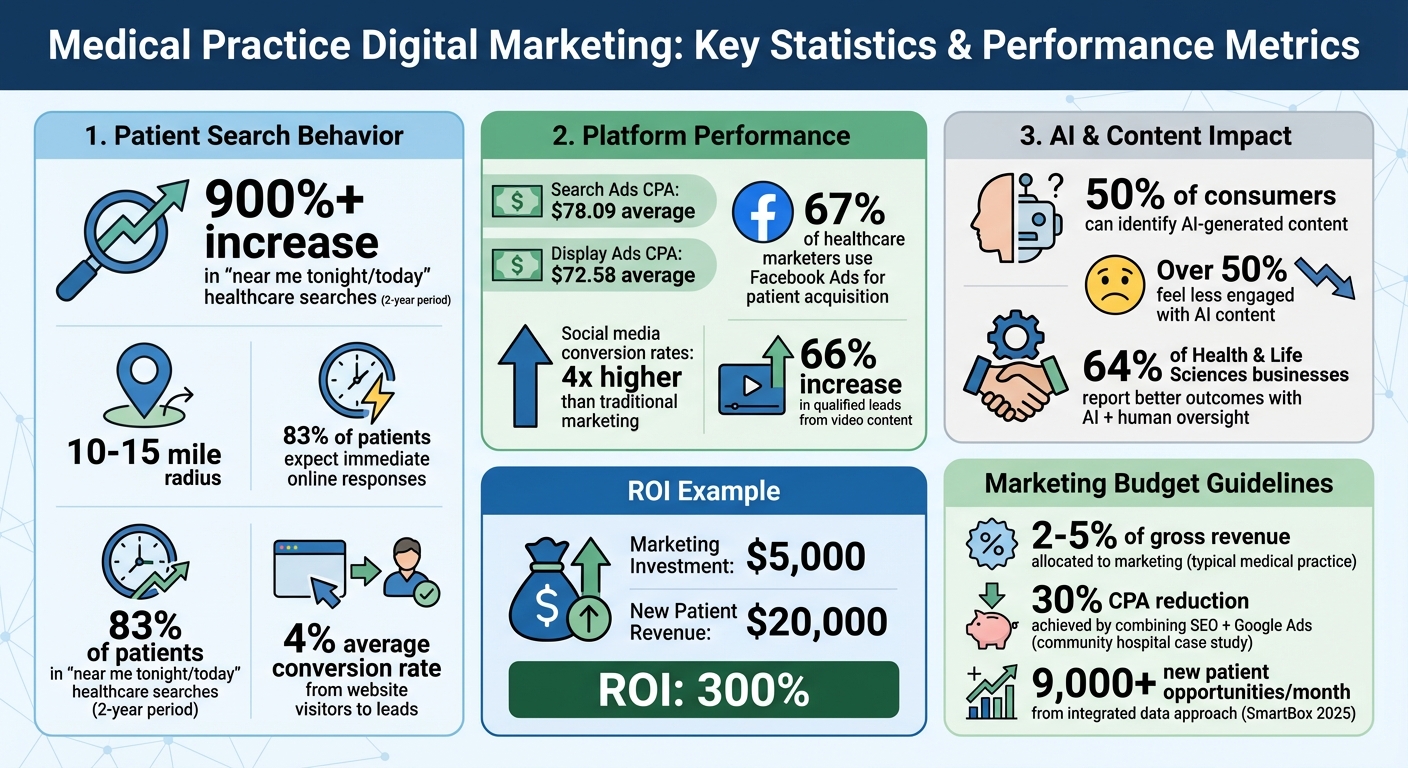
Medical Practice Digital Marketing ROI Statistics and Key Metrics
Why Healthcare Marketing is Stuck in the Past (And How to Catch Up)
How to Run Effective PPC Campaigns for Medical Practices
Pay-per-click (PPC) advertising is a powerful way to connect your medical practice with patients actively searching for your services. Unlike traditional advertising that targets a broad audience, PPC zeroes in on individuals looking for specific care, such as a dermatologist, orthopedic surgeon, or pediatrician in your area. The secret to success lies in understanding patient search behavior, crafting compliant ads that resonate with their needs, and directing clicks to pages designed to turn interest into appointments.
Finding the Right Keywords for Medical Services
Every effective PPC campaign starts with understanding what patients are searching for and why. Patient intent varies – someone searching for "knee pain treatment near me" is likely ready to book an appointment, while "what causes knee pain" signals early research. Identifying these differences can shape your ad strategy to meet patients where they are in their journey.
Long-tail keywords – phrases with three or more words like "pediatric dentist accepting new patients Dallas" – are especially useful. They often reflect specific and actionable intent, making them more likely to convert. For example, a search like "urgent care open Sunday" shows an immediate need, making it worth allocating more budget to these high-intent terms rather than broad, generic keywords.
Additionally, tailoring your keywords to different audiences can refine your targeting. Patients and healthcare professionals often use distinct language. For instance, while a patient might search for "back pain relief", a referring physician could look for "spine specialist accepting referrals." By segmenting keywords for each audience, you can enhance both targeting and messaging.
Writing Ad Copy That Follows Healthcare Rules
Healthcare advertising comes with strict regulations, especially around HIPAA compliance. The Privacy Rule requires written authorization before using any protected health information (PHI) for marketing purposes. This means you must avoid referencing specific patient cases, using testimonials without explicit consent, or making claims that cannot be substantiated.
Instead, focus your ad copy on benefits and credentials. For example, rather than promising "We’ll cure your back pain", you could say "Board-certified spine specialists with 20+ years of experience." Emphasize what makes your practice stand out, such as same-day appointments, multilingual staff, extended hours, or specialized treatments. Use clear and actionable language with calls-to-action like "Schedule Your Consultation" or "Call Now for Same-Day Appointments."
Building Landing Pages That Convert Visitors to Patients
The goal of a landing page is simple: turn visitors into patients. Unlike a general website, a landing page eliminates distractions like navigation menus or unrelated content, focusing entirely on converting clicks into appointments.
Start with a headline that directly reflects your ad to maintain consistency. Add visuals, patient-focused content that addresses common concerns, and trust-building elements such as credentials, certifications, and patient reviews.
Place a bold, eye-catching call-to-action (CTA) above the fold, such as "Schedule Appointment" or "Call (555) 123-4567." Make sure your phone number is clickable for mobile users and keep forms straightforward by asking only for essential details like name, phone number, and preferred appointment time.
Next, we’ll dive into how social media ads can expand your digital reach even further.
Using Social Media Ads to Reach Patients
Platforms like Facebook, Instagram, and YouTube provide medical practices with a direct way to connect with potential patients where they already spend their time. Unlike search ads, which target people actively looking for care, social media ads help build awareness and educate people who might not yet know they need your services. The key is crafting content that resonates with the right audience in your area while staying within healthcare advertising guidelines. This approach complements your overall digital marketing efforts.
Targeting Patients in Your Local Area
Using geographic and demographic filters ensures you’re reaching patients who are most likely to visit your practice. Most people seeking non-emergency care tend to stay within a 10–15 mile radius. Setting your ad radius to match this range helps avoid spending money on ads that reach people too far away to schedule an appointment.
Start by identifying your ideal audience based on factors like location, age, gender, income, and family status. For instance, if you’re a pediatric dentist, targeting parents aged 25–45 within a 10-mile radius is likely more effective than casting a wide net. It’s also important to consider platform-specific demographics – Instagram generally appeals to younger users, while Facebook tends to attract an older audience. A cosmetic dermatology practice catering to younger patients might focus on Instagram, whereas an orthopedic clinic addressing arthritis might see better results on Facebook.
You can also use ZIP code targeting to focus on neighborhoods with a high concentration of potential patients. This is particularly valuable given the rise in "near me tonight/today" searches, which increased by over 900% in just two years. These searches highlight that patients are actively looking for nearby healthcare options.
Creating Video Ads for Patient Education
Video content is a powerful tool for building trust. It gives potential patients a chance to see your practice, hear from you directly, and get a sense of your care philosophy – all before they even schedule an appointment. Social media platforms often prioritize video because it generates higher engagement rates, like more likes, shares, and comments, which can boost your ad’s visibility.
Focus your video ads on educating patients. You could explain common procedures, answer frequently asked questions, or share practical health tips. For example, a dermatologist might create a short video explaining the differences between medical and cosmetic acne treatments. A physical therapist could demonstrate simple stretches to relieve back pain for desk workers. These types of videos not only provide value but also position you as a knowledgeable and approachable expert.
Patient testimonials can also be impactful, but remember to get written consent before including anyone in your ads to comply with HIPAA regulations. If testimonials aren’t an option, consider filming behind-the-scenes content. Showcasing your team, office, or equipment can make your practice feel more relatable and welcoming, all without requiring patient authorization. Be sure to grab viewers’ attention in the first few seconds by highlighting key information right away.
Coordinating Campaigns Across Multiple Platforms
Advertising across multiple platforms can expand your reach, but the key to success lies in maintaining consistent messaging. When patients encounter your ads on Facebook and then see your practice again on Instagram or YouTube, it reinforces your brand and makes them more likely to take action. This repetition helps build familiarity and trust .
Keep your branding consistent across all platforms – use the same logo, colors, fonts, and imagery to ensure your ads are recognizable. While your core message should remain the same, adapt the content to fit each platform’s strengths. For example, you could use Instagram Stories for quick health tips, YouTube for in-depth educational videos, and Facebook for community updates or event announcements. Tools that integrate campaigns across platforms can help you streamline this process.
To get the most out of your efforts, monitor the performance of each platform individually. Track metrics like clicks, impressions, appointment bookings, and patient acquisition costs to see where your budget is most effective. While it’s smart to adjust spending based on results, maintaining a presence across multiple channels ensures your campaigns have a broader impact. This coordinated approach can strengthen both brand recall and patient acquisition over time.
sbb-itb-f6ab3ee
Improving Your Website’s Search Engine Rankings
Boosting your website’s search engine rankings is a key step in enhancing your PPC and social media efforts. Many patients start their healthcare journey online, and those top local listings get the lion’s share of clicks. Unlike paid ads – which stop delivering the moment you stop paying – strong rankings can bring in a steady flow of potential patients over time. The focus here is on reaching people actively searching for care, not just creating general awareness.
AI tools like Google AI Overviews and Microsoft CoPilot are changing how patients find healthcare providers. These systems favor websites that offer clear, straightforward answers to common questions. If your practice isn’t recognized as a reliable source by these tools, you risk missing out on a growing number of searches. The solution? Structure your content so it’s easy for both traditional search engines and AI assistants to understand and recommend. This approach lays the groundwork for effective local strategies and detailed service pages.
Local SEO Strategies for Medical Practices
At the heart of local SEO is your Google Business Profile. When someone searches for "pediatrician near me" or "urgent care in [your city]", Google relies on these profiles to populate the map pack – the three local listings that appear at the top of search results. To optimize your profile, ensure all details are accurate, upload high-quality photos, and keep your practice information consistent across all directories. Inconsistent details can hurt your rankings.
Patient reviews are another powerful factor. They provide fresh, keyword-rich content that search engines prioritize while also building trust with potential patients. Encourage happy patients to leave reviews by sending follow-up emails or texts after their appointments. Respond to both positive and negative feedback to show that you genuinely value patient opinions.
Local SEO isn’t limited to your Google Business Profile. Incorporate location-specific keywords throughout your website, such as "orthopedic surgeon in Austin" or "family dentist serving downtown Chicago." If you operate multiple offices, create separate pages for each location. Include details like neighborhood names, landmarks, or ZIP codes to help search engines and patients pinpoint where you practice and who you serve.
Optimizing Individual Service Pages
Every treatment or specialty you offer deserves its own dedicated page. These pages should act as complete resources, addressing all the questions a potential patient might have. For example, if you provide knee replacement surgery, your page should cover what the procedure involves, who it’s for, recovery timelines, costs, and what sets your approach apart. Research shows that detailed pages tend to perform better.
Organize your content around frequently asked questions, using natural, conversational language. Instead of a technical heading like "Arthroscopic Meniscus Repair Procedure", try something like "What happens during knee arthroscopy?" or "How long is recovery after meniscus surgery?" This style matches how people search, especially when using voice assistants or AI tools. Platforms like Google AI Overviews prefer pages with clear headings, concise text blocks, and self-contained answers between 80 and 300 words.
Don’t overlook technical aspects. Your site should load quickly, work seamlessly on mobile devices, and use HTTPS for security. Adding schema markup can help search engines better understand your content and may even enable rich snippets like star ratings or appointment links in search results. Embedding patient reviews and testimonials on service pages adds credibility and provides keyword-rich content that can further improve rankings.
Publishing Educational Content for Patients
Posting regular, informative articles that answer common patient questions can position your practice as a trusted authority. Hosting a blog on your website can significantly boost your SEO rankings and drive consistent traffic. For instance, a dermatologist might write about "How to recognize a cancerous mole" or "Top treatments for adult acne", addressing real concerns patients often have before booking an appointment.
Educational content also builds trust and improves conversion rates. When patients find helpful information on your site, they’re more likely to choose your practice when they’re ready to make an appointment. Research shows that offering diverse content types increases engagement, and videos can boost qualified leads by up to 66%.
Focus on topics related to your services and common patient concerns. For example, a physical therapist could write about exercises for back pain, posture tips for remote work, or when to seek professional care versus trying home remedies. Use clear headings, short paragraphs, and simple language to make the content easy to understand. AI-driven search tools prioritize straightforward answers to user queries, so avoid using medical jargon unless you provide quick, easy-to-follow explanations.
These strategies create a strong foundation for integrating data and AI to refine your marketing efforts even further.
Using Data and AI to Improve Marketing Performance
Keeping track of the right metrics is what sets successful marketing strategies apart from those that waste money. For healthcare providers, this means ensuring marketing and clinical teams work together, sharing data to link ad spending with patient retention and new leads. By pulling data from platforms like Google Ads, Facebook, email campaigns, and appointment bookings, you can identify which strategies work and which ones drain your budget. The tricky part? Doing this securely. Using HIPAA-compliant tools is non-negotiable when handling sensitive patient information. Once data is consolidated safely, you can focus on the numbers that truly matter.
Some of the most important metrics include cost per lead, conversion rates (like how many site visitors actually book appointments), and return on ad spend. These figures reveal whether your campaigns are delivering actual results – or just empty clicks. Tools like Google Analytics, social media dashboards, and email reports let you monitor patient behavior and campaign performance in real time. By keeping an eye on these numbers, you can make informed decisions, tweak your campaigns, and allocate your budget to the channels that perform best. Incorporating these insights into your strategy ensures every marketing dollar contributes to patient growth.
Measuring the Right Performance Metrics
A conversion is any completed action – whether it’s a phone call, an appointment request, or a form submission. If you’re not tracking conversions and revenue, you’re only looking at costs, which won’t tell you much about success. Set up specific conversion goals in your analytics platform for every campaign, whether it’s a PPC ad, a social media post, or an email blast.
Also, pay attention to how long it takes patients to convert. Some might book an appointment right after clicking an ad, while others could take weeks and multiple site visits. Knowing this timeline helps you fine-tune follow-up strategies and remarketing efforts. Another key metric? Identifying which channels bring in the best leads – patients who not only book appointments but also show up and return for ongoing care. A channel that gets 100 clicks but zero appointments isn’t worth your investment.
Here’s a real-world example: In 2025, SmartBox, a medical marketing agency, used TapClicks to consolidate client data into one HIPAA-compliant platform. By refining their remarketing campaigns with this integrated data, they generated over 9,000 new patient opportunities each month while drastically reducing the time spent on manual reporting.
Defined metrics like these also lay the groundwork for leveraging AI tools to predict patient behavior effectively.
Using AI to Predict Patient Behavior
AI tools can dig into patient data and uncover patterns, helping you forecast future needs and tailor your marketing strategies. With predictive analytics, you can analyze appointment histories, website activity, and social media engagement to build detailed patient profiles. This allows for targeted outreach and automation of routine tasks like appointment reminders, post-visit follow-ups, and personalized health education content. Given that 83% of patients expect immediate online responses, AI-powered chatbots can handle common inquiries 24/7, freeing up your staff for more complex tasks.
But here’s the catch: authenticity still matters. Studies show that half of consumers can identify AI-generated content, and over half feel less engaged when they know it’s created by AI. The key is blending AI’s efficiency with human oversight. Use AI for tasks like data analysis and content curation, but make sure a human reviews everything for accuracy and compliance. Focus on creating original, emotionally engaging content that reflects your brand’s personality. After all, 64% of Health & Life Sciences businesses acknowledge that smart AI use – paired with human input – leads to better outcomes.
Choosing the Right Plan for Your Practice Size
Medical PPC Agency offers flexible plans tailored to your practice’s size and needs. They have three tiers: Basic, ideal for small practices just starting with digital marketing; Advanced, suited for growing practices that need multi-platform strategies; and Premium, designed for multi-location groups requiring full-scale marketing, AI tools, and SEO services. Each plan is custom-quoted based on your patient volume, goals, and budget. By combining data insights with AI capabilities, Medical PPC Agency ensures that your marketing efforts align perfectly with your practice’s growth objectives.
Calculating ROI and Growing Your Marketing Efforts
Once you’ve established effective PPC and social media strategies, understanding your ROI becomes essential for driving your digital marketing success. ROI helps you directly link your marketing spend to patient revenue. The formula is simple: ROI = (Revenue – Marketing Cost) / Marketing Cost. For instance, if you invest $5,000 in ads and bring in $20,000 in new patient revenue, your ROI is 300%. This metric is the foundation for making informed decisions about scaling and refining your campaigns.
How to Calculate Marketing ROI
Start by defining what counts as a conversion – this could be a phone call lasting over two minutes, a completed appointment, or an office visit. Keep in mind that not every lead will convert. On average, about 4% of visitors to a medical practice’s website turn into leads.
Another critical metric is Customer Lifetime Value (CLV), which measures the long-term revenue a patient brings to your practice. For example, a patient who schedules regular checkups and refers others holds far more value than a one-time visitor. Institutions like Cleveland Clinic have successfully leveraged digital marketing to achieve higher ROI.
To accurately track conversions and calculate Cost Per Acquisition (CPA) by channel, use analytics tools like Google Analytics, HubSpot, or Salesforce. For reference, industry averages show CPAs around $78.09 for search ads and $72.58 for display ads. By consolidating this data, you can pinpoint which channels are most effective in bringing in new patients and adjust your efforts accordingly.
Expanding Campaigns as Your Practice Grows
When scaling your campaigns, a deliberate approach is essential. Focus on expanding the channels that have already proven successful. For example, one community hospital cut its CPA by 30% by combining SEO with Google Ads for urgent care services.
Introduce new platforms one at a time – such as Facebook Ads, video campaigns, or email marketing – and carefully track their performance before committing additional resources. Gradually increase budgets for your top-performing campaigns instead of spreading your funds across too many channels. Social ads, in particular, offer strong potential, with healthcare brands seeing conversion rates nearly four times higher than traditional marketing. In fact, 67% of healthcare marketers rely on Facebook Ads for acquiring new patients.
As your practice grows, integrating your marketing platforms with your Electronic Health Record (EHR) system can provide a more complete view of the patient journey, helping to eliminate data silos and improve decision-making.
Best Practices for Continued Success
To keep your marketing efforts effective, make A/B testing a regular part of your strategy. Test ad headlines, landing pages, and email subject lines to see what resonates most. Consistently review performance data and reallocate budgets to the channels delivering the best results. By maintaining consistent metric definitions, you can identify long-term trends and make smarter decisions.
For example, Mayo Clinic used analytics tools to identify their highest-performing website pages and made targeted adjustments, resulting in a significant ROI boost. While many medical practices allocate 2-5% of their gross revenue to marketing, your ideal budget will depend on your growth objectives and the level of competition in your market. The key is ensuring every dollar spent drives measurable patient outcomes, supporting the sustainable growth of your practice.
FAQs
How can medical practices ensure their digital marketing follows healthcare regulations?
To stay aligned with healthcare regulations, medical practices must focus on protecting patient privacy and securing data. This means obtaining explicit patient consent before using any protected health information (PHI) for marketing purposes and ensuring all data is securely stored and encrypted. Never share identifiable patient information without proper authorization.
Equipping your staff with regular training on HIPAA and other applicable laws is crucial for staying informed about regulatory changes. It’s also important to routinely review your marketing materials and workflows to confirm they meet current compliance standards. These efforts not only safeguard your practice but also strengthen patient trust.
How can I use social media ads to attract local patients to my medical practice?
To connect with local patients, leverage geo-targeted social media ads on platforms like Facebook, Instagram, and TikTok. These tools let you zero in on specific locations, demographics, and interests, ensuring your message reaches the right people in your area.
Craft content that speaks directly to your community. Highlight local events, share patient success stories, or post health tips tailored to your region. Responding quickly to comments and messages not only boosts engagement but also builds trust and fosters stronger relationships.
Don’t forget to keep an eye on your ad performance metrics. Regularly reviewing and tweaking your targeting and messaging will help you keep your campaigns effective and aligned with your objectives.
How can AI tools help medical practices improve patient engagement and marketing results?
AI tools are changing the way medical practices connect with patients and refine their marketing efforts. With AI-powered chatbots, practices can respond to patient questions instantly, fostering better communication and building trust. These tools also enable personalized interactions, offering tailored health tips and reminders that can improve patient satisfaction and encourage loyalty.
When it comes to marketing, AI dives into data to sharpen campaigns, fine-tune SEO strategies, and pinpoint valuable patient groups. It helps create targeted content and messages that truly resonate, leading to more inquiries and scheduled appointments. On top of that, AI can handle routine tasks like appointment scheduling, allowing staff to dedicate more time to delivering quality patient care.