
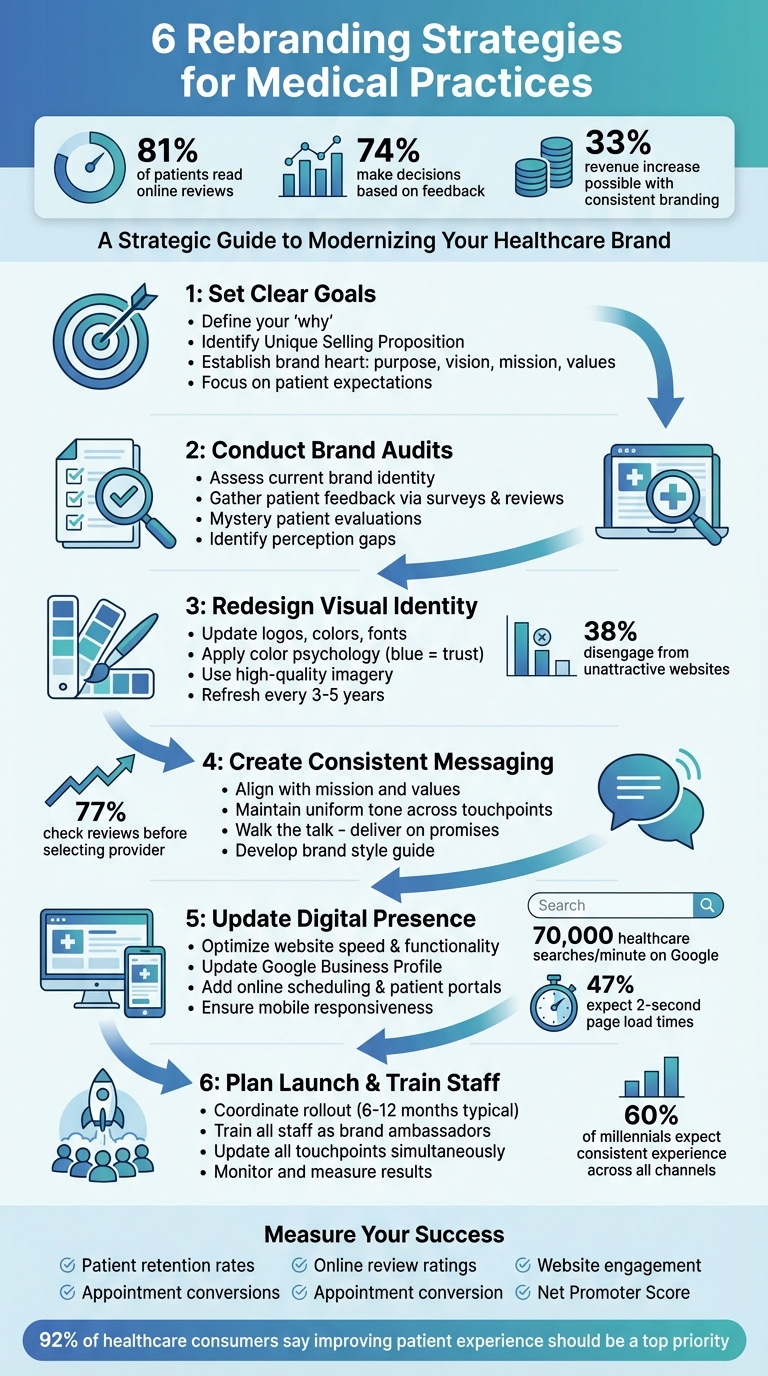
Rebranding a medical practice is about aligning your brand with patient expectations and market needs. Here’s a quick guide to the six key strategies:
- Set Clear Goals: Define why you’re rebranding and what you want to achieve – like targeting new demographics, addressing reputation issues, or improving patient experience. Many practices support these goals by launching Google Ads for medical practices to capture immediate search intent during the transition.
- Conduct Brand Audits: Assess your current brand identity and compare it to patient perceptions. Use surveys, focus groups, and online reviews to identify gaps.
- Redesign Visual Identity: Update logos, colors, and imagery to reflect your practice’s values and ensure consistency across all platforms.
- Create Consistent Messaging: Align your messaging with your practice’s mission and values. Ensure all patient touchpoints – from websites to front-desk interactions – are uniform.
- Update Digital Presence: Optimize your website, Google Business Profile, and social media for speed, clarity, and functionality. Ensure features like online scheduling and patient portals are user-friendly.
- Plan Launch and Train Staff: Coordinate a smooth rollout of your rebrand, train staff to embody the new identity, and ensure consistency across digital and physical touchpoints.
Why it matters: Patients increasingly act like informed consumers, with 81% reading online reviews and 74% making decisions based on feedback. A rebrand not only attracts new patients but also builds trust and loyalty among existing ones.
Pro Tip: Measure success with clear metrics like patient retention, online review ratings, and website engagement to ensure your rebranding efforts deliver results.
6 Essential Rebranding Strategies for Medical Practices
1. Set Clear Goals and Objectives
Alignment with Practice Goals
Before diving into design work, it’s essential to understand the why behind your rebranding efforts. The most effective rebrands start with a strategic evaluation of your practice – what you currently offer, how patients perceive you, and how you want to be seen moving forward. A successful rebrand should reflect your actual strengths and align with the direction of your business.
Your rebranding goals should stem from real changes within your practice. Maybe you’ve merged with another provider, expanded into new regions, or decided to target a different patient demographic. Whatever the reason, your objectives should focus on your Unique Selling Proposition – that one thing your practice does better than anyone else in your market. Without this clarity, you risk sending mixed signals to your patients.
At the heart of this process is defining your "brand heart" – your purpose, vision, mission, and core values. These elements should act as a guiding light, connecting your internal goals with how patients perceive your practice. Every marketing and operational choice should flow from this foundation. For more expert insights on healthcare growth, stay updated with the latest industry trends.
According to Geonetric, "Your brand is what sets you apart from your competitors, communicates your mission and values as an organization, and reassures patients that they’ve come to the best place to receive care."
Impact on Patient Experience and Engagement
Improving the patient experience isn’t just a nice-to-have – it’s a must. In fact, 92% of healthcare consumers believe it should be a top priority. Your rebranding goals should reflect this expectation. For example, 70% of millennials prefer healthcare providers that offer mobile apps. Features like these often play a significant role in their decision-making.
Your brand establishes the baseline for patient expectations, so your goals need to ensure those expectations are met consistently. Whether it’s offering telehealth services, extended office hours, or multilingual support, your rebranding objectives should align with what your patients value most.
Consistency Across Digital and Physical Touchpoints
Consistency is everything: 60% of U.S. millennials expect the same experience whether they’re interacting online, in person, or over the phone. Rebranding isn’t just about updating your website or logo – it’s about creating a seamless experience across every point of contact. For instance, if your website presents a sleek, modern image but your office feels outdated, patients may question your credibility. Take a close look at the entire patient journey – from online scheduling to the in-office visit – and address any inconsistencies.
Measurable Outcomes
A goal without measurable outcomes is just wishful thinking. Your rebranding objectives should include specific, trackable metrics that reflect both patient engagement and financial performance. For example, you might track patient acquisition rates, retention percentages, or brand awareness levels. Many successful practices focus on the "Three A’s": Awareness (how many people know about your brand), Association (the perceptions tied to your brand), and Advocacy (how likely patients are to recommend you).
Financial metrics are equally important. Research shows that practices with consistent branding across all platforms can see revenue increases of up to 33%. Additionally, consistent branding is linked to 10% to 20% higher revenue growth compared to competitors with inconsistent messaging. Set clear, concrete targets: How many new patients do you want to bring in over the next six months? What percentage increase in appointment bookings are you aiming for? What’s your ideal Net Promoter Score? By grounding your goals in data, you can measure the true impact of your rebranding efforts.
sbb-itb-f6ab3ee
2. Conduct Brand Audits and Market Research
Alignment with Practice Goals
A brand audit helps you answer a critical question: does your current brand still represent who you are today? If your practice has grown to multiple locations, adopted new technologies, or shifted its focus to meet the needs of a changing patient base, your brand should reflect those updates. Start by assessing whether your mission, vision, and values are clearly communicated in your marketing materials, website, and even your physical spaces.
This process also helps you define your Unique Selling Proposition – what sets your practice apart. Maybe you offer advanced technology, extended hours, or a specialized treatment approach. Clearly articulating this unique value ensures that patients understand why they should choose your clinic. Beyond refining your message, this step lays the groundwork for stronger patient connections.
Impact on Patient Experience and Engagement
The gap between how patients perceive your brand and the reality of their experience can make or break your rebranding efforts. Patient feedback from online reviews and surveys is invaluable here. Platforms like Healthgrades, Vitals, and Yelp are good starting points, as most patients rely on online reviews, and even 74% of physicians consider reviews when choosing colleagues.
Dive deeper by conducting patient surveys, focus groups, and even "Mystery Patient" evaluations. A mystery patient can assess the entire journey – from the initial phone call to parking, signage, waiting room atmosphere, and staff interactions. This outside perspective often highlights service gaps or friction points that might go unnoticed internally.
Consistency Across Digital and Physical Touchpoints
A comprehensive brand audit ensures that every interaction with your practice aligns with your brand promise. For instance, if your website highlights cutting-edge care but your office decor feels outdated, it could create doubts about your credibility.
Make sure your Name, Address, and Phone number (NAP) are consistent across platforms like Google My Business and Yelp. Similarly, check that your logo, color scheme, and fonts are uniform across all materials – business cards, brochures, building signage, and social media profiles. Even small inconsistencies, like an old logo lingering on a sign while your website features a new one, can make your practice seem less professional.
Measurable Outcomes
Your brand audit should produce actionable data that you can monitor over time. Track metrics like website traffic, click-through rates, and the keywords patients use to find you online. Measure patient retention and advocacy to gauge trust in your brand. Post-appointment surveys are another great tool to confirm whether the patient experience aligns with your brand’s promises.
3. Redesign Visual Identity with Patient-Focused Design
Alignment with Practice Goals
After setting your strategic goals and analyzing the market, refreshing your visual identity becomes a critical step in a successful rebrand. Elements like logos, color schemes, fonts, and imagery play a huge role in communicating who you are at a glance. For example, if your practice aims to be seen as an innovator, your design should lean toward a modern and sleek style. On the other hand, if compassionate care is your focus, warmer tones and imagery of genuine patient-provider interactions are more effective.
Color psychology plays a key role in shaping patient perceptions. Blue is a popular choice in healthcare branding because it conveys trust and authority, while softer colors create a sense of calm and ease. A great case study is Northwell Health’s 2016 rebrand. They replaced their generic medical logo with vibrant, upward-pointing arrows, symbolizing growth and positivity, which helped them transition from a regional provider to a nationally recognized brand. To be effective, your visual identity needs to integrate seamlessly across every touchpoint, reinforcing the cohesive approach mentioned earlier.
Impact on Patient Experience and Engagement
First impressions matter. Studies show that 38% of people disengage from websites that appear unattractive, and nearly half expect pages to load in under two seconds. High-quality, professional imagery can humanize your practice and make it more relatable. On the flip side, an outdated visual identity – usually one that hasn’t been updated in three to five years – can lead patients to question whether your care is up-to-date. With online reviews and visual presentation playing such a big role in provider selection, having a modern and authentic brand is no longer optional.
"Within the healthcare industry, branding is synonymous with building trust, fortifying patient-provider relationships, and cultivating the patient experience." – Kali Armstrong, Content Writer, Tebra
Consistency Across Digital and Physical Touchpoints
Consistency is crucial for earning patient trust and building a memorable brand. Imagine your website advertises cutting-edge technology, but your office features outdated furniture or signage with an old logo. Mixed signals like these can erode confidence. Consistency is the quickest way to make your brand stick.
Your logo, colors, and fonts should be consistent across every platform – your website, social media, business cards, brochures, and even office decor. For example, in 2024, a multi-specialty medical group scaling from 2 to 50 locations produced over 100 unique posters and 50+ campaign emails monthly to unify their brand. The results? A 75% boost in internal communication satisfaction and over 700 new staff followers on social media.
Measurable Outcomes
To understand the impact of your redesigned visuals, track key metrics like website traffic, click-through rates on digital ads, and the amount of time patients spend on your site. Post-appointment surveys can also provide valuable feedback on whether your visual identity aligns with the patient experience. For instance, if your rebrand promotes "modern care" but patient reviews still describe your office as outdated, you’ll know where to focus next. With 92% of healthcare consumers emphasizing the importance of improving the patient experience, these insights can help ensure your visuals are meeting expectations.
4. Create Consistent Messaging Across All Patient Touchpoints
Alignment with Practice Goals
Your messaging should genuinely reflect the essence of your practice. Before drafting any communication, take the time to define your mission, vision, and core values clearly – these elements are the backbone of all patient interactions. As discussed earlier, your brand’s credibility depends on aligning what happens inside your practice with what you communicate to the outside world. Simply put, you need to "walk the talk." For instance, if you promise "convenience", you must deliver tangible benefits like extended hours, online scheduling, or same-day appointments. Failing to meet these expectations can quickly erode trust. By setting clear expectations and delivering on them, you lay the groundwork for a better patient experience where every interaction reflects your core values.
"Branding is more than a logo and a website. It is everything that your customers and potential customers… experience with you that ultimately drives them to continue to do business with you."
- American Association for Physician Leadership
Impact on Patient Experience and Engagement
Consistency plays a huge role in whether patients choose your practice and stick with it long-term. When patients experience the same tone, values, and promises across all touchpoints – whether it’s your website or a conversation with your front desk staff – it builds their confidence in you. Studies reveal that consistent brand presentation can increase revenue by up to 33%. Additionally, with 77% of patients checking online reviews before selecting a provider, any gap between what you promise and what you actually deliver becomes public knowledge quickly. For example, if your website emphasizes "compassionate care" but your staff seems hurried or indifferent on the phone, patients notice – and they’ll likely share that disconnect in reviews.
Consistency Across Digital and Physical Touchpoints
Every interaction with your practice is a touchpoint: the Google search that brings up your website, the phone call to schedule an appointment, the atmosphere in your waiting room, the doctor’s demeanor during a visit, and even the billing process. To maintain consistency, all touchpoints should reflect your brand’s identity through uniform language and style. A brand style guide can help here – detailing your colors, fonts, and tone of voice ensures that every piece of communication aligns with your established identity. Want to take it a step further? Conduct a mystery patient evaluation. By having someone go through the entire patient journey, you can identify where the experience might stray from your brand promise.
Measurable Outcomes
Consistent messaging builds trust, which is key for attracting and retaining patients. When patients repeatedly encounter the same professional identity, it boosts brand awareness and encourages loyalty. To ensure your messaging aligns with your promises, track metrics like new patient inquiries, appointment booking rates, online review feedback, and patient satisfaction survey results. These insights can confirm whether your patient experience matches the standards you’ve set. With 92% of healthcare consumers saying that improving the patient experience should be a top priority, aligning your messaging with what you deliver isn’t just a marketing strategy – it’s essential for growth.
5. Update Digital Presence and Online Platforms
Alignment with Practice Goals
Your digital presence is often the first impression potential patients have of your rebrand. With 70,000 healthcare-related searches happening on Google every minute, your website and online profiles become the main stage to showcase your updated mission, values, and unique offerings. Optimizing these platforms is a crucial part of your rebranding journey. For example, if your rebrand highlights patient education, consider adding blogs and newsletters that reflect this focus. On the other hand, if you’re aiming to position your practice as tech-savvy, your website should go beyond just saying it – features like online scheduling and patient portals are a must.
"Your brand is what sets you apart from your competitors, communicates your mission and values as an organization, and reassures patients that they’ve come to the best place to receive care."
- Geonetric
Impact on Patient Experience and Engagement
How your practice performs online can make or break a patient’s decision to choose you. 77% of patients read online reviews before selecting a provider. Start by updating your Google Business Profile with your new logo, fresh office photos, accurate contact information, and direct links for booking appointments. Your website should also offer clear service descriptions and display real-time appointment availability – something over 30% of patients actively look for. Don’t overlook technical performance, either. 47% of users expect web pages to load in two seconds or less; a slow site could send potential patients straight to your competitors.
Consistency Across Digital and Physical Touchpoints
Your digital presence should align seamlessly with the in-office experience. For instance, if your website promotes "cutting-edge technology", your practice should feature state-of-the-art equipment when patients walk through the door. To maintain consistency, update your website, social media profiles, email signatures, and directory listings at the same time. Even something as small as an outdated logo on a third-party listing can undercut your rebranding efforts.
Measurable Outcomes
To determine if your digital updates are hitting the mark, track metrics that matter. Monitor appointment conversions from your online scheduling tools, track click-to-call actions and direction requests from your Google Business Profile, and measure patient portal usage to gauge engagement. Since 81% of patients read reviews even after receiving a direct referral, it’s vital to manage your online reputation. Respond to feedback promptly and actively encourage reviews – patients are 2.3 times more likely to leave a review when asked. These efforts not only strengthen your digital presence but also set the stage for a successful rebrand launch and staff training.
If you need expert help aligning your digital platforms with your rebranding goals, consider reaching out to Medical PPC Agency. Their specialized knowledge in healthcare digital marketing can ensure your online presence is optimized to attract and engage patients while supporting your practice’s growth.
6. Plan Launch Coordination and Train Staff
Alignment with Practice Goals
Launching a rebrand successfully requires careful coordination across every department and touchpoint. This step brings your updated visuals and digital platforms to life. Start by setting a clear launch date and crafting a detailed distribution plan tailored to your practice’s unique needs – whether you’re navigating a merger, expanding geographically, or modernizing an outdated image. Begin internally by communicating the changes to your team, then extend the message to referring doctors, donors, and patients. A comprehensive plan should include an internal rollout, a set launch date, and a well-defined budget for design and communication efforts. Keep in mind, a full rebrand typically takes 6 months to a year to implement. With a solid plan in place, your team can confidently embody the new brand from day one.
Impact on Patient Experience and Engagement
Your team plays a critical role in representing the rebrand. With 92% of healthcare consumers prioritizing improved patient experiences, your staff must deliver on the promises your new brand communicates. Before the public launch, conduct stakeholder interviews and brand workshops to ensure your staff fully understands the purpose behind the rebrand. This internal alignment is essential – when team members can clearly and authentically explain the rebrand to patients, it builds trust and maintains loyalty during the transition.
"Consistent branded experiences occur when all team members fully understand and are supported in their role as brand ambassadors." – Physician Leaders
Consistency Across Digital and Physical Touchpoints
On launch day, it’s crucial to update every digital and physical touchpoint simultaneously. 60% of U.S. Millennials expect brand experiences to remain consistent across online, in-person, and phone interactions. Even something as minor as an outdated logo on a third-party listing can create confusion and weaken the impact of your rebrand.
To ensure consistency, use a comprehensive style guide that integrates seamlessly into staff training. This guide should outline standards for colors, typography, voice, and tone, and these elements should be reflected in job descriptions, policy manuals, and employee handbooks. Train all team members – from front-desk staff to medical assistants and billing departments – on the new communication standards. This ensures that patients experience the same brand personality whether they’re booking an appointment, visiting the office, or following up after their visit.
Measurable Outcomes
After the launch, track success by monitoring patient interactions and online feedback. Analyze website traffic, appointment conversions, and online reviews to identify and address any inconsistencies. With 81% of patients reading online reviews even after receiving a direct referral, paying attention to how patients describe their experiences with your rebranded practice is essential. Use patient surveys to gather insights and pinpoint areas of friction before they affect retention or new patient acquisition.
Your Medical Practice Needs a Brand – Here’s How to Build It
Conclusion
Rebranding your medical practice is about earning trust and meeting the changing expectations of your patients. The six strategies discussed earlier work together to create a brand that connects with your community while staying true to your practice’s long-term vision. From defining clear goals and conducting in-depth market research to updating your visual identity and ensuring your team is prepared, every step shapes how patients view and engage with your practice. This unified approach lays the groundwork for a successful rebrand.
Consistency is key to building a strong brand. In fact, research shows that 60% of U.S. millennials expect a consistent experience across all brand interactions – whether online, in-person, or over the phone. Mixed messages can erode trust, so it’s essential to maintain alignment across every patient touchpoint. As Amanda Kanaan, Medical Marketing Specialist at WhiteCoat Designs, explains:
"From your office decor to the look of your website, it’s all part of an equation patients subconsciously utilize to decipher who you are as a brand".
Rebranding isn’t a one-and-done process – it requires ongoing evaluation and active reputation management. Regularly assess your brand’s performance to ensure it stays competitive. Monitor key indicators like patient satisfaction surveys, online reviews, and website analytics to gauge the success of your efforts.
To amplify your rebranding efforts, consider integrating them with a robust healthcare marketing strategy. Partnering with experts, such as Medical PPC Agency, can help ensure your online presence aligns with your rebrand and reaches the right audience.
With the healthcare industry evolving rapidly, practices that fail to adapt risk becoming outdated. Brian Lischer, Founder of Ignyte, emphasizes this point:
"Addressing the changing needs of patients is one of the most important reasons any healthcare company should rebrand".
FAQs
What are the best ways to measure the success of rebranding my medical practice?
To measure how well your rebranding efforts are working, focus on key performance indicators (KPIs) that highlight both financial results and patient experience. Keep an eye on metrics like patient acquisition cost, patient lifetime value, conversion rates, and overall ROI to gauge the financial impact of your rebrand. At the same time, use tools like Net Promoter Scores (NPS) to track patient satisfaction, along with retention and referral rates.
On the digital side, dive into your website analytics. Look at organic and direct traffic, click-to-call actions, form submissions, and video engagement to see how effectively your online presence supports the rebrand. Patient surveys and feedback can further reveal how your new brand identity connects with your audience. Taken together, these insights will help you pinpoint what’s working and what could use a little fine-tuning.
What mistakes should you avoid when rebranding a medical practice?
Rebranding a medical practice can breathe new life into your image, but it’s easy to stumble into pitfalls that derail the process. One common misstep is rushing the rebrand – diving into a new name, logo, or design without a solid plan can leave patients confused and even harm your reputation. Another issue arises when practices exclude key stakeholders, such as staff and patients, from the process. This oversight can result in a brand that feels disconnected from the actual patient experience.
Another frequent mistake is inconsistent updates across various platforms. If your website, signage, social media, and forms don’t align with the new brand, it sends mixed signals and undermines trust. Timing matters too – rebranding during significant operational changes or skipping proper market research can lead to a loss of recognition and patient loyalty.
To sidestep these challenges, start with a clear reason for rebranding. Engage your team and patients to gather feedback and insights. Finally, plan a consistent rollout across all touchpoints. Taking a deliberate, data-informed approach not only safeguards your reputation but also ensures the rebrand delivers the results you’re aiming for.
How can I maintain consistent branding across all patient touchpoints during a rebrand?
To ensure your rebrand resonates at every stage of patient interaction, start by crafting a detailed brand style guide. This guide should cover the essentials: your updated logo, color palette, typography, tone of voice, and key messaging. Share this guide with everyone on your team – whether they’re at the front desk, working as clinicians, or handling administrative tasks. Provide training to help them incorporate the new branding into everyday tasks, like welcoming patients, answering calls, or completing forms.
Next, take a close look at all materials that patients interact with. This includes signage, brochures, email templates, website pages, patient portals, social media profiles, and even online ads. Update these assets to reflect your new branding before the official launch. To maintain consistency moving forward, create a checklist for future updates. Mapping out the patient journey can also help pinpoint every touchpoint, allowing you to assign responsibility for keeping the brand experience consistent at each stage.
When it comes to digital marketing, make sure your Google Ads, Facebook Ads, SEO content, and AI-driven patient acquisition tools align with your refreshed branding. Regularly review patient feedback and performance analytics to spot any misalignments and fine-tune as needed. If this feels overwhelming, consider working with a specialist like Medical PPC Agency. They can help ensure your branding flows seamlessly across both online and offline channels, giving your rebrand a polished and unified look.