
Pay-per-click (PPC) advertising helps medical practices connect with patients at the exact moment they’re searching for care. Unlike SEO, which takes time, PPC delivers instant visibility on search engines like Google. With over 70,000 health-related searches happening every minute, PPC ensures your practice shows up when potential patients are ready to take action. Here’s why it works:
- Instant Visibility: PPC places your practice at the top of search results, even for highly competitive keywords like "urgent care near me."
- Builds Trust: Features like the "Google Screened" badge and clear, patient-focused messaging reassure potential patients.
- Targets the Right Audience: Geo-targeting and audience segmentation ensure your ads reach local patients actively searching for your services.
- Drives Action: 70% of mobile health searches lead directly to phone calls, making PPC a direct path to new appointments.
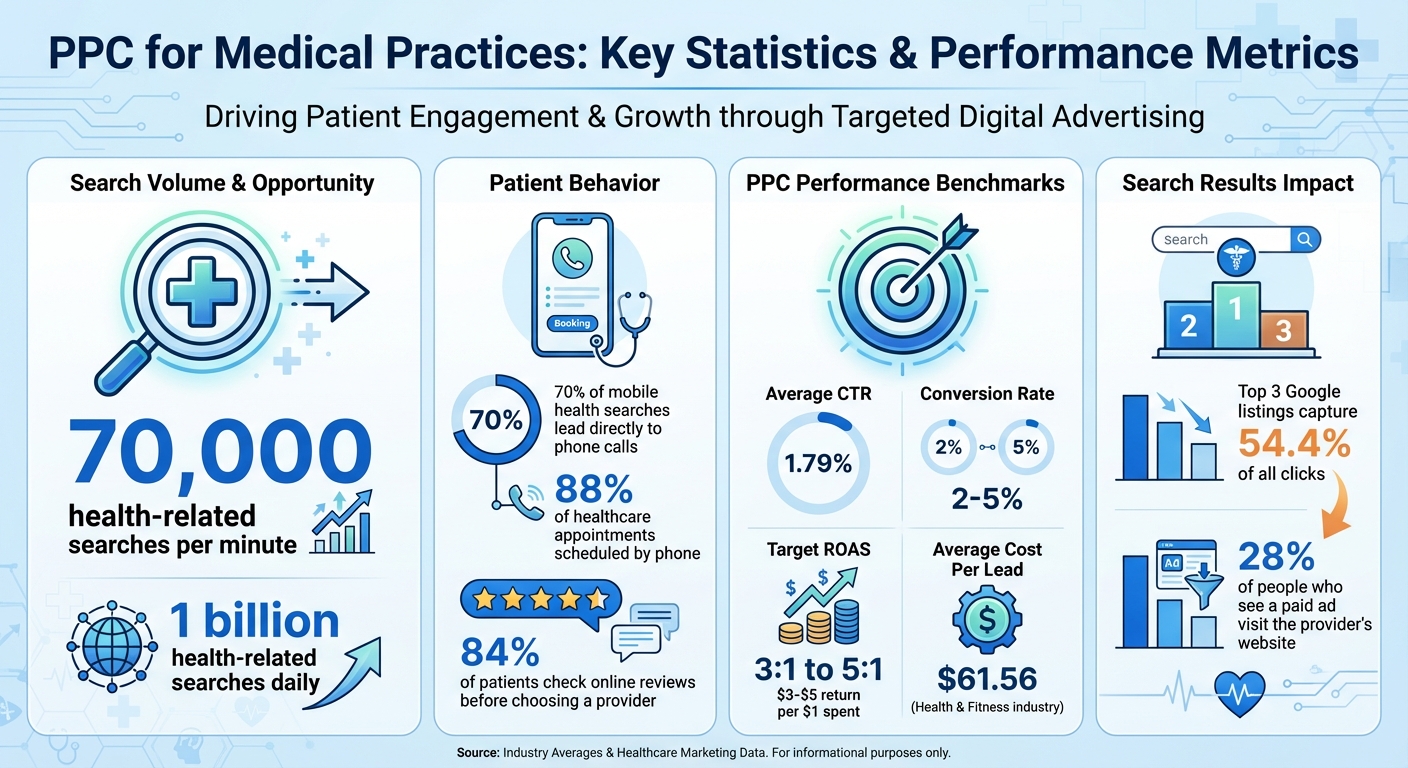
PPC Statistics for Medical Practices: Key Performance Metrics and Patient Behavior Data
Healthcare PPC Advertising Essentials
How PPC Builds Your Medical Brand
PPC advertising doesn’t just drive patient traffic; it plays a key role in shaping and strengthening your medical brand online. Your brand is essentially how patients perceive your practice when they encounter it online. With PPC, you can actively influence this perception by placing your practice front and center when patients are searching for care.
Boosting Your Practice’s Online Visibility
PPC campaigns give your practice instant visibility at the top of search results – no waiting months for organic SEO to take effect. When someone searches for terms like "pediatrician in Chicago" or "urgent care near me", your ad shows up prominently, capturing their attention during high-intent moments.
This kind of visibility is critical in healthcare, where timely access to information can make all the difference. For context, healthcare ads have an average click-through rate of 1.79%, and 28% of people who see a paid ad end up visiting the provider’s website. Programs like Google Screened further enhance your presence by displaying a verification badge on your ads, signaling that your practice meets specific quality standards.
Appearing prominently in search results not only increases visibility but also lays the foundation for building trust – an essential element in healthcare marketing.
Establishing Trust with Clear and Consistent Messaging
Trust is everything in healthcare. To build it, your ad messaging needs to align seamlessly with the content on your landing pages. Any disconnect, like overpromising in ads and underdelivering on your website, can erode patient confidence. In this field, educating patients and earning their trust takes priority over quick conversions.
To achieve this, focus on patient-centered language. Instead of highlighting accolades, emphasize what matters most to patients: "Same-day appointments available" or "Board-certified specialists accepting new patients." Transparency about services, insurance options, and appointment availability can establish trust right from the first interaction.
Ad extensions are another great tool for reinforcing credibility. Features like callout extensions can highlight key details such as "Accepts All Major Insurance" or "Over 20 Years Serving the Community." These small but impactful touches can make a big difference, especially since 84% of patients check online reviews before choosing a healthcare provider.
Creating Targeted PPC Campaigns That Reach the Right Patients
Reaching the right audience means ensuring your ad budget is spent only on potential patients – not on people outside your area or those uninterested in your services. The secret lies in carefully segmenting your audience and applying geo-targeting to focus your resources where they’ll have the most impact. These techniques align perfectly with the branding strategies discussed earlier, laying a solid foundation for effective PPC campaigns.
Segmenting Your Audience for Better Targeting
Start by building patient personas using historical data. Think about factors like age, profession, income, and specific healthcare needs. For example, a family practice catering to young parents will need a completely different strategy compared to a cardiology clinic targeting older adults with chronic conditions.
It’s also important to distinguish between two types of search intent: research-phase queries (like “what causes back pain”) and action-oriented searches (like “back pain specialist near me”). Each requires its own campaign. For people in the research phase, focus on educational content, while those ready to book an appointment should see ads with clear calls to action.
Choose platforms wisely based on user intent. Google Ads works best for high-intent searches, while platforms like Facebook or Instagram are better for raising awareness among specific demographics. For instance, a dermatology clinic might use Instagram to post skincare tips and Google Ads to capture searches like “acne treatment near me.”
Keep your campaigns tightly focused by separating keywords by service. For example, don’t mix terms like “teeth whitening” with “dental implants.” Each service should have its own ad copy and landing page to ensure your messaging stays relevant and your conversion rates remain strong. And remember, avoid remarketing for sensitive conditions like mental health or chronic illnesses to stay within HIPAA guidelines.
Once you’ve segmented your audience, geo-targeting becomes the next critical step.
Using Geo-Targeting to Attract Local Patients
For local medical practices, geo-targeting is non-negotiable. You don’t want to waste ad spend on clicks from people 100 miles away who are unlikely to visit your office. Begin by setting a radius around your practice – 10 miles is a good starting point for general practitioners, while rare specialties might extend to 25 miles or more. This ensures your ads reach people within a reasonable driving distance.
Incorporate location-specific keywords into your campaigns. Phrases like “pediatrician in Chicago” or “urgent care near me” naturally attract local patients who are actively searching for services in your area. These searches tend to convert at higher rates because the intent is immediate. In fact, 70% of mobile health searches lead directly to phone calls, so make sure your ads include click-to-call buttons for convenience.
Optimize your bids based on ZIP code performance. If certain neighborhoods consistently bring in high-quality patients, consider increasing your bids by 20%–50% in those areas, while scaling back in underperforming zones. This approach helps you get the most out of your ad spend by concentrating on what works.
Another option is applying for Google Screened to run Local Services Ads (LSAs). These ads appear right at the top of search results and come with a trust-building badge. According to PPC.io:
"Local Service Ads, while more expensive than other advertising formats, tend to offer a higher return on investment (ROI). This is because they reach people who are more likely to be interested in what you’re offering."
Finally, use negative keywords like “jobs,” “salary,” or “research” to filter out irrelevant traffic and focus solely on prospective patients.
Keyword Strategies That Strengthen Brand Relevance
Your keyword strategy can make or break whether potential patients find your practice at the exact moment they need it. Medical PPC Agency employs targeted keyword approaches to ensure practices attract high-intent searches while building a strong digital presence. The right keywords align your ads with real patient needs, while poor choices waste your budget on clicks that don’t lead to conversions. To succeed, it’s essential to understand search intent and align keywords with every stage of the patient journey.
Choosing Intent-Based Keywords for Each Patient Journey Stage
Patients use different types of searches depending on where they are in their decision-making process. For example, someone searching "why do my knees hurt?" is in the early stages of understanding their issue, while another searching "orthopedic surgeon near me" is ready to take action. Your keyword strategy must cater to both scenarios.
Break keywords into intent categories:
- Informational keywords: For early research, such as "what is men’s chin augmentation?"
- Navigational keywords: Include your practice name or specific doctor names.
- Investigational keywords: Combine provider names with terms like "reviews."
- Transactional keywords: Target patients ready to act, such as "book dental cleaning".
These categories align with different stages of the patient journey. Early-stage patients respond to problem-aware keywords like "why does my back hurt?" Meanwhile, solution-aware terms like "male pattern baldness treatment Chicago" target those who already know what they need. Long-tail keywords – phrases with three or more words, such as "kid friendly dentist in Dallas" – are particularly effective because they’re more specific and face less competition.
Alex Membrillo, CEO of Cardinal Digital Marketing, underscores the importance of this approach:
"Keywords are the foundation of search engine optimization (SEO) in healthcare. They’re the language that people use to look online for information and answers related to their health."
To refine your strategy, use tools like Google Keyword Planner for search volume and cost estimates, Google Trends for seasonal insights, and platforms like AnswerThePublic to uncover patient questions. Additionally, reviewing your own patient data – such as contact forms and phone call transcripts – can reveal the exact language your patients use.
Once you’ve nailed intent-based keywords, combining branded and non-branded terms can further strengthen your strategy.
Combining Branded and Non-Branded Keywords
Building on intent-based approaches, incorporating both branded and non-branded keywords expands your reach and solidifies your online presence.
- Branded keywords: These include your practice name or doctors’ names. They protect your reputation, attract patients already familiar with your services, and typically cost less while delivering higher conversion rates. Plus, bidding on your own name ensures competitors don’t outrank your organic listing and siphon valuable clicks.
- Non-branded keywords: These target patients who haven’t yet chosen a provider. Phrases like "pediatrician near me" or "knee pain treatment" cast a wider net, helping you reach a massive audience. With over 1 billion health-related searches happening daily, non-branded terms open the door to countless potential patients.
The most effective strategy uses both. Non-branded keywords attract new patients searching for solutions, while branded keywords capture those ready to book an appointment. Separating campaigns by branded and non-branded terms allows for better budget management and makes it easier to measure ROI across different services.
sbb-itb-f6ab3ee
Designing PPC Ads That Build Trust and Credibility
The design of your ads plays a huge role in shaping patient trust and driving conversions. With people encountering anywhere from 4,000 to 10,000 ads daily, your medical practice needs to stand out by creating ads that inspire confidence. A well-crafted ad does more than just attract clicks – it also reinforces your practice’s reputation. By using responsive formats and ad extensions effectively, you can turn search results into powerful opportunities to highlight your expertise, even before potential patients visit your website.
Using Responsive and Dynamic Ads for Consistent Branding
Responsive Search Ads (RSAs) have become the go-to format on Google. These ads allow you to provide multiple headlines and descriptions, which Google’s AI rotates to find the best-performing combinations for each searcher. To make an impact, include trust-building details like "Board-Certified Specialists" or "20+ Years Serving the Community" in your RSA headlines and descriptions. Alex Membrillo, CEO of Cardinal Digital Marketing, explains:
"With RSAs, Google optimizes your headlines, ad copy, and CTA for you based on audience and search terms. All you have to do is supply the ad headlines, descriptions, and so on".
Your headlines should reflect your practice’s strengths – whether it’s location-specific services or unique offerings – and they need to work well across all devices. Equally important is ensuring that your landing page aligns with your ad’s messaging and delivers on its promises. As the WebFX team puts it:
"The landing page must deliver on your ad. If it doesn’t, people will return to the search results, which doesn’t help your healthcare advertising initiative".
By optimizing RSAs, you create a solid foundation for additional features that can further enhance your credibility.
Using Ad Extensions to Showcase Your Expertise
Ad extensions add valuable real estate to your ads, giving you more room to highlight your expertise before someone even clicks. These extensions can significantly boost your click-through rate, which is especially important in competitive healthcare markets where the top three Google listings snag 54.4% of all clicks.
For medical practices, call extensions are essential. With 70% of mobile health searches leading directly to phone calls, having a clickable phone number in your ad makes it easy for patients to get in touch – whether they need urgent care or want to schedule an appointment. Location extensions, which display your address, map, and directions, help build trust by confirming your local presence. Meanwhile, sitelink extensions can guide users to key pages like "Meet Our Doctors", "Patient Testimonials", or "Online Booking", showcasing your authority while simplifying the path to conversion. Callout extensions can highlight additional trust signals such as "Accepting Most Major Insurance", "Same-Day Appointments", or "Free Initial Consultation", while structured snippets let you list services or conditions treated, like "Services: Pediatric Care, Immunizations, Wellness Exams".
The choice of extensions should align with the search intent. For example, if someone searches for "emergency dentist", call extensions should take priority. On the other hand, for research-driven searches like "best knee surgeon", sitelinks directing them to detailed pages about your specialists can be more effective.
Managing Budgets and Tracking Performance for Branding Growth
Managing your budget effectively is what separates successful PPC campaigns from those that waste resources. The first step is to set clear objectives – whether it’s increasing patient appointments, promoting specific treatments, or building brand awareness. Once your goals are defined, focus your spending on high-intent keywords. For instance, terms like "knee pain specialist near me" are likely to attract potential patients, while broader terms might just bring in casual browsers.
Adjust your budget based on seasonal trends. For example, allocate more resources to flu shots in the fall or allergy treatments in the spring. Keep an eye on performance data and shift funds from underperforming campaigns to those generating high-quality leads. A great example of this approach is XYZ Dermatology Clinic, which saw a 40% increase in online appointments and a 25% improvement in conversion rates through targeted PPC strategies in May 2025.
AI-Powered Bidding Strategies for Better ROI
AI-driven bidding strategies can take your budget allocation to the next level by focusing on maximizing ROI. Once your campaigns hit 15–30 conversions a month, you can switch to strategies like Target CPA (Cost Per Acquisition) or Target ROAS (Return on Ad Spend). These tools use machine learning to adjust bids in real time, focusing on outcomes that matter most to your practice. In healthcare, campaigns generally aim for a ROAS of 3:1 to 5:1, meaning every $1 spent generates $3–$5.
Smart Campaigns are another option, automating ad placements, audience targeting, and bidding. However, as Medical Marketing Guru points out:
"In most cases, it takes a full quarter of consistent data to evaluate performance meaningfully. Additionally, an overreliance on AI-driven optimization… can misinterpret intent in healthcare contexts".
This highlights the importance of giving AI tools time to learn while keeping a close eye on their performance to account for healthcare-specific nuances.
To measure budget efficiency and ROI, track conversions such as form submissions, appointment bookings, and especially phone calls – since 88% of healthcare appointments are scheduled by phone. These insights help you understand the real return on your investment.
Tracking Performance and Using Remarketing for Brand Recall
Tracking key metrics is essential to refining your branding strategy. Here are a few metrics to monitor:
- Click-Through Rate (CTR): This shows if your messaging is connecting with your audience. Healthcare ads typically achieve a CTR of around 1.79%.
- Quality Score: Google rates your keywords, ads, and landing pages on a scale of 1–10. A higher score means better visibility and lower costs.
- Conversion Rate: This measures the percentage of users who take desired actions, with healthcare PPC campaigns often seeing rates between 2% and 5%.
- Cost Per Acquisition (CPA): Divide your total marketing spend by the number of new patients to gauge budget efficiency. In the Health & Fitness industry, the average cost per lead is approximately $61.56.
- Impression Share: Keep an eye on this to ensure your practice dominates branded search queries.
As Paige White from SocialClimb advises:
"If you’re not measuring your results, you’re wasting your marketing dollars".
Remarketing is another powerful tool for brand recall, especially for visitors who didn’t book an appointment right away. Remarketing Lists for Search Ads (RLSA) let you customize search campaigns for past visitors, enabling more aggressive bids on high-intent keywords when they return to search. Tailor your ads based on the services they viewed – someone browsing your orthopedics page should see joint-care-related ads, not general ones.
Important compliance note: Google prohibits remarketing for sensitive medical conditions, such as mental health services, to protect patient privacy. Always ensure your campaigns follow Google’s Healthcare & Medicine Advertising Policy. When done right, remarketing bridges the gap in healthcare decision-making, which often involves longer and more personal considerations compared to traditional e-commerce.
Comparison Table: PPC Plans from Medical PPC Agency
Medical PPC Agency offers tailored PPC plans to meet healthcare providers’ branding and growth needs:
| Plan Name | Price | Features | Ideal For |
|---|---|---|---|
| Basic Plan | Custom Quote | Google Ads, Facebook Ads, basic analytics | Small practices starting their digital efforts |
| Advanced Plan | Custom Quote | Google Ads, Facebook Ads, YouTube Ads, advanced analytics, campaign management | Growing practices expanding their patient base |
| Premium Plan | Custom Quote | All features, including AI marketing, Microsoft Advertising, and SEO | Large practices with ambitious growth goals |
Each plan includes campaign management and data-driven strategies designed for healthcare providers. The Premium Plan stands out with its AI-powered marketing tools and SEO integration, giving your practice both immediate PPC results and long-term organic visibility.
Conclusion
PPC plays a crucial role in building a strong digital presence for medical practices by connecting with patients at the exact moment they’re searching for care. With an astonishing 70,000 health-related searches happening every minute, PPC ensures your practice gains immediate visibility at the top of search results – cutting through the lengthy process often associated with SEO.
By delivering consistent, patient-focused messaging, PPC helps establish trust. Earning a badge like Google Screened and using ad copy that addresses genuine patient concerns with empathy boosts credibility. As Anton Lipsky, a PPC Specialist, explains:
"Healthcare advertising is fundamentally different – it’s about building trust and educating patients, not just driving conversions".
When your ads, landing pages, and overall messaging align seamlessly, patients are more likely to feel confident about choosing your practice. This highlights the importance of timely and authentic advertising in healthcare.
To achieve measurable results, it’s essential to manage budgets carefully and track performance. Prioritize high-intent keywords, utilize AI-driven bidding strategies, and monitor key metrics such as an average click-through rate of 1.79% and conversion rates typically ranging between 2% and 5%. Remarketing efforts also play a vital role in keeping your practice top-of-mind for patients who may need more time to make decisions. By optimizing spending and tracking performance, your PPC campaigns can remain both flexible and effective.
Consider this: 88% of healthcare appointments are scheduled by phone. Well-optimized PPC campaigns not only drive immediate results but also support long-term patient growth, making PPC a powerful strategy for sustainable digital branding.
FAQs
How can PPC advertising help medical practices build trust with potential patients?
PPC advertising plays a key role in building trust for medical practices. When potential patients search for care, professionally crafted ads and landing pages appear prominently, signaling credibility and dependability. This strategic visibility helps practices stand out as trustworthy options.
By presenting relevant information exactly when it’s needed, PPC campaigns establish a sense of familiarity. Over time, this consistent presence not only strengthens the practice’s reputation but also encourages patients to move forward and seek care.
How can I use PPC to attract more local patients to my medical practice?
To bring in local patients through PPC campaigns, focus on geotargeting your ads. This means narrowing down your audience to specific ZIP codes, cities, or a defined radius around your practice. Incorporate location-based keywords like “urgent care near me” or “dentist in [city]” to appeal to users actively searching for services in your area. Enhance visibility by using Google Ads location extensions and call-only ads, which display your address, phone number, and a clickable call button directly in search results – making it simple for potential patients to reach you.
Your ad copy should resonate with the local community. Mentioning nearby landmarks or emphasizing your connection to the neighborhood – like “Providing trusted care for families in [neighborhood]” – can increase engagement and relevance. On the technical side, ensure your landing pages are fast-loading, prominently feature your address and hours, and include a clear, actionable “Schedule an Appointment” button. Also, align your ad scheduling with your practice hours (e.g., 8:00 AM–5:00 PM) to maximize efficiency.
For a more refined approach, consider demographic and behavioral filters to target patients based on factors like age, income, or health interests, while ensuring compliance with HIPAA regulations. If you manage multiple locations, set up separate campaigns for each site. Tailor the targeting, ad copy, and landing pages for each location to better connect with the local audience.
Finally, keep an eye on key metrics like cost-per-click (CPC) and conversion rates to fine-tune your campaigns and make the best use of your budget. Partnering with experts like Medical PPC Agency can help you implement these strategies and continuously improve your campaigns to attract more local patients.
What are the best ways for medical practices to track the success of their PPC campaigns?
Medical practices can measure the effectiveness of their PPC campaigns by keeping an eye on several key metrics. These include cost-per-click (CPC), cost-per-lead (CPL), and conversion rates, such as how many appointments are actually booked as a result of the ads. To gauge the financial impact, tracking return on investment (ROI) and cost-per-acquisition (CPA) is essential.
Equally important are click-through rates (CTR) and the quality of leads generated. By carefully analyzing these numbers, healthcare providers can fine-tune their campaigns to attract more patients while ensuring their advertising dollars are spent wisely.