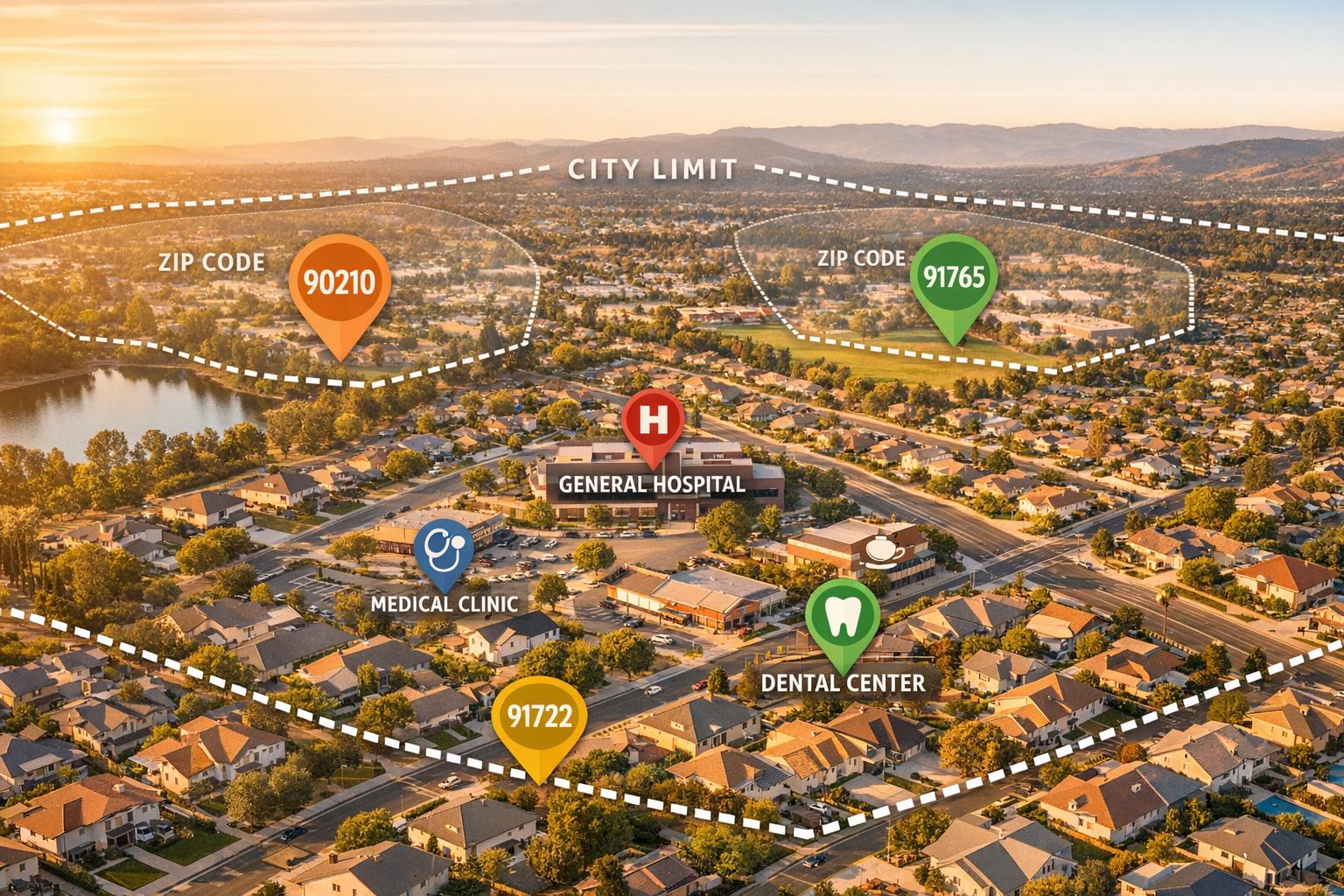
Want to attract more local patients to your practice? Geo-targeting is the answer. By focusing your Google Ads campaigns on specific neighborhoods, cities, or zip codes, you can reduce wasted ad spend and connect with patients who are actively searching for care nearby. Here’s what you need to know:
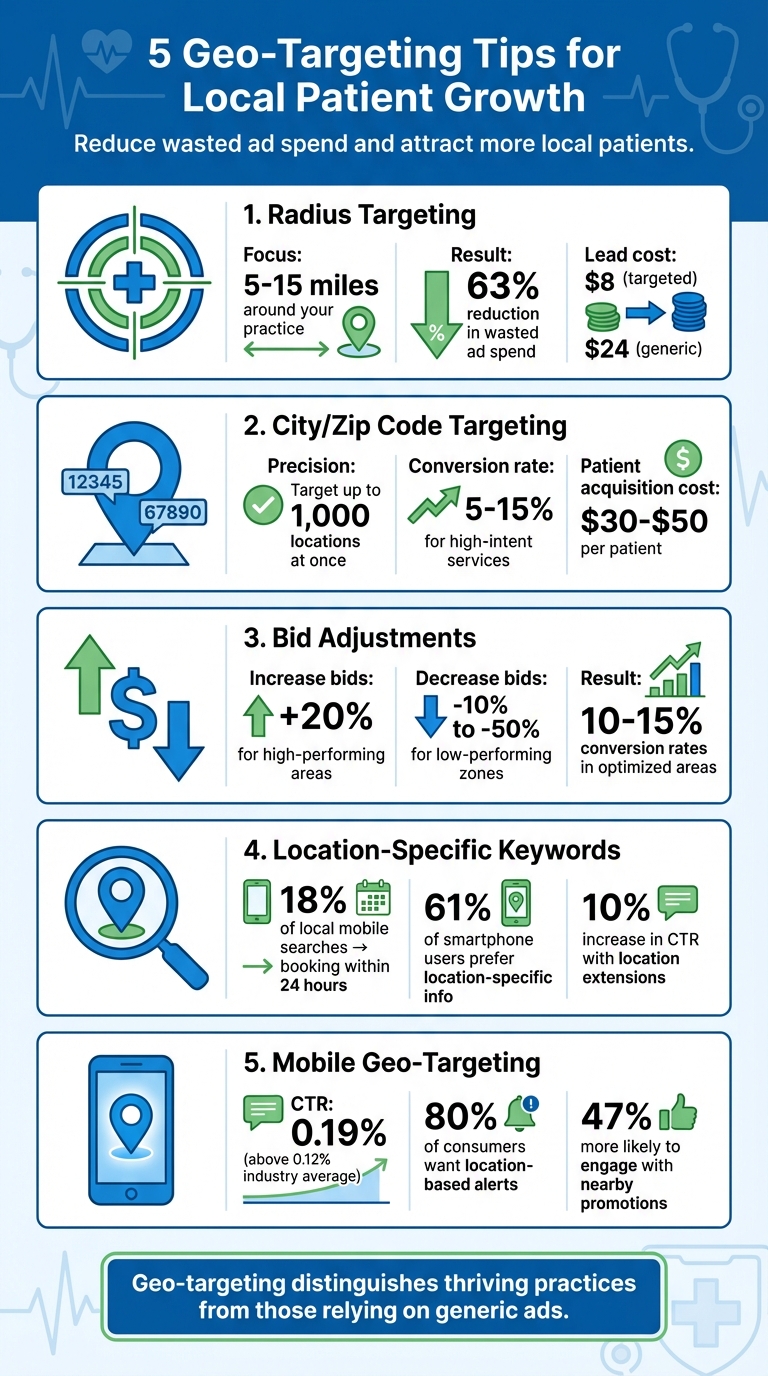
- Radius Targeting: Focus ads on people within 5–15 miles of your practice to cut wasted ad spend by 63%.
- City/Zip Code Targeting: Pinpoint specific areas where your ideal patients live for better ad performance.
- Bid Adjustments: Allocate more budget to high-performing locations for efficient ad spending.
- Location-Specific Keywords: Use terms like "pediatrician in [City Name]" to attract high-intent local searches.
- Mobile Geo-Targeting: Reach nearby patients on their phones with location-based ads and call extensions.
These strategies not only improve ad efficiency but also turn local searches into booked appointments, helping your practice grow.
5 Geo-Targeting Strategies to Attract Local Patients
1. Set Up Radius Targeting Around Your Practice Location
Effectiveness in Attracting Local Patients
Radius targeting, also known as proximity targeting, focuses your ads on people within a set distance from your practice – usually 5–15 miles for urban clinics. This approach helps avoid wasting ad spend on clicks from users too far away to become patients. In fact, switching from broad campaigns to radius targeting can reduce wasted ad spend by 63%. Instead of reaching a general audience with low conversion potential, you’re zeroing in on high-intent searchers – people actively looking for care nearby with searches like "pediatrician near me" or "urgent care open now". Let’s dive into how you can quickly set this up.
Ease of Implementation for Medical Practices
Setting up radius targeting in Google Ads is straightforward and takes about 5–7 minutes. Start by entering your practice address, selecting the radius option, and defining your desired distance (as small as 1 mile). Google Ads provides a map preview, so you can double-check the coverage area before saving your settings. Be sure to adjust the default "Presence or Interest" setting to "Presence". This ensures your ads reach people physically located within your chosen radius, rather than those merely researching the area.
Additionally, make sure your Google Business Profile is accurate and linked to your ads. This connection not only determines the center of your radius but also adds location extensions, which can boost click-through rates by 10%.
Impact on Patient Engagement and Practice Growth
Once your radius targeting is live, you’ll likely notice improved patient engagement and more efficient ad spending. By focusing on local relevance, this strategy delivers better-qualified leads. For instance, targeted campaigns generate leads at approximately $8 each, compared to $24 for broader campaigns. As Harvee Healthcare pointed out:
"Targeted campaigns often pull a $8 cost per qualified lead versus $24 for generic ones. That’s not strategy fluff, that’s arithmetic." – Harvee Healthcare
Beyond cost savings, radius targeting enhances key performance metrics. Ads tailored to local search intent improve your Quality Score, which lowers your cost per click. Conversion rates also benefit, as you’re reaching people who are actually able to visit your practice. In fact, 61% of smartphone users prefer websites that provide location-specific information.
Start with a small radius around your practice, track which areas generate the most appointments, and adjust your bids to prioritize high-performing zones. This approach ensures your ad spend works harder for you, driving both patient engagement and practice growth.
2. Target Specific Cities and Zip Codes
Effectiveness in Attracting Local Patients
Radius targeting is great for covering a broad area, but if you want to focus your efforts and budget, city and zip code targeting is the way to go. This method allows you to pinpoint specific neighborhoods, gated communities, or metro areas where your ideal patients are most likely to live. By tapping into searchers’ clear local intent, your ads are shown to people actively looking for care nearby.
Take, for instance, a cosmetic dermatology practice. They could allocate their ad budget to focus solely on affluent zip codes – areas where residents are more likely to invest in elective procedures – and skip over regions with low conversion potential. For healthcare groups with multiple locations, this strategy becomes even more useful. By creating campaigns tailored to each city, you can ensure your advertising dollars are spent on filling the right appointment slots. This level of precision means your ads reach the local audience most likely to convert into patients.
Ease of Implementation for Medical Practices
Setting up city and zip code targeting in Google Ads is surprisingly simple. You can use the "Add locations in bulk" feature to upload as many as 1,000 cities or zip codes at once. To make your ads even more personal, apply dynamic location insertion with the {LOCATION(City)} parameter. This automatically adds the searcher’s city name into your ad copy, creating headlines like "Top Pediatrician in [City Name]".
The setup process is straightforward: go to your campaign’s location settings, choose "Enter another location", and either search for specific cities or upload your pre-made list. Don’t forget to exclude areas you don’t serve by using the "Exclude" function. This helps prevent unnecessary clicks from users outside your service area, saving you money.
Impact on Patient Engagement and Practice Growth
Targeting specific cities and zip codes doesn’t just improve the quality of your leads – it also makes your ad spend more efficient. By boosting your Quality Score, this approach lowers your cost per click and increases conversion rates because you’re connecting with people who can actually visit your practice.
The financial upside is clear. Healthcare practices running geo-targeted campaigns often see conversion rates between 5% and 15% for high-intent services, with acquisition costs ranging from $30 to $50 per patient. To take it a step further, create location-specific landing pages (like yourpractice.com/city-name) for each major area you serve. You can also adjust bids for high-performing zip codes – raising bids by 20% or more in areas that consistently generate appointments. This attention to detail can make a big difference in driving patient engagement and practice growth.
3. Adjust Bids Based on Location Performance
Effectiveness in Attracting Local Patients
Once you’ve set up location targeting, fine-tuning your bids can take your campaign to the next level. Not all locations perform equally – some generate a steady stream of conversions, while others drain your budget with little return. By adjusting bids based on location performance, you can allocate your budget where it matters most. For instance, increasing bids by 20% for areas within a 5-mile radius and reducing them by 10%-50% for farther regions based on real-time CPA and ROAS can make a big difference.
This approach uses real-time data to guide your decisions. Some practices even tie bid adjustments to external factors. Imagine an orthopedic clinic increasing bids for joint pain treatments during colder weather or a family practice boosting bids for flu shots during flu season. These targeted strategies ensure your ads reach the right audience at the right time, maximizing their impact.
Ease of Implementation for Medical Practices
Platforms like Google Ads and Microsoft Ads make it straightforward to adjust bids by location. Start by reviewing the "Locations" tab to analyze performance, then use bid multipliers to refine your strategy. You can dig deeper into the data by narrowing it down to cities, zip codes, or even congressional districts to see exactly where your patients are coming from.
Distance reports are another useful tool, helping you identify where conversion rates drop off. Once you’ve pinpointed your best-performing areas, apply bid multipliers directly in the platform. As Mark Irvine, Director of PPC at SearchLab Digital, puts it:
"You can use location bid adjustments to bid more aggressively for areas near your business where you expect local users to be easier to convert and reduce your bids as a searcher is further away".
Following these steps allows you to implement dynamic bidding strategies that adapt to real-time campaign performance.
Impact on Patient Engagement and Practice Growth
Fine-tuning your bids by location can significantly improve both campaign efficiency and patient engagement. By focusing on high-performing areas, practices often see conversion rates climb to 10–15% for services with high patient intent. Adding location extensions to your ads can further boost click-through rates by 10%, leading to more patient inquiries.
This strategy also helps reduce your CPA by avoiding costly clicks from less effective areas. To keep your campaigns optimized, it’s a good idea to audit your location settings at least twice a year. Local market trends and patient demographics can shift, and staying on top of these changes ensures your campaigns remain effective.
Google Ads Geotargeting (Location Targeting) Explained
sbb-itb-f6ab3ee
4. Add Location-Specific Keywords to Your Ads
Taking your optimized bid strategies a step further, adding location-specific keywords helps you zero in on high-intent local patients who are ready to take action.
Why Location-Specific Keywords Work
Location-specific keywords are incredibly effective for connecting with patients actively searching for care in their area. When someone types "pediatrician in Boston" or "ENT near me", they’re not just browsing – they’re looking for immediate care nearby. These types of searches show clear intent.
But there’s more to it than just matching search queries. By incorporating location modifiers, you can filter out irrelevant traffic from outside your service area. This ensures your ad budget is spent attracting patients who can actually visit your practice. And the results speak for themselves: targeted local campaigns often see a cost per qualified lead of about $8, compared to $24 for broader, generic campaigns. On top of that, using regional terms can improve your ad’s Quality Score, which helps lower your cost per click.
How to Add Location Keywords to Your Ads
Adding location-specific keywords to your ad campaigns is straightforward. Start by including your city name, ZIP codes, or neighborhood names alongside your existing service keywords. For example, instead of just "family doctor", use "family doctor in [City Name]" or "family doctor in [ZIP Code]." Don’t forget "near me" phrases like "urgent care near me" or "dentist open now", which are especially effective for mobile users searching for immediate care.
If your practice serves multiple areas, Dynamic Location Insertion can make your campaigns even easier to manage. By using the {LOCATION(City)} parameter in Responsive Search Ads, the ad headlines automatically update based on the searcher’s location. As Mark Irvine, Director of PPC at SearchLab Digital, puts it:
"Localizing your ad copy for each city, town, or state you serve is a clear and effective way to show your business is local to your searchers".
You can also use structured snippets labeled "Neighborhood" to highlight the areas you serve. This works hand-in-hand with your geo-targeting setup, ensuring your ad copy aligns with the local terms patients are searching for.
Boosting Engagement and Driving Growth
Incorporating location-specific keywords isn’t just about increasing clicks – it’s about attracting the right clicks. Paired with radius targeting and bid adjustments, these keywords create a well-rounded strategy to connect with high-intent patients. Add location extensions to the mix, and you could see conversion rates improve significantly, with click-through rates increasing by up to 10%.
The true power of this approach lies in capturing patients at the exact moment they’re ready to act. Around 18% of local mobile searches lead to a booking within 24 hours, and 61% of smartphone users prefer websites that provide location-specific information. By tailoring your ads to reflect neighborhoods like "Back Bay" or specific ZIP codes, you not only attract more leads but also build trust with potential patients. This hyper-local strategy results in more inquiries and helps bring in patients who are more likely to stay with your practice long-term.
If you want to refine your geo-targeted campaigns even further, working with specialists like Medical PPC Agency can help craft strategies tailored to your unique market needs.
5. Use Mobile Geo-Targeting to Reach Nearby Patients
Effectiveness in Attracting Local Patients
Mobile geo-targeting connects with patients right when they need care. For instance, searches like "urgent care near me" often indicate someone is ready to take action. One urgent care provider with two locations demonstrated this by using geofencing to target mobile users near ERs, competitors, a university, and pharmacies. Over 60 days, their campaign generated 420,000 impressions with a click-through rate (CTR) of 0.19% – well above the 0.12% industry average – and brought in 109 walk-ins at a cost of $41.28 each. This example highlights how mobile geo-targeting can effectively drive immediate patient visits.
Ease of Implementation for Medical Practices
Implementing mobile geo-targeting is straightforward and builds on precise location strategies. Start by setting a targeting radius of 5–15 miles around your practice, especially in urban areas where patients tend to choose nearby options. Adding call extensions to your ads allows mobile users to call your office directly with a single tap – an easy feature that can significantly increase conversions for time-sensitive services.
To make your ads feel more personalized, use geo-customizers to include the searcher’s city or neighborhood in the ad headline. For example, "Top-Rated Dentist in [City Name]" creates a sense of familiarity and trust. Additionally, ensure your landing pages load in under three seconds, as mobile users searching for urgent care are unlikely to wait for a slow website. To maximize visibility, increase bids for mobile users within your target radius, ensuring your ads appear in top positions when it matters most.
These strategies not only make implementation simple but also directly improve engagement and appointment bookings.
Impact on Patient Engagement and Practice Growth
Mobile geo-targeting delivers high-quality clicks and lowers the cost of acquiring qualified leads. Adding location extensions to your mobile ads can increase click-through rates by 10%, and 61% of smartphone users prefer websites that adapt to their location.
The real value lies in quickly converting high-intent searchers into patients. Studies show that 80% of consumers want to receive location-based alerts from businesses, and 47% are more likely to engage with promotions when they’re nearby. By combining precise radius targeting, click-to-call features, and location-specific ad copy, your practice can meet patients exactly where they are – both physically and mentally – helping fill appointment slots with individuals who are more likely to become loyal, long-term patients.
Conclusion
Geo-targeting takes your advertising efforts and turns them into tangible results – real patient visits – by honing in on local searches. By implementing radius targeting, narrowing your focus to specific cities or zip codes, fine-tuning bids based on performance, using location-specific keywords, and tapping into mobile geo-targeting, you create a system that connects your practice with the right audience at the exact moment they’re seeking care. This targeted approach drives measurable patient growth.
The numbers speak for themselves: geo-targeting reduces wasted ad spend and increases efficiency in capturing local patient searches. Your potential patients are already searching online – geo-targeting ensures they find and choose your practice.
"Geo-targeting distinguishes thriving practices from those relying on generic ads." – Harvee Health Care
By adopting these strategies, your practice establishes a streamlined and effective outreach system. This is where Medical PPC Agency comes in. Specializing in Google Ads, Facebook Ads, and AI-powered patient acquisition systems tailored for healthcare providers, they take the guesswork out of geo-targeting. Their data-driven strategies help attract more qualified patients from your local area.
The healthcare landscape has shifted. Today’s patients expect quick, convenient, and nearby solutions when they search for care. Geo-targeting meets them exactly where they are – both geographically and in their patient journey – transforming online searches into booked appointments and clicks into lasting patient relationships.
FAQs
How can geo-targeting help medical practices save on ad costs?
Geo-targeting allows medical practices to make the most of their advertising budgets by concentrating ads within specific local areas, such as ZIP codes, city limits, or a set radius around the practice. By narrowing the audience to people in your service area, you avoid spending money on clicks from individuals outside your reach, cutting down on unnecessary costs.
This approach doesn’t just save money – it also boosts ad performance. With a more focused audience, click-through rates tend to increase, and cost-per-click decreases. The result? Your budget works harder for you, reaching local patients who are more likely to book an appointment.
How do location-specific keywords help attract more local patients in healthcare advertising?
Using location-specific keywords in healthcare advertising is a smart way to ensure your ads connect with people actively looking for care in your area. This approach makes your ads more relevant, boosts click-through rates, and attracts potential patients who are genuinely interested in your services.
Focusing on nearby users also helps you avoid wasting money on ads shown to people outside your service area. Instead, your budget works harder by targeting individuals who are more likely to visit your practice. This strategy not only increases your online presence but also helps expand your local patient base in a meaningful way.
How does mobile geo-targeting help clinics attract more local patients?
Mobile geo-targeting taps into a smartphone’s GPS, Wi-Fi, or cellular signal to deliver ads or notifications tailored to a user’s location. For clinics, this means reaching potential patients with location-specific messages as they enter a designated area near your practice. The result? Timely, relevant communication that encourages engagement and boosts appointment bookings.
Imagine this: a clinic targets users searching for nearby healthcare services by running customized Google Ads or sending push notifications with special offers – like a complimentary flu shot for those within a 5-mile radius. By reaching patients at just the right moment and place, mobile geo-targeting turns casual searches into actual visits, helping your clinic grow and connect more effectively.
Working with professionals like Medical PPC Agency ensures these campaigns are fine-tuned to show up exactly when patients are searching for care, delivering stronger results for your practice.