
Running Google Ads for medical practices requires strict adherence to FDA guidelines. Non-compliance risks include fines, account suspension, and legal actions. To ensure your ads meet standards, focus on these five key principles:
- Balance Risk and Benefit Claims: Present drug benefits and risks equally in ads and landing pages.
- Substantiate Medical Claims: Only use FDA-approved information backed by clinical trials.
- Disclose Sponsorships Clearly: Identify ad sponsors and any paid relationships.
- Follow Google’s Rules: Obtain certifications and avoid restricted terms or locations.
- Include Risk Disclosures in Ads: Ensure risks are as prominent as benefits, even in short formats.
Healthcare ads must comply with both FDA and Google policies. Regular audits and expert guidance can help you avoid penalties while maintaining effective campaigns.
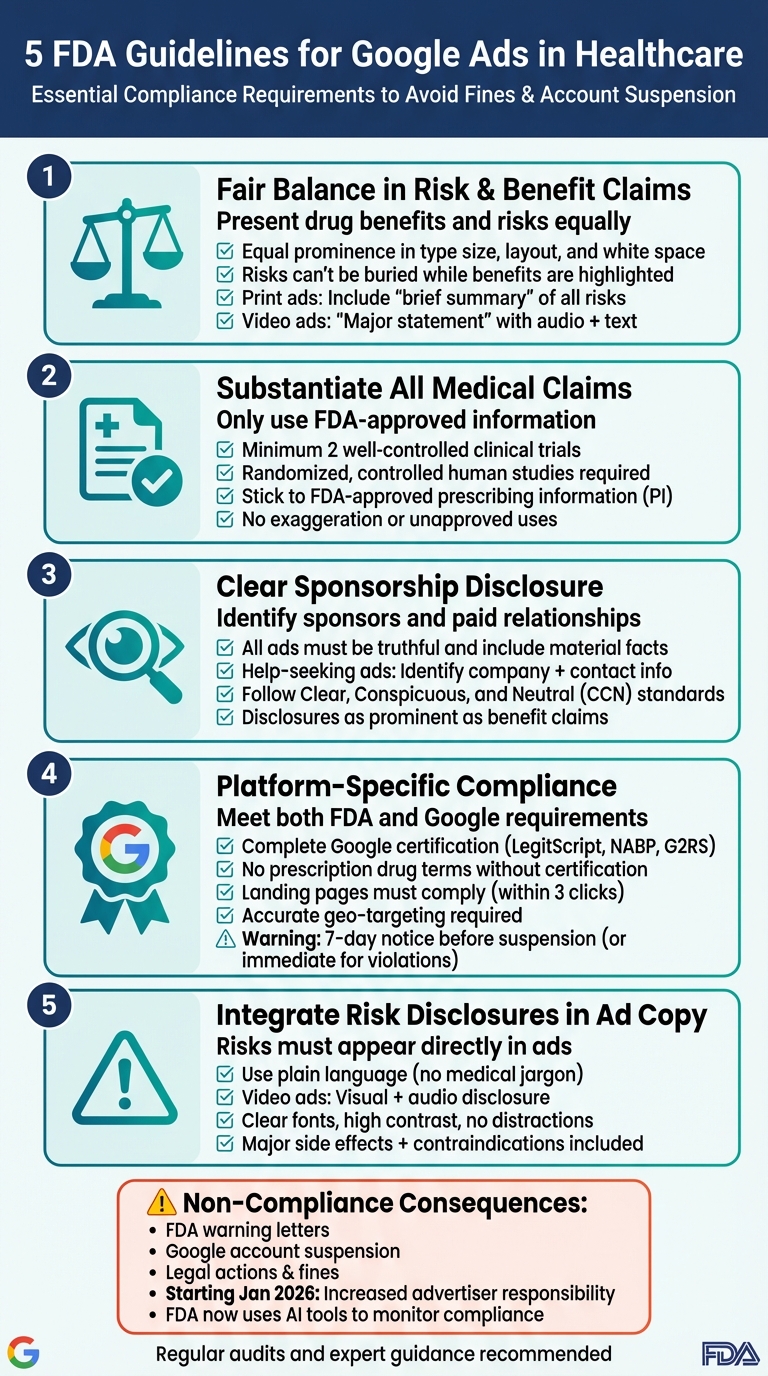
5 FDA Guidelines for Healthcare Google Ads Compliance
Rx Drug Promotion and the Clear, Conspicuous, and Neutral Final Rule
sbb-itb-f6ab3ee
1. Maintain Fair Balance in Risk and Benefit Claims
The fair balance principle is a cornerstone of the FDA’s guidelines for prescription drug advertising. According to the FDA, "the content and presentation of a drug’s most important risks must be reasonably similar to the content and presentation of its benefits". This doesn’t mean risks and benefits need identical space but ensures that benefits aren’t emphasized disproportionately over risks.
How you present this information matters just as much as what you include. The FDA scrutinizes elements like type size, bullet points, white space, and headlines to determine compliance. For example, if your Google Ad headline highlights a drug’s benefits in bold, large text but hides side effects in tiny print at the bottom of your landing page, you’re not meeting fair balance standards. Similarly, upbeat music or flashy visuals during risk disclosures in video ads can undermine the message and violate these rules. Risks should never be buried in hard-to-find sections while benefits take center stage; both must be presented with equal prominence.
For product claim ads, specific requirements must be followed. These ads need to include the brand and generic names, one FDA-approved use, and a comprehensive disclosure of risks. Print ads must feature a "brief summary" of all risks based on the prescribing information, while video ads require a "major statement" that covers the most important risks, presented in both audio and text formats. For Google Search ads, you can meet the "adequate provision" standard by including a clear link to the full FDA-approved prescribing information on your landing page.
Additionally, print ads are required to carry this exact statement: "You are encouraged to report negative side effects of prescription drugs to the FDA. Visit MedWatch or call 1-800-FDA-1088". This mandate, introduced under the Food and Drug Administration Amendments Act of 2007, ensures patients know how to report any adverse reactions.
Lastly, ensure that every claim in your ad is backed by credible, verifiable evidence. A balanced and truthful presentation is not just a regulatory requirement – it builds trust with your audience.
2. Ensure All Medical Claims Are Substantiated and Accurate
When it comes to medical claims, there’s no room for guesswork or flimsy evidence. The FDA demands solid scientific proof, not just testimonials, customer surveys, or animal studies. What they’re looking for is robust clinical evidence – usually randomized, controlled human clinical trials conducted by qualified professionals. For most prescription drug claims, meeting the "substantial evidence" standard means providing results from at least two well-controlled clinical studies.
Randomized, controlled trials are the gold standard here. These studies must include proper control groups, randomization, and double-blinding to ensure the results are reliable. When crafting Google Ads copy, you’re required to stick strictly to the FDA-approved prescribing information (PI). That means no exaggerating benefits, cherry-picking data, or making claims about uses that haven’t been approved by the FDA. Any deviation from these guidelines can result in serious consequences.
The risks of unsupported claims are not to be taken lightly. Google treats the promotion of unapproved substances or misleading health claims as an "egregious violation", which could result in an immediate account suspension. Beyond Google’s penalties, the FDA can take action as well – this could include issuing warning letters, requiring corrective advertising, or even pursuing criminal charges. Recent enforcement actions by the FDA highlight how seriously they take deceptive claims.
The Federal Trade Commission (FTC) echoes this sentiment:
"Companies must support their advertising claims with solid proof. This is especially true for businesses that market food, over-the-counter drugs, dietary supplements… and other health-related products." – Federal Trade Commission
To stay compliant, verify every claim against the FDA-approved prescribing information and consult independent experts for study design and analysis. Keep in mind, the quality of research matters far more than the quantity – one well-executed trial holds more weight than multiple flawed ones.
3. Provide Clear Disclosure of Sponsorships and Third-Party Content
Sticking to FDA guidelines, transparency is not just a best practice – it’s a legal requirement in healthcare advertising. The FDA makes it clear: all prescription drug ads must be truthful, not misleading, and include all material facts about the sponsor or the product. For Google Ads, this means you must clearly identify the sponsor and disclose any paid relationships.
The type of ad you’re running determines the kind of disclosure needed. For example, help-seeking ads (also called disease awareness ads) can identify the pharmaceutical company sponsoring the ad and share contact details like a website or phone number for consumers to get more information. As the FDA explains:
"While this ad may not name a drug, it may identify the company sponsoring the ad and provide a telephone number to call or a website to visit for more information." – FDA
Understanding the difference between ad types is key. If a help-seeking ad mentions or suggests a specific prescription drug, it’s no longer a help-seeking ad – it becomes a "product claim ad." This shift means it must meet all FDA disclosure requirements, including a balanced presentation of risks and benefits. Why does this matter? Because it determines whether the FTC or FDA oversees your content.
For Google Ads campaigns, transparency must extend to both your ad copy and landing pages. You’ll need to follow "adequate provision" guidelines, which require offering multiple ways for consumers to access the drug’s full prescribing information – typically through a toll-free number or a website. The Clear, Conspicuous, and Neutral (CCN) standards, effective November 20, 2024, also emphasize that disclosures must be easy to notice and understand. They should never be overshadowed by claims about the product’s benefits. To meet these standards, ensure your ad layouts display sponsorship and risk information just as prominently as benefit claims, using clear font styles and strong contrast.
4. Comply with Platform-Specific Advertising Policies and Restrictions
When it comes to healthcare advertising, meeting FDA standards isn’t enough. Platforms like Google have their own set of rules, which can add another layer of complexity. Google explains, "We’re dedicated to following advertising regulations for healthcare and medicine, so we expect that ads and destinations follow appropriate laws and industry standards". Essentially, the FDA governs what you can say, while Google dictates who can say it and where.
One of the first hurdles is certification. If you’re a healthcare advertiser, Google requires you to complete a certification process. This often involves third-party verification through organizations like LegitScript, NABP, or G2RS. For U.S. health insurance advertisers, G2RS certification is mandatory before targeting ACA-related keywords. It’s a good idea to start this process early, as it’s entirely separate from FDA compliance.
Google also enforces strict content restrictions. Ads, landing pages, and keywords cannot include prescription drug terms, unapproved medications, dangerous supplements, or opioid painkillers. Violating these rules can lead to immediate suspension.
Your landing pages are just as important as your ads. Google’s crawlers analyze both, and any issues – like misleading claims or links to unauthorized drug sales – can result in ad disapproval or even account suspension. If you’re not certified to use certain restricted drug terms, those terms must stay off your ads, landing pages, and even content within three clicks of your landing page. This might mean creating standalone landing pages that are completely separate from restricted content on your main site.
Google typically gives a seven-day warning before suspending healthcare-related accounts. However, violations involving unauthorized pharmacies or prescription opioid painkillers can lead to an immediate suspension without any prior notice. Even with certification, your ads might be labeled as "Eligible (limited)", meaning they’ll only appear in specific locations or for certain search queries. This makes accurate geo-targeting essential – advertising in areas where you’re not licensed is considered a serious violation.
For help navigating Google’s complex compliance requirements and making the most of your ad campaigns, consider consulting a specialized agency like Medical PPC Agency.
5. Integrate Risk Disclosures Directly Into Advertising Copy
When it comes to pharmaceutical advertising, the FDA requires that risk disclosures be part of the ad copy itself. If your ad mentions a drug by name and discusses its benefits, you must also include the key risks directly within the ad. This ensures that the presentation of risks is just as clear and noticeable as the benefits, maintaining the balance required under FDA guidelines. This principle, known as the fair balance doctrine, emphasizes that details about risks must be displayed with equal prominence – considering factors like font size, layout, contrast, and use of white space.
The FDA’s CCN Final Rule further specifies that risk disclosures must avoid medical jargon and use plain, straightforward language. For video ads, such as those on YouTube, risks should be communicated both visually and audibly. The text and audio must align, ensuring that key phrases are clear and easy to follow. As the FDA states:
"The major statement’s audio information, in terms of the volume, articulation, and pacing used, is at least as understandable as the audio information presented in the rest of the advertisement".
Given the practical limitations of platforms like Google Ads, where character counts are tight, the challenge is to convey risks succinctly yet thoroughly. Focus on concise phrases that highlight major side effects and contraindications without exceeding platform limits. To improve readability, use clear fonts, high contrast, and avoid clutter or distracting visuals and sounds during the disclosure. If you’re unsure whether your ad meets these requirements, the FDA’s Office of Prescription Drug Promotion (OPDP) offers a voluntary review process for draft ads before they are published.
These rules aren’t just guidelines – they’re essential. Failure to comply with risk disclosure standards can lead to serious consequences. For example, in September 2025, the FDA issued around 100 cease-and-desist letters to companies for misleading ads. The agency has also adopted AI-driven tools to monitor digital drug advertisements, shifting from a reactive to a proactive enforcement approach.
If you’re navigating the complexities of creating compliant and effective Google Ads, Medical PPC Agency offers specialized digital marketing solutions tailored to healthcare providers, ensuring your practice stays both compliant and competitive.
Conclusion
Following Google’s advertising rules for healthcare isn’t just a formality; it’s essential for protecting your practice and your patients. These rules are built around five key FDA guidelines: maintaining a fair balance in messaging, backing up claims with evidence, clearly disclosing sponsorships, following platform-specific rules, and including risk disclosures seamlessly.
Failing to comply can have serious consequences. Healthcare advertisers risk receiving FDA warning letters and even having their Google accounts suspended. And the stakes are rising. Starting in January 2026, Google is shifting more compliance responsibility directly onto advertisers and agencies, particularly for certain programmatic pharmaceutical ads. This change means healthcare providers must take a more hands-on approach to ensure their ads meet all current standards. Regularly auditing your campaigns – checking ad copy, landing pages, and risk disclosures – is no longer optional; it’s a must.
Adding to the complexity, the FDA has announced plans to use AI tools to monitor digital advertising for compliance. With these challenges in mind, working with experts can make all the difference. Agencies like Medical PPC Agency specialize in navigating these technical and regulatory hurdles. From securing Google certifications and managing third-party verifications like LegitScript to setting up geographic targeting and incorporating risk disclosures, they ensure your campaigns stay compliant without sacrificing performance. This approach helps healthcare providers avoid costly penalties while effectively connecting with patients who need their care.
FAQs
What happens if healthcare providers don’t follow FDA guidelines when using Google Ads?
Failing to follow FDA advertising guidelines in healthcare can have serious repercussions. For starters, Google might reject your ads, preventing them from running. In extreme cases, your entire account could face suspension.
This kind of disruption can derail your marketing efforts, limit your ability to reach patients, and even damage your practice’s online reputation. To steer clear of these setbacks, make sure your ads fully comply with FDA regulations. Staying aligned with these rules protects both your campaigns and your credibility.
How can I make sure my healthcare ad claims meet FDA guidelines?
To meet FDA guidelines, make sure every claim in your healthcare advertisements is backed by solid scientific evidence and matches FDA-approved labeling. Present the information fairly by highlighting both the benefits and the risks. Keep all relevant documentation and research studies on hand for verification if needed. This not only helps you stay compliant but also builds trust in your advertising.
What certification is required to run Google Ads for healthcare services?
To advertise healthcare services through Google Ads in the U.S., you must secure Google’s U.S. Health Insurance Advertiser Certification. This certification confirms that your ads meet Google’s strict guidelines for promoting health-related products and services. Without it, your ads risk being disapproved or not shown at all.