Running PPC campaigns without data is like throwing darts blindfolded – you waste money and miss opportunities. For healthcare providers, data analytics transforms paid search into a powerful tool for attracting patients while keeping costs under control. Here’s why:
- 70% of patients search online before choosing a provider.
- Healthcare ads average a 3.57% click-through rate (CTR) and 4.92% conversion rate as of May 2025.
- Smart use of metrics like Cost Per Acquisition (CPA) and Return on Ad Spend (ROAS) ensures profitability.
Data analytics helps you pinpoint what works – keywords, ad copy, and landing pages – so you can focus your budget on campaigns that drive real results. By tracking patient behavior, integrating CRM data, and leveraging tools like A/B testing and predictive modeling, you can turn clicks into appointments efficiently.
The key takeaway: Data analytics is not just about tracking numbers; it’s about using those numbers to refine your strategy and maximize ROI. Below, we’ll explore the metrics, strategies, and tools that make this possible.
📊 Track Your Google Ads ROI Directly in Google Analytics 4 (GA4)
sbb-itb-f6ab3ee
Key PPC Metrics That Affect ROI
5 Essential PPC Metrics for Healthcare ROI Optimization
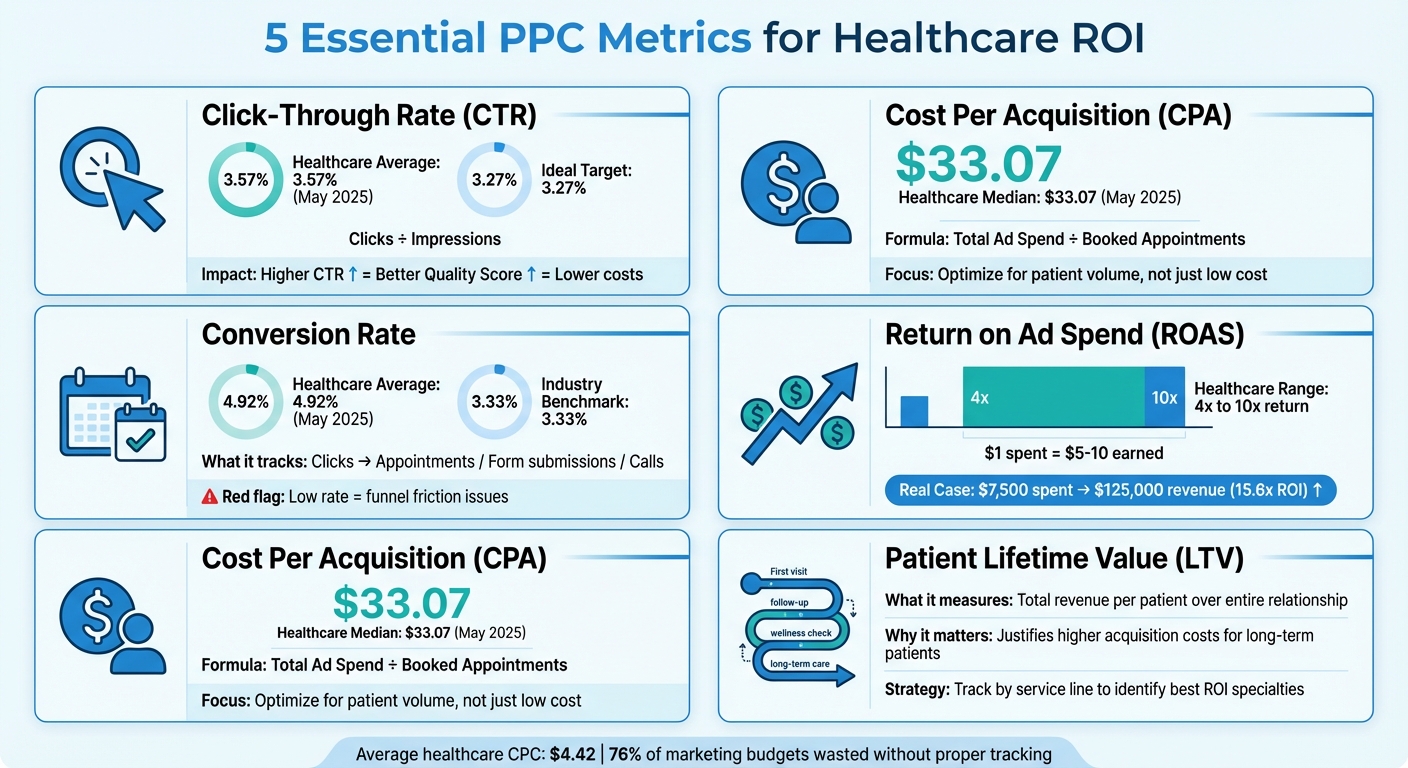
Tracking the right metrics can mean the difference between a profitable campaign and wasted ad spend. For healthcare providers, five key measurements directly determine whether your advertising dollars lead to booked appointments and long-term revenue growth.
Click-Through Rate (CTR)
CTR measures the percentage of people who click on your ad after seeing it. You calculate it by dividing the number of clicks by the total impressions. In healthcare, the ideal CTR is around 3.27%, though recent data from May 2025 shows the median CTR for Google Ads in this sector at 3.57%. If your CTR is low, it could mean your targeting is off or your ad copy isn’t resonating with what patients are searching for. Beyond that, a strong CTR boosts your Quality Score – Google’s 1-10 rating of your ad’s relevance – which can lower your cost per click and improve your ad placement.
Conversion Rate
This metric tracks how many clicks turn into valuable actions, such as appointment bookings, form submissions, or phone calls. The average conversion rate for healthcare and medical services is 3.33%, while the May 2025 median stands at 4.92%. A low conversion rate often points to "funnel friction" – issues like slow-loading pages, confusing design, or a mismatch between the ad and the landing page. For example, if you’re promoting diabetes screenings, your ad should direct patients to a dedicated screening page, not a generic homepage.
Cost Per Acquisition (CPA)
CPA measures how much it costs to acquire a new patient. You calculate it by dividing your total ad spend by the number of booked appointments. As of May 2025, the median CPA for healthcare Google Ads is $33.07. This metric is more telling than Cost Per Lead since not every inquiry turns into an actual patient. The focus for healthcare marketers is shifting – rather than just cutting costs, the goal is to optimize for actual patient volume, even if it means accepting a higher CPA for better-quality leads.
Return on Ad Spend (ROAS)
ROAS evaluates how much revenue your ads generate compared to what you spend. For instance, a ROAS of 5.0 means you earned $5 for every $1 invested. Paid search campaigns typically deliver a 4x to 10x return for healthcare providers. In one example from 2024, an orthopedic service line spent $7,500 on paid search, secured 50 booked appointments, and generated $125,000 in revenue – resulting in a 15.6x ROI. ROAS cuts through vanity metrics to show whether your campaigns are genuinely profitable.
Patient Lifetime Value (LTV)
LTV estimates the total revenue a patient brings to your practice over their entire relationship with you. This long-term perspective is essential for understanding how much you can afford to spend on acquiring new patients while staying profitable. For example, a primary care patient who comes in for annual checkups, refers family members, and eventually seeks specialist care is worth far more than their initial visit. By tracking LTV across service lines – like orthopedics versus primary care – you can identify which specialties justify higher ad budgets and deliver the best long-term returns.
How Data Analytics Improves PPC Performance
Metrics tell you what happened, but data analytics dives deeper to explain why and helps pinpoint actions to attract the right patients at the right cost. Let’s look at how strategies like behavioral targeting, predictive modeling, and systematic testing can transform PPC campaign outcomes.
Using Behavioral Data for Audience Targeting
Analytics platforms track key behaviors – search queries, visited pages, dwell times, and device types – offering insights into how potential patients interact with ads and websites. This data helps distinguish between two types of audiences: "Problem Aware" patients, who are researching symptoms, and "Solution Aware" patients, who are actively seeking treatment. For instance, someone searching for "chronic back pain relief" might engage with educational content about treatment options, while a query like "orthopedic surgeon accepting new patients" signals readiness to book an appointment.
Geographic and demographic data further sharpen targeting efforts. Since most patients prefer care within a 20- to 30-mile radius of their home, radius-based targeting ensures ad spend isn’t wasted on users too far away to visit. A great example of this approach comes from Georgia Behavioral Health Professionals. In February 2022, they implemented a closed-loop reporting system that integrated offline CRM data with Google Ads for medical practices. This allowed their algorithm to focus on users who became actual patients instead of just form-fillers. The result? A threefold increase in patient volume by shifting from efficiency-based to effectiveness-based targeting.
Predictive Modeling for Budget Allocation
Predictive models use machine learning to analyze signals like device type, location, time, and user intent, forecasting which clicks are most likely to convert. By integrating CRM data, practices can enable value-based bidding, prioritizing high-value procedures over routine visits. For example, Google’s Smart Bidding strategies, such as Target CPA and Target ROAS, automate bid adjustments based on conversion likelihood.
To fully unlock the potential of predictive modeling, practices must connect their CRM systems with PPC platforms. This integration gives algorithms a clearer picture of which leads turn into actual patients and generate revenue. By focusing on high-value procedures, like surgery consultations, value-based bidding can significantly improve campaign performance. When properly set up, automated smart bidding can deliver a 15% to 20% performance boost. However, healthcare decision cycles tend to be longer, so about a quarter’s worth of continuous data is typically needed to see meaningful results.
A/B Testing and Optimization
Data analytics takes the guesswork out of testing. For example, healthcare practices can test ad headlines like "Board-Certified Specialists" versus "Same-Day Appointments" to see which drives more clicks. Landing page tests – comparing form lengths, button colors, or trust signals like patient reviews and certifications – help identify what resonates most with users. Metrics such as click-through rate, conversion rate, and cost per acquisition guide these decisions.
Continuous, data-driven testing leads to measurable improvements. One healthcare firm, for instance, achieved a 20% increase in conversion rate while doubling targeted traffic through consistent optimization efforts.
How to Implement Data Analytics in Your PPC Campaigns
To make the most of your PPC campaigns, weaving data analytics into every step of your process – from initial setup to ongoing tweaks – is key. This approach helps you maximize ROI and refine your strategy over time.
Set Up Tracking and Data Collection
Start by linking Google Ads with GA4 and enabling auto-tagging to track essential post-click metrics. Use GA4 to monitor conversions like form submissions, phone calls, and appointment bookings. For healthcare practices, tracking multiple conversion types is essential since many patients prefer calling. Enable call reporting to capture calls lasting beyond a specific duration, and consider AI-powered call tracking tools to evaluate call quality and identify high-value patient leads. Don’t forget – any tracking tools you use must comply with HIPAA regulations to ensure the protection of sensitive health information.
Analyze Campaign Performance and Trends
Dive into your search terms report to find queries that perform well and add them as keywords. At the same time, identify irrelevant terms and exclude them as negative keywords to avoid wasting ad spend on unproductive searches.
"Simply tracking conversions from a campaign or channel level will not provide the necessary details on what needs to be done to grow conversions and scale profitably." – Sam Yadegar, CEO, HawkSEM
Pay close attention to your Quality Score, as higher scores can reduce costs and improve ad placements. Use this ROI formula to measure success: ROI = (Revenue – Cost) / Cost × 100. Keep in mind that decision-making in healthcare often takes longer than in e-commerce, so it’s better to evaluate campaign performance over an entire quarter rather than week-to-week. These insights will help you fine-tune your audience targeting for better results.
Segment and Optimize Audience Targeting
Break down performance data by demographics, location, and device type. Use remarketing lists to re-engage users who have already shown interest. Since mobile devices account for over 60% of healthcare-related web traffic, make sure your landing pages are optimized for all screen sizes. GA4’s demographic reports can help you refine your targeting, ensuring each audience segment is directed to a landing page that matches their intent.
Test Ad Variations and Reallocate Budgets
With performance data and audience segments in hand, experiment with different ad variations to see what works best. Test headlines, landing page layouts, and call-to-action buttons. Tools like heatmaps can reveal usability issues on landing pages. Keep an eye on metrics like click-through rate, conversion rate, and cost per acquisition (CPA) to identify top-performing ads. Shift budgets toward campaigns that deliver the lowest CPA. For context, the average cost-per-click for healthcare keywords is around $4.42, so even small gains in efficiency can lead to noticeable savings.
Monitor and Refine Continuously
Ongoing monitoring is essential to keep your campaigns on track. Regularly update your negative keyword lists to block irrelevant searches and adjust bids based on performance by device, location, and time of day. Take it a step further by integrating CRM data with your PPC platforms to enable closed-loop reporting. This allows your algorithms to optimize for actual patient acquisitions instead of just form submissions. Industry data shows that about 76% of marketing budgets are wasted when proper tracking and analysis aren’t in place, highlighting the importance of continuous refinement.
How Medical PPC Agency Uses Data Analytics
Medical PPC Agency takes a data-focused approach to running effective PPC campaigns, helping healthcare providers cut unnecessary ad spend and attract more patients. By weaving data analytics into every aspect of campaign management, the agency delivers targeted solutions tailored to the unique needs of healthcare practices, often sharing expert insights on industry trends. Their strategy revolves around specialized analytics, AI-driven tools, and adaptable service plans designed to grow alongside the practice.
Custom Analytics Solutions for Healthcare Practices
To address the specific needs of healthcare providers, Medical PPC Agency creates custom analytics frameworks. Using tools like Semrush and Ahrefs, the agency performs competitive gap analyses to uncover keyword opportunities that competitors may have overlooked. All tracking systems are HIPAA-compliant, ensuring patient data remains secure throughout the process.
The agency also uses Quality Score analysis to improve ad placements and lower cost-per-click (CPC) rates. By studying keyword performance – focusing on metrics like eligible impression share and keyword competitiveness – they adjust bids dynamically to maximize returns. Additionally, audience segmentation based on demographics, location (typically within a 5–25 mile radius), and behavior enables personalized ad content, targeting high-intent patients more effectively. These insights integrate seamlessly into the agency’s AI-powered strategies for even greater impact.
AI-Driven Insights for Better ROI
Building on their strong analytics foundation, Medical PPC Agency uses AI to further enhance campaign performance. AI tools automate bid adjustments, fine-tune targeting, and optimize ad copy, ensuring ads perform at their best. Machine learning algorithms continuously test and refine campaign elements, identifying the most effective combinations to drive patient conversions. By using consolidated campaign structures, the agency allows smart bidding algorithms to learn more quickly from larger pools of data – improving efficiency by as much as 11%.
"The more consolidated you are, the higher chances of smart bidding working for you, versus a highly segmented structure." – Alex Kemp, Director of PPC, Cardinal Digital Marketing
The agency also adapts campaigns for conversational search trends, optimizing for voice assistants and AI tools like ChatGPT by incorporating natural language headlines and question-based phrases.
Flexible Plans to Match Your Practice
Medical PPC Agency offers three service tiers, designed to meet the needs of practices of all sizes while ensuring continuous optimization through data-backed strategies:
- Basic Plan: Ideal for smaller practices, this plan includes PPC services for Google Ads, Facebook Ads, and basic analytics, limited to one platform.
- Advanced Plan: Expanding on the basics, this plan covers Google Ads, Facebook Ads, YouTube Ads, advanced analytics, and multi-platform campaign management.
- Premium Plan: A comprehensive package that includes all advertising platforms, AI-powered tools, Microsoft Advertising, and SEO services – perfect for practices with ambitious growth goals.
Each plan is customized with a quote based on the practice’s needs, with typical monthly campaign budgets ranging from $5,000 to $10,500. This flexibility ensures that every healthcare provider can find a solution that aligns with their goals and resources.
Conclusion
Data analytics transforms PPC campaigns into precise tools for generating revenue in healthcare practices. By analyzing detailed metrics like keyword performance, device usage, and geolocation data, practices can pinpoint where their ad spend leads to actual patient acquisitions – not just clicks. Shifting the focus from surface-level efficiency metrics to strategies centered on effectiveness ensures the goal remains on attracting real patients.
Ongoing monitoring and adjustments are crucial. As patient search habits and market trends change, regular performance audits help maintain a strong ROI. Integrating CRM data into PPC platforms through closed-loop reporting allows smart bidding algorithms to distinguish between general inquiries and high-value patients, fine-tuning campaigns for revenue generation. This strategy builds on earlier efforts by ensuring each refinement sharpens the focus on ROI.
The scale of healthcare-related search activity presents a major opportunity: over 70,000 health-related queries occur every minute. In fact, one in every 20 Google searches is health-related, highlighting the vast potential. To tap into this demand profitably, precision is key. Practices that streamline their campaign structures and leverage AI-driven bidding strategies often see improved results. For example, some have achieved an 11% boost in reach efficiency by feeding machine learning algorithms larger datasets.
As one industry expert put it:
"Markets and patient search behaviors are always shifting, so continuous segmentation and refinement are key for maximizing ROI." – EHM Results
At the heart of any successful data-driven PPC strategy lies HIPAA compliance. Ensuring that all tracking, targeting, and optimization efforts respect patient privacy is non-negotiable. By combining compliance with strategic analysis, A/B testing, and thoughtful budget allocation, healthcare practices can consistently attract high-intent patients while minimizing wasted spending.
FAQs
How does data analytics help healthcare practices lower PPC costs and improve ROI?
Data analytics enables healthcare practices to make smarter choices in their PPC campaigns by pinpointing top-performing keywords, fine-tuning audience targeting, and improving ad placements. By diving into performance metrics, practices can direct their budgets toward strategies that work, cutting down on wasted spend and improving their cost per acquisition (CPA).
A data-driven strategy ensures campaigns are geared toward reaching the right patients, all while boosting return on investment (ROI). This method not only trims unnecessary costs but also drives patient acquisition by precisely targeting the most relevant audiences.
How does predictive modeling help healthcare providers maximize their PPC budgets?
Predictive modeling enables healthcare providers to refine their PPC campaigns by analyzing data to pinpoint the keywords, ads, and audience segments that are most likely to convert patients. By zeroing in on these high-performing aspects, providers can allocate their advertising budgets more efficiently, cutting down on unnecessary spending.
With this data-backed strategy, every advertising dollar is directed toward reaching the right patients, boosting ROI, and contributing to the growth of the practice.
Why should healthcare practices connect their CRM data with PPC platforms?
Integrating your CRM data with PPC platforms can revolutionize how healthcare practices approach advertising. By tapping into detailed patient and lead insights, you can craft highly targeted ad campaigns that resonate with the right audience. This connection also enables real-time lead tracking, sharper audience segmentation, and smarter allocation of your ad budget.
When your PPC efforts align with CRM data, you’re not just running ads – you’re making strategic, data-backed moves that attract the right patients while adhering to healthcare regulations. The result? Better ROI and a more efficient, effective marketing strategy.