Medical practices face stiff competition online, but Google Ads can help attract local patients quickly and effectively. With 70,000 health-related searches on Google every minute, it’s clear that patients are actively seeking care. However, strict regulations like HIPAA and FTC guidelines make healthcare advertising complex. This article outlines seven actionable strategies to help medical practices run compliant, high-performing Google Ads campaigns:
- Target Local Patients: Use location settings and radius targeting to focus on nearby patients while excluding irrelevant areas.
- Use Ad Extensions: Add features like call extensions and sitelinks to make it easier for patients to contact you or find key information.
- Focus on High-Intent Keywords: Choose specific, condition-focused keywords like “urgent care near me” to attract patients ready to book.
- Write Compliant Ad Copy: Highlight patient benefits, avoid absolute claims, and include clear CTAs like “Call now” or “Schedule online.”
- Optimize Landing Pages: Ensure fast load times, clear forms, and mobile-friendly design to convert clicks into appointments.
- Track Campaign Performance: Use tools like conversion tracking and A/B testing to refine ads and improve ROI.
- Consider Professional Help: Partnering with a medical PPC agency can save time and ensure compliance while maximizing results.
Google Ads Tutorial For Medical Practices and Doctors
1. Target Local Patients with Location Settings
For most medical practices, reaching local patients is key. After all, your services are meant for people who can physically visit your office. With Google Ads, you can focus your budget on attracting local patients instead of wasting money on clicks from individuals who live far away.
Start by defining your primary service area. For many practices, this is usually within a 10–25-mile radius. If you specialize in fields like cardiology or orthopedics, you might extend that to 50 miles. On the other hand, urgent care centers often stick to a tighter radius of 5–10 miles. Use Google Ads’ "Location targeting" and "Radius targeting" features to set these boundaries.
Your strategy might also depend on your location. Urban practices may draw patients willing to travel farther for specialized care, while rural practices often serve a wider area due to fewer local options. Take a look at your current patient data to determine where most of your patients come from – this can help you fine-tune your targeting radius based on zip codes.
Location exclusions are just as important. If you’re a dermatology clinic in Dallas, for example, excluding nearby areas like Fort Worth could save your budget if you know patients from there rarely visit your practice. Similarly, you can exclude areas where you lack hospital privileges or where insurance networks don’t cover your services. This ensures you’re not paying for clicks from people who are unlikely to become your patients.
Adjusting bids is another way to make the most of your budget. For areas within 5 miles of your practice, consider increasing bids by 20% to 50%, as patients nearby are more likely to book appointments. For areas farther away, you can reduce bids by 10% to 30%, since conversion rates tend to drop with distance.
Tailor your targeting to match patient behaviors. For instance, a physical therapy clinic might focus on areas within a 15-minute drive because patients need to visit frequently over several weeks. In contrast, a plastic surgery practice could target a broader area, knowing patients are often willing to travel farther for elective procedures.
Mobile location targeting is also critical, especially for practices like urgent care centers, walk-in clinics, or emergency dental offices. Many healthcare searches happen on mobile devices when patients need immediate care, making proximity a top priority.
To refine your approach, consider testing different location strategies. For example, run one campaign targeting a 10-mile radius with higher bids and another for a 10–25-mile range with lower bids. This will help you see what works best for your practice.
Finally, combine location targeting with location-specific ad copy and landing pages. Including your city or neighborhood in ad headlines can make your practice feel more relevant and approachable to local searchers, boosting click-through rates and engagement.
2. Add Healthcare Ad Extensions
Ad extensions are a powerful way to enhance your ads, offering extra details that can grab attention and give potential patients more reasons to click. For medical practices, these extensions can be especially helpful, making it easier for patients to connect with your office and find the information they need quickly. Let’s break down how different types of ad extensions can effectively address patient needs.
Call Extensions include a clickable phone number directly in your ad, making it simple for patients to call your practice – particularly on mobile devices. Many people prefer to speak with someone before booking an appointment, which makes this feature perfect for urgent care centers, dental offices, and specialty clinics.
Location Extensions showcase your full office address alongside your phone number, helping to build trust and improve visibility. These extensions not only reassure patients about your location but also take up more space on the search results page, making your ad stand out.
Sitelink Extensions act like a mini-navigation menu, guiding potential patients to specific pages such as appointment scheduling, service details, or patient testimonials. Instead of funneling everyone to your homepage, you can direct them to pages that match their specific needs. This is especially helpful for practices offering a variety of services, as it allows you to address multiple patient concerns within a single campaign.
Structured Snippet Extensions highlight your services right in the ad, giving patients a quick overview of what you offer. For example, you could use a category like "Services" to list offerings such as "Pediatric Care" or "Mental Health Services." This helps patients easily identify whether your practice aligns with what they’re looking for.
To make the most of these extensions, ensure all details are accurate and up-to-date – like phone numbers, addresses, and landing pages. Keeping this information current not only improves the patient experience but also boosts your ad rank and increases the chances of converting clicks into appointments.
3. Choose Medical Keywords That Convert
When it comes to attracting patients ready to book appointments, high-intent keywords are your best bet. These are phrases that indicate someone is actively seeking medical care, not just browsing for general health tips. To make the most of your strategy, focus on condition-specific keywords and refine your approach to target patients with clear and immediate needs.
For instance, long-tail keywords like "herniated disc treatment" are excellent for reaching patients who know what they need. These detailed keywords often come with a lower cost per click and tend to attract people further along in their decision-making process.
Another effective tactic is to use treatment-focused keywords such as "root canal near me." These phrases capture patients who are ready to act, as they’ve moved past the research phase and are looking for immediate solutions. Keywords like these often deliver higher conversion rates compared to general searches.
Adding a local touch can make your keywords even more powerful. Local medical searches combine geographic targeting with specific medical needs, helping you connect with patients actively searching for nearby providers. Keywords like "pediatrician in [your city]," "urgent care downtown," or "dermatologist accepting new patients" are great examples. These searches often signal urgency, which means they’re likely to convert quickly.
For practices offering same-day services, emergency and urgent care keywords are essential. Phrases like "tooth pain emergency," "walk-in clinic," or "urgent eye exam" highlight patients who need immediate care and are ready to book right away.
When choosing keywords, it’s important to balance search volume with competition. Medium-volume keywords with less competition can often outperform high-volume terms that everyone is bidding on. For example, a keyword with 500 monthly searches at $3 per click might deliver better results than one with 2,000 searches at $15 per click if it converts more effectively.
To avoid wasting your budget, add negative keywords like "free," "home remedies," "symptoms," or "causes." These terms help filter out users who are just researching and not looking for treatment, ensuring you only pay for clicks with real potential.
Seasonal trends also play a role in keyword performance. For example, dermatology practices might notice a rise in searches for "skin cancer screening" during summer, while mental health providers often see more interest during certain times of the year. Adjusting your keyword strategy to align with these patterns can improve both your results and your cost-efficiency.
Finally, don’t overlook insurance-related keywords like "accepts Blue Cross" or "Medicare provider." These terms connect you with patients who are ready to book but want to confirm their coverage first. Keywords like "in-network specialist" can help you reach these patients at the perfect time.
4. Write Clear, Compliant Ad Copy
Crafting ad copy for medical practices is a balancing act. You need to connect with patients on a personal level while staying within strict healthcare advertising regulations. The goal? Attract the right patients without compromising trust or compliance.
Start by focusing on patient benefits rather than features. For instance, instead of saying, "Board-certified cardiologist with 15 years of experience," opt for something like, "Get your heart health back on track." This shifts the focus to what patients care about most: their health and outcomes, not credentials they may not fully understand.
Your headlines should be specific and action-driven. A phrase like "Same-day appointments available" is far more compelling than "Quality healthcare services." Why? It addresses an immediate need and provides a clear benefit. Similarly, headlines like "Stop tooth pain today" or "Find relief for back pain" speak directly to patients who are actively seeking solutions.
Stay compliant by avoiding absolute claims such as "cure," "guaranteed results," or "miracle treatment." Instead, use language that conveys confidence without overpromising, like "effective treatment options," "proven methods," or "relief for many patients." This keeps your ad within legal guidelines while still reassuring potential patients.
Expand on your headline in the description lines by including practical details about your practice. For example, if your headline mentions same-day appointments, your description could say, "Walk-ins welcome. Most insurance accepted. Convenient downtown location with evening hours." These specifics make it easier for patients to take the next step.
Including insurance and payment details in your ad copy can also remove potential barriers. Phrases like "Most insurance plans accepted," "Medicare provider," or "Flexible payment options" reassure patients that your services are accessible and affordable. This transparency encourages clicks and builds trust.
When it comes to your call-to-action (CTA), match it to the patient’s intent. For urgent care, use CTAs like "Call now" or "Walk in today." For routine care, phrases like "Schedule online" or "Book your appointment" are more effective. If you’re advertising emergency services, emphasize urgency with "Get immediate care." A well-matched CTA can significantly improve engagement.
Tailor your ads further by including location-specific details. Instead of generic lines, try something like, "Serving downtown Chicago families for over 10 years" or "Your trusted neighborhood pediatrician in Westfield." This personal touch helps build trust and highlights your connection to the local community.
Use simple, easy-to-understand language instead of medical jargon. For example, replace "comprehensive diagnostic evaluation" with "thorough health checkup." Similarly, "joint pain treatment" is clearer than "orthopedic intervention." Straightforward language ensures patients immediately understand what you’re offering.
Emotional appeals can also be effective, as long as they’re genuine and not exaggerated. For example, phrases like "Get back to the activities you love" or "Feel confident in your smile again" resonate with patients’ desires for a better quality of life.
For specialty practices, focus on the conditions you treat rather than technical procedures. A dermatology ad that says "Clear skin solutions for acne, eczema, and psoriasis" will connect better than one listing complex treatment names that patients might not recognize.
Seasonal messaging can make your ads more relevant. For instance, "Allergy season relief available" works well for ENT practices in the spring, while "Stay healthy this flu season" is perfect for family medicine practices in the fall. Just make sure the messaging aligns with actual patient needs for that time of year.
Finally, test different ad variations to see what resonates most with your audience. Small tweaks in wording can lead to big differences in click-through rates and appointment bookings. What works for one specialty or location might not work for another, so monitor performance closely.
And, of course, always review your ad copy for compliance with medical advertising regulations in your state. Some states have stricter rules than others, so staying informed protects both your practice and your patients while maintaining trust in your services.
Clear, patient-focused ad copy that meets regulatory standards is essential for running effective Google Ads campaigns in the healthcare space. It’s all about connecting with patients while ensuring your practice remains compliant.
sbb-itb-f6ab3ee
Build Landing Pages That Convert Visitors
Your Google Ads might be bringing in clicks, but if your landing pages aren’t turning those visitors into patients, you’re throwing money away. A landing page serves as the crucial link between someone searching for care and actually booking an appointment with your practice.
Here’s a key stat to keep in mind: if a mobile site takes more than three seconds to load, 53% of users will abandon it. Even a one-second delay can slash conversions by 20%. Since 44% of patients book appointments through mobile searches, it’s critical to optimize your site for speed and usability on mobile devices.
To improve loading times, compress images and remove unnecessary scripts. Your goal? A page that loads in under three seconds. Tools like Google PageSpeed Insights can help pinpoint what’s slowing things down so you can fix it fast. A quick-loading page isn’t just about convenience – it sets the stage for a design that delivers on your ad’s promises.
Speaking of promises, your landing page should seamlessly align with your ad copy. If your ad mentions same-day appointments, your landing page needs to highlight those options prominently. This consistency reassures visitors they’re in the right place and keeps them from bouncing back to search results.
Keep your appointment form simple and to the point. Only ask for the essentials: name, phone number, preferred appointment time, and the reason for the visit. Long forms create unnecessary friction and can drive patients away. Place the form above the fold so it’s the first thing visitors see.
Don’t forget click-to-call features. Many patients prefer calling directly, especially for urgent medical needs. Make sure your phone number is large, tappable, and easy to spot at the top of your mobile landing page. A smooth mobile experience builds trust and encourages visitors to take the next step.
Testimonials can also play a huge role in conversions. Nearly 98% of consumers consider them essential when making decisions, and 50% trust online reviews as much as personal recommendations. Display testimonials that highlight positive outcomes relevant to your audience, such as recovery stories or patient satisfaction.
Adding staff bios with photos and credentials can make a big difference, too. Patients want to know who they’ll be seeing, especially for sensitive medical issues. A brief bio highlighting a provider’s education, experience, and specialties builds trust before they even set foot in your office.
When writing your landing page content, focus on addressing common patient concerns without overwhelming them with medical jargon. Highlight the benefits of your services – how they’ll help patients feel better or get back to their daily lives – rather than diving into overly technical details.
Be transparent about practical details like accepted insurance, office hours, location, parking, and any extended hour or telehealth options. This information removes barriers to booking and helps visitors quickly decide if your practice is the right fit for them.
For even better results, create dedicated landing pages for each service or specialty. For example, a page tailored to pediatric care, women’s health, or urgent care can address specific patient concerns more effectively than a generic landing page.
Use clear, action-oriented headlines that reflect your ad copy. For instance, if your ad promises relief for back pain, a headline like “Get Back Pain Relief Today” works far better than a generic greeting.
Social proof goes beyond testimonials. Highlight how long you’ve been serving the community, the number of patients you’ve treated, or your local involvement. Statements like “Trusted by over 5,000 local families” or “Serving downtown Portland for 15 years” can boost confidence in your practice.
Finally, test different variations of your landing page. Small tweaks – like adjusting headlines, moving the form, or emphasizing trust signals – can lead to significant improvements in conversion rates.
And don’t forget about HIPAA compliance. Avoid using patient photos without consent, keep testimonials free of specific medical details, and ensure any forms collecting patient information are secure. Protecting patient privacy isn’t just about compliance – it’s about maintaining the trust that turns visitors into patients.
A fast, trustworthy, and user-friendly landing page can turn more of your ad clicks into actual appointments.
6. Track and Improve Campaign Performance
Running Google Ads without monitoring performance is like navigating without a map – you won’t know what’s working or where your budget is being wasted. To make informed decisions about your medical practice’s advertising, you need clear data on what drives results.
Start by implementing conversion tracking to measure key actions like appointment bookings, phone calls, or form submissions. Without this data, you’re essentially guessing, which makes optimizing your campaigns nearly impossible.
One of the first steps should be setting up phone call tracking, as many patients prefer calling directly. Use Google’s call extensions and forwarding numbers to capture all phone-related conversions. This ensures you’re fully aware of how your ads are generating patient inquiries.
For online appointment bookings, install Google Ads’ conversion tracking code on your "thank you" or confirmation page. Every time someone books an appointment after clicking on your ad, it will be recorded as a conversion. This data is essential for analyzing performance.
Pay close attention to metrics like click-through rate (CTR), conversion rate, and cost per conversion. For example, if you’re spending $150 to acquire a new patient and their average value is $300, that’s a solid return. But if acquisition costs climb to $400, it’s time to adjust your approach.
Another critical factor is your Quality Score, which Google assigns to your keywords based on expected CTR, ad relevance, and landing page experience. Scores range from 1 to 10, and higher scores lead to lower costs and better ad placements. Monitor these scores weekly and refine low-performing keywords by improving ad copy or creating more relevant landing pages.
Leverage Google Ads’ reporting tools effectively. The Search Terms Report reveals what users actually type before clicking your ads. This can uncover new keyword opportunities or highlight irrelevant searches that waste your budget. Add high-performing terms as keywords and block irrelevant ones using negative keywords.
The Demographics Report provides insights into who’s clicking your ads, including their age, gender, and household income. For instance, if you’re a pediatrician but most clicks come from seniors, your targeting needs adjustment. Similarly, if you’re a cosmetic surgeon attracting clicks from low-income demographics, you might be spending money on unqualified leads.
Geographic data is another goldmine. It can show which zip codes deliver higher conversion rates or patients with greater lifetime value. Allocate more budget to these high-performing areas and reduce spending in locations that don’t deliver quality patients.
To prevent budget overruns, set up automated rules to pause keywords that exceed your target cost per conversion. For example, if a keyword’s cost jumps from $200 to $300 over three days, the rule can pause it automatically.
Monitor your campaigns every two weeks, allowing at least one week for any changes to take effect before evaluating results. Look at performance patterns by time and day as well. For example, urgent care ads may perform better on weekends and evenings, while elective procedure ads might see stronger results during weekday business hours.
Use this timing data to adjust your ad scheduling. If Tuesdays consistently deliver appointments at half the cost of Saturdays, reallocate your budget to the more effective day. Simple adjustments like this can significantly boost your return on ad spend.
Don’t overlook assisted conversions, which track how patients interact with your ads before booking. A patient might click your ad on Monday, revisit your site via organic search on Wednesday, and finally call on Friday. Google’s attribution reports help you understand these journeys, ensuring you don’t undervalue your ads’ contributions.
For better precision, create custom conversion actions for services with different values. For instance, a cosmetic surgery consultation is worth far more than a routine check-up. By tracking these separately, you can bid more aggressively on high-value keywords.
Finally, regular A/B testing is key to improving your campaigns. Test one element at a time – such as ad headlines, descriptions, or landing pages – and let the test run for at least two weeks to gather meaningful insights. Small improvements in conversion rates can add up to substantial savings and patient growth over time.
Keep in mind that medical advertising often requires longer evaluation periods compared to other industries. Patients typically take time to research providers and book appointments, especially for non-urgent care. Focus on overall trends rather than daily fluctuations to get a clearer picture of your campaign’s performance.
7. Work with Medical PPC Agency
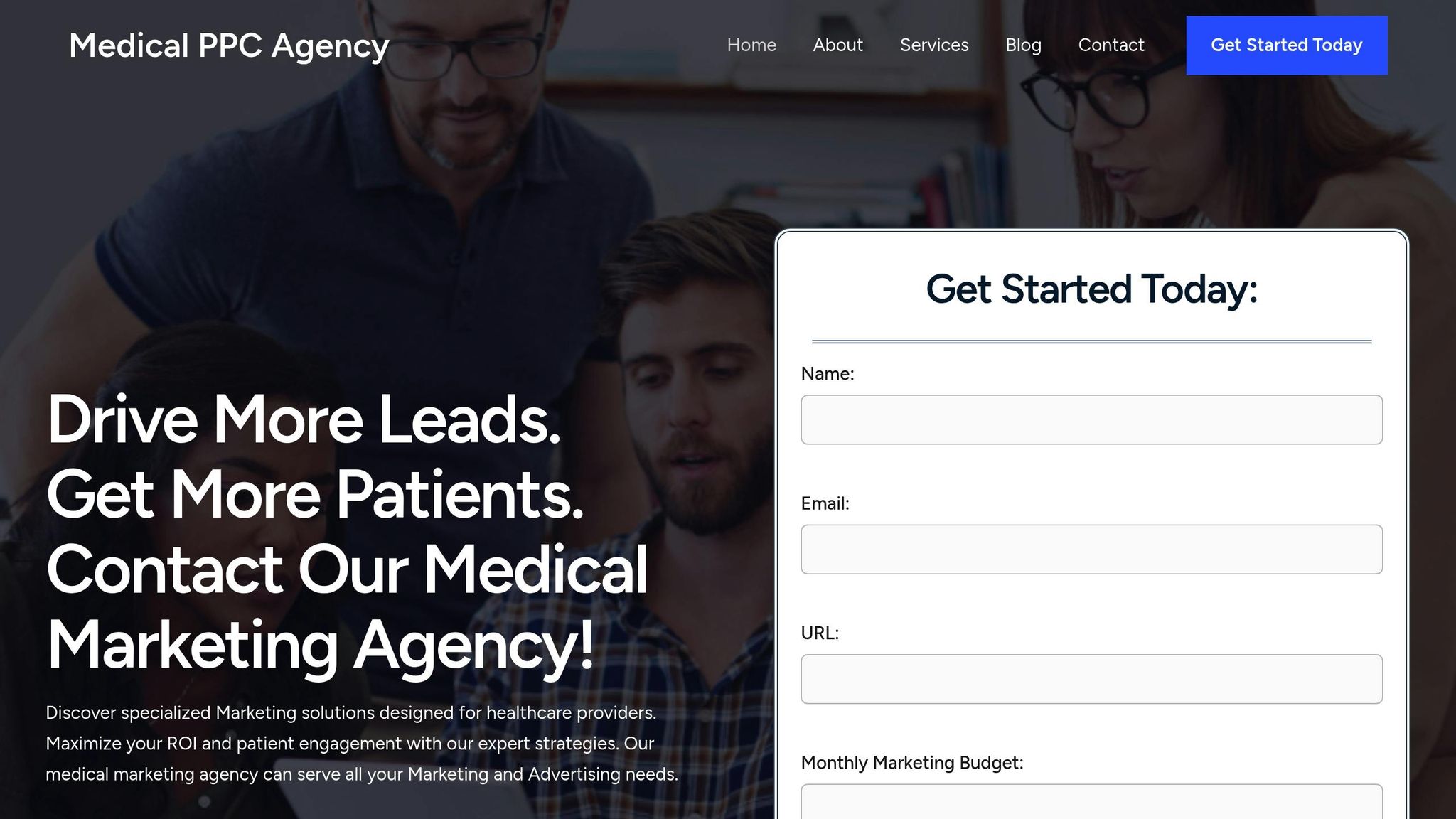
Running Google Ads campaigns while managing a medical practice can feel like juggling too many balls at once. Between caring for patients, handling administrative tasks, and staying on top of medical advancements, finding the time – or expertise – to fine-tune advertising campaigns can be a challenge. That’s where Medical PPC Agency steps in, offering tailored expertise for healthcare providers.
Medical PPC Agency specializes in creating campaigns designed specifically for medical practices. Their team understands the nuances of healthcare marketing, from identifying the most effective keywords for different specialties to crafting ad copy that complies with strict advertising regulations. They also know what it takes to turn clicks into actual patient appointments. With their deep knowledge of compliance, they ensure your campaigns stay within the rules while still delivering strong results – no small feat in a field governed by strict privacy laws and advertising standards.
Their approach focuses on what truly matters: patient acquisition. Instead of just driving traffic, they optimize campaigns to generate real outcomes like appointment bookings, phone calls, and qualified leads. They also account for the fact that patients often take more time to make healthcare decisions, tailoring strategies to fit this longer decision-making process.
Using a data-driven approach, Medical PPC Agency constantly tests and refines campaigns. They pinpoint which ad variations attract the right patients, identify high-performing geographic areas, and even adjust campaign schedules to align with peak appointment times. Their strategies are built to maximize your return on investment, not just clicks.
The agency also handles every aspect of campaign management, from budget adjustments to seasonal strategy tweaks. They even use advanced AI tools to refine patient acquisition further. Predictive analytics help identify which potential patients are most likely to schedule appointments, while automated bidding ensures your budget is working as efficiently as possible.
Medical PPC Agency offers flexible pricing plans tailored to your practice’s size and needs. Whether you’re a small practice looking for basic Google Ads management or a larger organization in need of a full-scale digital marketing solution, they provide a clear breakdown of services and budget allocation. Transparency is key – they make sure you know exactly what you’re paying for and what results to expect.
Beyond managing your Google Ads, the agency provides advanced analytics and reporting. These go well beyond standard metrics, giving you a clear picture of your advertising ROI and helping you make smarter marketing decisions. They also offer strategic consulting to ensure your website and broader digital presence work seamlessly with your ads to attract and convert patients.
Conclusion
These seven strategies can reshape how your practice attracts patients online. By combining local targeting, tailored ad extensions, strategic keyword selection, and compliant ad copy, you can effectively boost patient acquisition. Add optimized landing pages to turn clicks into scheduled appointments, and use performance tracking to ensure your campaigns run efficiently, making every dollar count. Together, these tactics can improve both the volume and quality of patient inquiries for medical practices.
The healthcare advertising landscape is always changing, requiring ongoing adjustments and strict adherence to regulations. For many practices, balancing the technical demands of campaign management – like bid optimization, keyword research, and compliance monitoring – with patient care can be overwhelming. These tasks often take up valuable time that could be better spent focusing on patients.
That’s where Medical PPC Agency steps in. They take the burden off your shoulders by managing every aspect of your campaigns. With their expertise in healthcare advertising, they ensure your ads remain compliant while driving patient acquisition. Their tiered services are designed to align with your practice’s growth, giving you the flexibility to scale as needed.
To see measurable results, start by integrating local targeting and healthcare-specific ad extensions into your campaigns. Experiment with variations of compliant ad copy, fine-tune your landing pages, and gradually enhance your tracking systems. Each small improvement builds on the last, creating a more efficient and effective patient acquisition strategy.
For even greater results, professional management can supercharge your efforts. By streamlining your campaigns and delivering higher-quality patient leads, a consistent and well-executed strategy can lead to better conversion rates and sustained growth for your practice.
FAQs
What steps can medical practices take to ensure their Google Ads campaigns comply with healthcare advertising regulations like HIPAA and FTC guidelines?
To ensure Google Ads campaigns align with healthcare regulations, medical practices need to focus on protecting patient privacy and maintaining transparency. This means avoiding the inclusion of Protected Health Information (PHI) in any part of the campaign – whether in ad copy, URLs, or conversion tracking data. It’s also crucial to make sure all landing pages are secure by using HTTPS and providing clear, easy-to-understand privacy policies.
When it comes to advertising strategies, steer clear of remarketing tactics that target sensitive health conditions or behaviors tied to PHI. Ads should also avoid making claims about treatments or services that cannot be verified or might mislead potential patients. Following these practices not only ensures compliance but also helps establish trust with your audience.
How can medical practices use ad extensions in Google Ads to boost patient engagement?
Ad extensions are an excellent tool for medical practices to make their Google Ads more engaging and informative. By including additional details in your ads, you can give potential patients the information they need to act quickly and confidently.
Here are some effective ad extensions tailored for medical practices:
- Location extensions: Display your practice’s address, making it easy for local patients to locate you.
- Call extensions: Add a clickable phone number so patients can reach your office directly with just one tap.
- Sitelink extensions: Guide users to specific pages, such as online appointment scheduling or patient testimonials.
- Callout extensions: Highlight specific features like "Same-Day Appointments" or "Board-Certified Specialists" to showcase what sets your practice apart.
These extensions not only make your ads more engaging for patients but also enhance your ad’s visibility and click-through rate, helping your practice stand out in a competitive space.
What are the best ways for medical practices to track and improve the performance of their Google Ads campaigns?
Medical practices can keep a close eye on their Google Ads campaigns and improve results by focusing on a few critical performance metrics. Key areas to monitor include click-through rates (CTR), conversion rates (like appointment bookings or phone calls), cost per conversion, and pinpointing the keywords that lead to real patient inquiries.
To refine campaigns, dive into performance data regularly, experiment with different ad copy, and fine-tune targeting settings to better connect with local patients. Tools like conversion tracking can help identify which actions bring in new patients, allowing you to shift your budget toward the strategies that work best.