Every day, over 1 billion healthcare searches happen online, but only 2%–5% of website visitors book appointments. This means many potential patients are lost. The solution? A well-designed patient booking funnel.
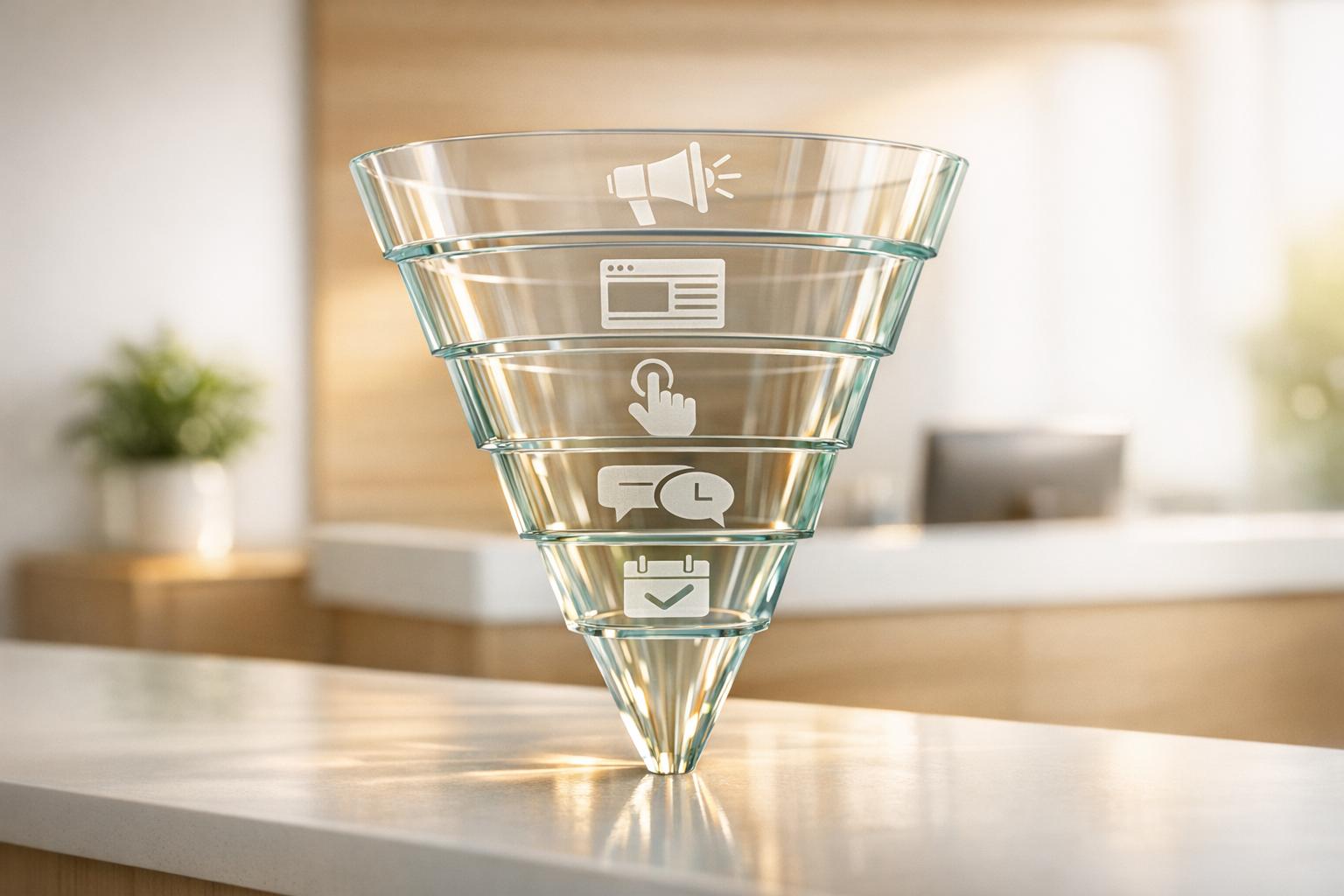
This funnel guides patients from discovering your practice to scheduling an appointment. To make it work effectively, you need to:
- Target the right audience with ads that match patient needs.
- Design specific landing pages aligned with your ads for trust and clarity.
- Simplify booking forms by asking only for essential details.
- Use automated follow-ups to reduce no-shows and keep patients engaged.
- Track and test everything to find and fix drop-off points.
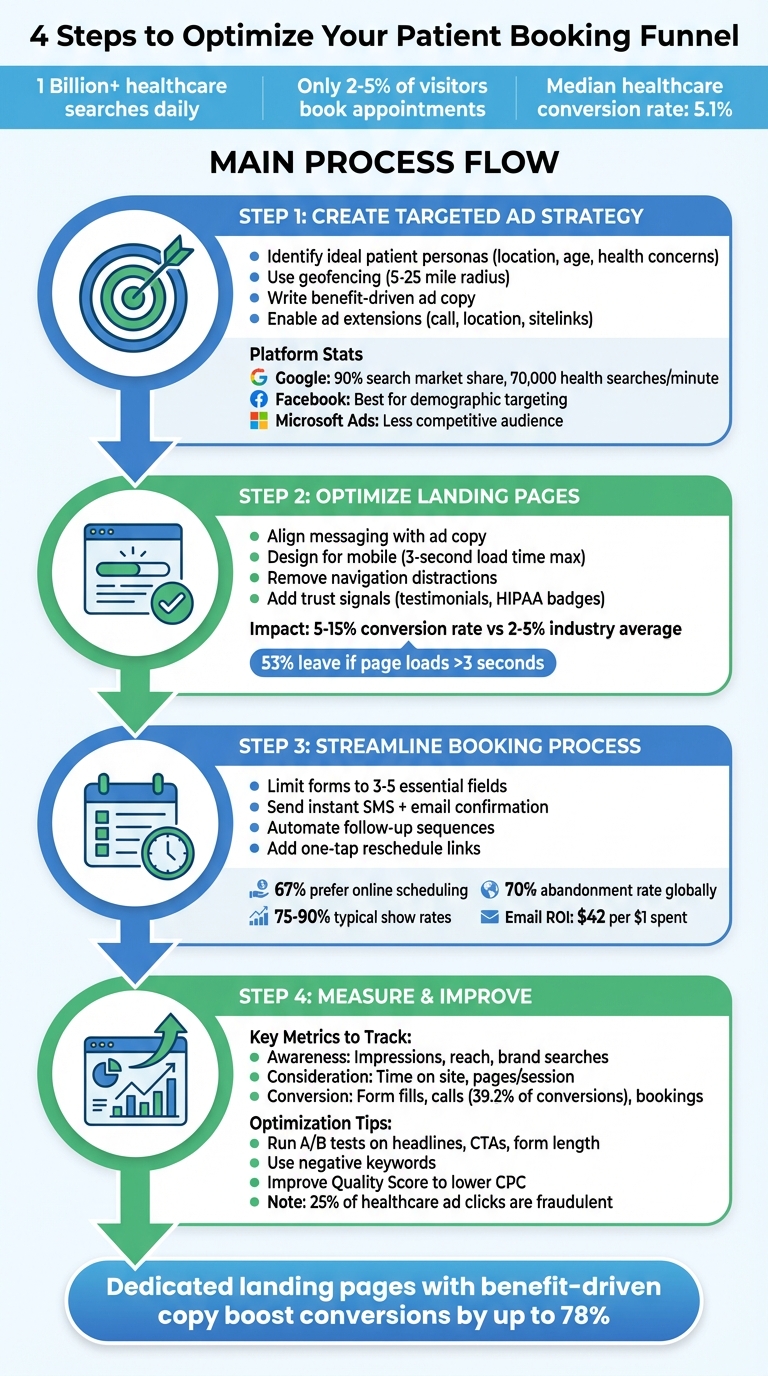
4-Step Patient Booking Funnel Optimization Process for Healthcare Practices
Step 1: Create a Targeted Ad Strategy
At Medical PPC Agency, your booking funnel begins the moment a potential patient sees your ad. The key is precise, patient-centered targeting that turns ad views into actual appointments.
Identify Your Ideal Patient to Drive Bookings
Modern healthcare marketing thrives on detailed patient personas. These personas should consider factors like location, income, health concerns, and motivations. For example, an orthopedic surgeon might focus on adults aged 50–70 searching for terms like "knee replacement specialist." This allows you to align your messaging with where the patient is in their decision-making process. Someone searching "knee pain causes" is likely just starting to understand their problem (Problem Aware), while a search for "best orthopedic surgeon Chicago" shows they’re closer to booking (Product Aware).
Use tools like geofencing to target people within a 5–25-mile radius of your practice or geo-conquesting to reach potential patients near a competitor’s location. Refine your focus further by layering in demographics such as age, gender, and parental status. Don’t forget to add negative keywords to filter out irrelevant searches and ensure your ads only reach the right audience.
With this data, craft ad copy that directly addresses patient needs and concerns.
Write Ad Copy That Speaks to Patients
Your ad copy should focus on what patients gain, not just your qualifications. Instead of saying, "Board-Certified Physician with 20 Years Experience", try something like, "Get Relief from Back Pain – Same-Day Appointments Available." This shifts the focus to patient outcomes. Use benefit-driven language, emphasizing messages like "Accepting New Patients", "No Referral Needed", or "Evening and Weekend Hours".
Headlines written in Title Case tend to catch more attention, and every ad should include a clear call-to-action, such as "Book Your Appointment Now", "Call Today", or "Schedule a Free Consultation".
"Writing persuasive ad copy means empathizing – it means understanding what your audience’s needs are at precisely the moment they encounter your ads."
- Alex Membrillo, CEO, Cardinal Digital Marketing
To increase clicks, enable ad extensions like call buttons, location details, and sitelinks. These features make it easier for patients to contact your office or book directly.
Once your ad copy is ready, choose the best platforms to reach your audience.
Choose the Right Advertising Platforms
Google Ads is a must for healthcare advertising. With nearly 90% of the global search engine market as of 2025, Google captures patients actively searching for care. In fact, there are over 70,000 health-related searches every minute – more than 1 billion daily. Use Search Ads for high-intent queries like "urgent care near me" or "LASIK consultation", and Call-Only Ads for situations where immediate contact is critical.
Facebook Ads, on the other hand, excel at targeting specific demographics and interests. This makes them ideal for building brand awareness, retargeting past visitors, or promoting elective procedures. Microsoft Ads can complement your Google campaigns, often reaching a less competitive but still valuable audience.
Here’s a quick guide to campaign types and their best uses:
| Type | Best For | Platform |
|---|---|---|
| Search Ads | High-intent services like "ER open now" | Google / Microsoft |
| Display Ads | Retargeting, brand awareness, seasonal services | Google / Meta |
| Call-Only Ads | Urgent care, same-day appointments | |
| Performance Max | Broad automated reach across multiple channels |
Match your platform to the patient’s intent. For example, someone searching "neurologist Chicago" likely needs immediate care, making Google Search Ads the ideal choice. Meanwhile, a campaign promoting flu shots might perform better with Facebook’s demographic targeting.
sbb-itb-f6ab3ee
Step 2: Optimize Landing Pages for Conversions
Once your ad grabs a potential patient’s attention, the next hurdle is the landing page. This is where interest turns into action – or doesn’t. A well-crafted landing page can make the difference between someone booking an appointment or leaving your site.
Align Landing Page Content with Ad Messaging
Your landing page and ad should feel like two pieces of the same puzzle. If your ad promises "Same-Day LASIK Consultations", the landing page headline should reinforce that specific offer – not shift focus to general eye care services. Consistent messaging builds trust and encourages visitors to take the next step.
Google Ads Quality Score heavily factors in how relevant your landing page is to the searcher’s intent. A highly relevant page not only improves your ad ranking but also reduces your cost per click. This is why generic homepages often fail in pay-per-click (PPC) campaigns. Instead, create dedicated landing pages tailored to each campaign. For example, an ad targeting "pediatric urgent care" should direct users to a page featuring pediatric-specific visuals and services – not unrelated content or images of senior citizens.
"If you clicked on an ad for pediatrics but ended up on a page with pictures of senior citizens, how would you feel? You’d think you’re in the wrong place."
- Jessica Oliver, Media Place Partners
Match your ad’s headline and call-to-action (CTA) on the landing page. If your ad says "Book Your Free Consultation", make sure those exact words are prominently displayed above the fold. Additionally, tailor each landing page to the theme of the service being promoted. This approach keeps the experience relevant and seamless for the user.
Now that your messaging aligns, let’s talk about mobile optimization.
Design for Mobile Users
Mobile users are impatient – if your page takes more than 3 seconds to load, 53% of them will leave. And for every additional second of load time, conversions drop by 20%. Clearly, speed matters.
To improve load times, compress images, use responsive layouts, and ensure buttons are large enough for easy tapping. Include clickable phone numbers for direct calls. Simplify the design by removing distracting navigation menus or external links that pull attention away from booking. The average mobile checkout process requires 120 taps and has a 27% abandonment rate, so make every interaction as straightforward as possible. Healthcare landing pages designed with these principles can achieve conversion rates of 5% to 15%, far surpassing the typical 2% to 5% industry average.
Reduce Friction in the Booking Path
The more steps you add between a visitor and a confirmed appointment, the more likely they are to drop off. Simplify your booking form by asking only for essential details – name, phone number, email, and preferred appointment time.
Build trust by placing credibility signals like patient testimonials, star ratings, and HIPAA compliance badges near the CTA button. Use bold, contrasting colors for the CTA button to make it stand out, and consider adding a "sticky" button that stays visible as users scroll.
"If something doesn’t lead to the point of your healthcare landing page, it probably means it is unnecessary."
- Jessica Oliver, Media Place Partners
Don’t stop there – test everything. A/B testing elements like headline phrasing, button colors, or the placement of testimonials can reveal what resonates most with your audience. Even small tweaks, such as switching your CTA text from "Schedule Your Appointment" to "Schedule My Appointment", can boost click-through rates.
With a streamlined booking process in place, the next step is to monitor and refine your funnel’s performance.
Step 3: Streamline the Appointment Booking Process
Getting patients to click on an ad is just the first step – what happens next can make or break the entire process. While 67% of healthcare consumers prefer the convenience of scheduling appointments online, global online abandonment rates hit around 70% in 2023. Why the disconnect? Friction during booking. Simplifying every step, from filling out forms to confirming appointments, can significantly reduce drop-offs and speed up the process.
Optimize Online Booking Forms
Keep it simple. Limit booking forms to 3–5 essential fields like name, phone number, email, and preferred appointment time. The more fields you add, the higher the risk that patients will abandon the form. Use dropdown menus for treatment options and calendar pickers for dates to make it easier. For returning patients, pre-fill fields automatically to save time.
Make sure your forms are mobile-friendly. This means using tap-friendly buttons, responsive layouts, and ensuring load times are under 3 seconds. Requiring upfront account registration can be a dealbreaker, so skip it to avoid losing potential bookings. If your booking process has multiple steps, include a progress bar so patients know how close they are to finishing.
Send Instant Confirmation
Once a patient completes the form, sending an immediate confirmation builds trust. Use both SMS and email to confirm their appointment details right away. This reassurance reduces anxiety and ensures patients know their submission went through. Make sure your SMS number is clearly displayed on your website and office materials so patients recognize it and don’t mistake the message for spam.
Tailor confirmation messages with helpful details. For instance, if the appointment is for a fasting blood test, remind patients not to eat for 12 hours beforehand. For consultations, mention any documents they should bring. Also, ensure that any automated messaging vendor you work with complies with HIPAA by signing a Business Associate Agreement (BAA).
Set Up Follow-Up Automation
Keeping patients engaged after booking is just as important as getting them to book in the first place. Automated follow-ups can reduce no-shows and improve retention. For example, send a sequence of messages: a confirmation, a reminder before the visit with directions and parking info, and a same-day reminder that includes a one-tap reschedule link. With show rates for healthcare practices typically ranging from 75% to 90%, a solid follow-up strategy can help keep those numbers high.
Post-visit follow-ups are equally valuable. Send care instructions, links to prescriptions, and a request for feedback while the experience is still fresh. Email marketing in healthcare offers an impressive average ROI of $42 for every $1 spent, making it a cost-effective way to stay connected. For patients who miss appointments or haven’t scheduled their annual checkups, trigger re-engagement messages to bring them back into the fold.
| Follow-Up Stage | Content | Purpose |
|---|---|---|
| Immediate | Confirmation with directions and parking info | Reassures patients and helps them prepare |
| Same-Day | Reminder with a one-tap reschedule link | Reduces no-shows |
| Post-Visit | Care tips, prescription links, and review requests | Builds loyalty and enhances online reputation |
| Long-Term | Annual checkup reminders and missed appointment recalls | Re-engages inactive patients |
Step 4: Measure and Improve Funnel Performance
Once your booking process is streamlined, the next step is to measure its performance and fine-tune it for better results.
Creating the funnel is just the beginning. To truly understand its effectiveness, you need proper tracking. Did you know that while the median conversion rate in healthcare is 5.1%, only 11% of inquiries at medical practices turn into actual patients? That gap often exists because many practices don’t know where potential patients drop off – or why.
Track Funnel Metrics
With your ads, landing pages, and booking systems in place, it’s time to start tracking metrics at every stage of the funnel. At the awareness stage, focus on metrics like impressions, reach, and brand search volume to see how many people are discovering your practice. During the consideration phase, look at time spent on the site, pages viewed per session, and interactions with reviews to understand how patients are researching before booking. For conversions, track form submissions, phone calls, and completed online bookings.
One critical metric to remember: 39.2% of healthcare conversions happen over the phone. Without call tracking that uses unique numbers for different marketing channels, you could lose nearly 40% of your attribution data. Also, page speed matters – a one-second delay in load time can reduce conversions by 20%. Use analytics tools to identify where patients drop off. For instance, if your ads get clicks but conversions are low, the problem might be your landing page or booking form.
| Funnel Stage | Key Metrics to Track | Purpose |
|---|---|---|
| Awareness | Impressions, Reach, Brand Search Volume | Measure visibility and interest at the top of the funnel |
| Consideration | Time on Site, Pages per Session, Review Interactions | Assess engagement and trust-building efforts |
| Conversion | Form Fills, Phone Calls, Booking Completions | Evaluate the success of acquisition strategies |
| Efficiency | CPC, CTR, Cost Per Lead (CPL) | Optimize ad spend and identify top channels |
Run A/B Tests
A/B testing helps you identify what works best by tweaking one variable at a time. Start with high-impact elements like headlines, call-to-action (CTA) buttons, or form lengths. For example, research shows that using first-person language in CTAs (like "Sign Me Up!") can perform better than second-person phrasing. You could test a shorter form that asks for just an email and phone number against a longer one that gathers more details. Or, compare the effectiveness of static images versus embedded videos in building trust. Once you’ve identified a winner, implement it and retire the losing version. Track metrics like CTR, CPC, and cost per conversion to measure the true return on your investment.
Lower Cost-Per-Acquisition
A well-optimized funnel doesn’t just improve conversions – it can also reduce costs. By consolidating campaigns, you allow machine learning to analyze real-time conversion patterns, which can lead to more leads at a lower cost-per-acquisition (CPA).
"The more consolidated you are, the higher chances of smart bidding working for you, versus a highly segmented structure."
– Alex Kemp, Director of PPC, Cardinal Digital Marketing
To further refine your efforts, integrate offline CRM data with ad platforms using closed-loop reporting. This helps algorithms focus on generating high-quality leads – those who actually become patients, not just form fillers. Improving your Quality Score by increasing CTR and ensuring landing page relevance can also lower your cost-per-click while securing better ad placements. Additionally, using negative keywords like "medical jobs" or "health advice" can help you avoid wasting money on irrelevant searches. Considering that about 25% of digital ad clicks in healthcare are fraudulent, protecting your budget from low-value traffic is crucial. Lastly, incorporating email follow-ups can make a big difference – email traffic converts at twice the rate of paid ads.
Conclusion
Improving a patient booking funnel requires continuous effort and attention to detail at every step. From creating targeted ads and designing mobile-friendly landing pages to simplifying the booking process, each element plays a role in turning interest into confirmed appointments. One key factor is maintaining consistent messaging between ads and landing pages. For instance, using dedicated landing pages with benefit-driven copy has been shown to boost conversions by up to 78%.
To refine your funnel, ongoing measurement is essential. Tools like A/B testing, conversion tracking, and cost-per-acquisition analysis help identify what’s working and what needs improvement. With 47% of internet users searching for healthcare professionals online and 70% relying on mobile devices for healthcare information, it’s clear that regular testing of headlines, CTAs, and form fields can significantly enhance your results.
Patient behavior today is more dynamic than ever. The journey to booking an appointment is no longer a straight line. Patients may enter your funnel at various stages or move back and forth between awareness and consideration before committing. This means your funnel needs to deliver value at every touchpoint. Expert insights, social proof like patient testimonials, and low-commitment actions such as downloadable health guides can engage potential patients who aren’t ready to book yet.
"A full-funnel marketing strategy allows you to maximize conversion potential while still maintaining HIPAA compliance."
– Alex Membrillo, CEO, Cardinal Digital Marketing
For healthcare practices aiming to boost appointments and strengthen their online presence, working with specialists in healthcare marketing can make all the difference. At Medical PPC Agency, we use data-driven strategies to fine-tune your patient booking funnel, ensuring that every interaction moves patients closer to scheduling an appointment.
FAQs
How can I target the right audience to boost patient bookings?
To connect with the right audience for patient bookings, it’s essential to leverage location-based targeting. This means setting a specific geographic area around your practice – like a 10–20 mile radius – or targeting particular zip codes and cities where your potential patients live. By narrowing your focus, your ads are more likely to reach people who are within a reasonable distance and likely to visit your practice.
Fine-tuning your ad campaigns with local targeting not only improves efficiency but also makes the most of your advertising budget. By concentrating on qualified leads, you increase the likelihood of attracting patients ready to book appointments, which can significantly boost your campaign results and patient acquisition.
What makes a landing page effective for booking healthcare appointments?
An effective healthcare appointment booking landing page should focus on clarity, trust, and simplicity. Start with a strong headline that immediately communicates value to the patient, like "Schedule Your Health Consultation Today" or "Expert Care, Just One Click Away." This sets the tone and lets visitors know exactly what they can expect.
Follow up with a concise explanation of what sets your service apart. Is it the convenience of online scheduling? Affordable care options? Or perhaps the expertise of your medical team? Highlight this in a way that resonates with your audience.
To build trust, include social proof such as patient reviews or testimonials. These help reassure potential patients that others have had positive experiences. Make sure your call-to-action (CTA) stands out – phrases like "Book Now" or "Request an Appointment" should be prominently displayed and easy to click.
Finally, keep the design clean and free of unnecessary distractions. A straightforward layout ensures visitors stay focused on scheduling an appointment. By combining trust-building elements, clear communication, and an intuitive design, you can create a landing page that effectively turns visitors into patients.
How do automated follow-ups help reduce patient no-shows?
Automated follow-ups play a key role in cutting down patient no-shows by keeping them informed and involved. These systems send timely reminders about scheduled appointments, making it simpler for patients to confirm or reschedule as needed.
Beyond reminders, regular communication fosters trust and makes patients feel appreciated. This sense of connection encourages them to attend their appointments, boosting attendance rates while also improving patient satisfaction and the overall efficiency of the practice.