AI is transforming healthcare PPC (pay-per-click) campaigns by focusing on patient acquisition, not just cheaper clicks. Here’s the key takeaway: AI-driven strategies like automated bidding, dynamic creative optimization, predictive analytics, and programmatic advertising improve ROI while ensuring compliance with healthcare regulations.
Why AI Matters in Healthcare PPC:
- Patient Acquisition Focus: AI identifies leads likely to book appointments, not just submit forms.
- Improved ROI: Automated bidding can boost conversion value by 14%, while predictive analytics delivers up to 30% better performance.
- Compliance: AI ensures HIPAA-compliant ad targeting and messaging.
- Efficiency: Tasks like bid management and ad testing become faster with AI, saving hours of manual work.
Key AI Strategies:
- Dynamic Creative Optimization (DCO): AI adjusts ad elements in real time, improving click-through rates by up to 31%.
- Automated Bidding: AI fine-tunes bids based on signals like location and time, reducing costs and boosting performance.
- Predictive Analytics: Analyzes data to target high-value patients before they search.
- Programmatic Advertising: Automates ad buying across platforms, ensuring ads reach the right audience at the right time.
Challenges:
- Requires quality data (e.g., CRM integration) and human oversight to avoid errors.
- Compliance with HIPAA and regulatory changes needs constant monitoring.
AI-powered PPC strategies are ideal for healthcare providers aiming to maximize patient acquisition while staying compliant. Focus on integrating tools like automated bidding and predictive analytics into your campaigns for measurable results.
AI-Driven Paid Media Strategies for Healthcare Marketing Success
1. Dynamic Creative Optimization (DCO)
Dynamic Creative Optimization (DCO) leverages AI to tailor ad elements – like images, headlines, copy, and calls-to-action – in real time. It does this by analyzing factors such as the viewer’s demographics, browsing habits, and search intent. For healthcare marketers, this means showing urgent care information to someone searching for immediate assistance, while offering elective surgery details to those conducting research. These real-time adjustments lead to measurable improvements in return on investment (ROI), as outlined below.
ROI Impact
DCO delivers impressive results. Creative assets alone contribute to 49% of the total sales impact of advertising. For healthcare advertisers, enhancing their Ad Strength from "Poor" to "Excellent" results in an average 12% increase in both clicks and conversions. Additionally, incorporating image assets into search ads can boost click-through rates by 6%, and adding business logos and names drives 8% more conversions – all without increasing the cost per conversion.
Efficiency
DCO doesn’t just improve ROI – it also makes campaign testing faster and more efficient. Instead of manually creating dozens of ad variations and waiting weeks for performance insights, AI can test thousands of combinations and adapt in real time. As Google Ads Help explains:
"AI-powered solutions can help deliver creative variations at the speed, quality, and quantity required to resonate with your customers today".
Healthcare-Specific Benefits
For healthcare marketing, DCO addresses two major hurdles: personalization and compliance. The technology allows for separate creative tracks, such as targeting healthcare professionals with clinical data while engaging patients with symptom-focused content. When it comes to compliance, DCO adjusts low-risk elements – like tone, format, and call-to-action placement – while ensuring that core medical claims remain within pre-approved guidelines. A "human-in-the-loop" approach ensures that AI-generated content is reviewed for clinical accuracy and adherence to HIPAA regulations. In regulated industries like healthcare, DCO boosts campaign efficiency while maintaining critical compliance standards.
2. Automated Bidding Strategies
Automated bidding relies on AI to fine-tune bid amounts by analyzing billions of signals, such as device type, location, time of day, browser, and operating system, to predict the likelihood of conversions. For instance, in healthcare, it might bid aggressively on urgent mobile searches like "emergency dentist near me" at 9 PM on a Saturday, while taking a more cautious approach for someone casually researching treatment options on a Tuesday morning.
ROI Impact
Switching from Target CPA to Target ROAS can lead to impressive results. Advertisers have reported a 14% boost in conversion value without increasing their spend. AI-powered bid optimization enhances cost efficiency by 85% and overall performance by 82%. Considering that B2B healthcare CPC reached an average of $4.66 in 2024 (a 10% rise), these improvements can significantly reduce patient acquisition costs.
Efficiency
Managing bids manually can take 8–12 hours, but AI-driven adjustments only require 30–60 minutes. The Pedowitz Group explains this shift well:
"AI-driven bid optimization continuously evaluates signals like conversion likelihood, competition, and time-of-day to recommend (and automate) smarter bids. Teams replace 8–12 hours of manual analysis with 30–60 minutes of AI-orchestrated adjustments."
This streamlined process is particularly advantageous for low-volume medical keywords. AI uses query-level data from the entire account to set precise bids for specialized treatments, even when there isn’t enough historical data to guide manual optimization.
Scalability
Automated bidding strategies offer flexibility depending on your goals. Maximize Conversions increases patient volume within a set budget, Target CPA ensures a stable cost-per-lead, and Maximize Conversion Value focuses on high-value actions. Over 80% of Google advertisers now use automated bidding, which typically requires at least 15 conversions within 30 days (50+ for optimal performance).
This scalability is particularly useful for healthcare providers, offering not just growth potential but also compliance and performance benefits tailored to the industry.
Healthcare-Specific Benefits
In healthcare, automated bidding aligns well with compliance needs by focusing purely on numeric optimization – an AI task considered "low-risk". Critical areas like medical claims remain under human oversight, and setting ROAS or CPA caps helps avoid overbidding in competitive niches. For practices with longer sales cycles – averaging 11.5 months in healthcare B2B – integrating CRM data into ad platforms allows AI to optimize for actual patient appointments, not just form submissions.
For healthcare providers ready to embrace these strategies, Medical PPC Agency offers customized PPC campaign management services. These solutions are designed to maximize ROI while adhering to industry-specific compliance standards.
Automated bidding works seamlessly alongside other AI strategies, creating a robust framework for optimizing healthcare PPC campaigns.
3. Predictive Analytics
Predictive analytics uses machine learning to sift through large datasets and anticipate audience behavior, giving healthcare marketers the ability to connect with potential patients even before they start actively searching. MonsterInsights sums up this proactive approach well:
"By analyzing past behavior, AI predicts future actions."
This shift takes healthcare PPC from being reactive to proactive, allowing marketers to engage with patients early in their decision-making process.
ROI Impact
Predictive analytics has a direct impact on ROI by pinpointing high-value conversions and helping marketers allocate budgets more effectively toward the most profitable patient segments. By combining first-party data with AI, marketers can see performance improvements of up to 30% and boost overall campaign efficiency by 10–13%.
One major trend is the move toward value-based bidding. Instead of focusing solely on click volume, marketers now optimize for "conversion value", which can include metrics like a patient’s predicted lifetime value. Additionally, companies that adopt advanced tools like Marketing Mix Modeling (MMM) are more than twice as likely to surpass revenue goals by at least 10%.
Efficiency
Beyond ROI, predictive analytics enhances operational efficiency. These models analyze patient journeys across every touchpoint – from the first search query to the completion of treatment – allowing marketers to optimize spending across various service lines, such as emergency care or specialized treatments. AI-driven anomaly detection can quickly identify unusual spending patterns or performance changes, enabling rapid adjustments without constant manual monitoring. AI also clusters search queries to uncover intent patterns and identify negative keywords that manual research might overlook. This automation reduces time spent on account management while improving targeting accuracy.
Scalability
Predictive forecasting enables healthcare providers to prepare for seasonal demand surges, such as flu vaccinations in the fall or increased mental health needs during the winter. With healthcare ad spending projected to hit $24.71 billion by 2026, this kind of foresight is becoming increasingly important. For example, integrating first-party customer and lead lists into ad platforms allows AI to create more refined lookalike audiences. Historical data can also be used to automate bid increases 2–3 weeks ahead of anticipated demand spikes, like allergy season or the end-of-year rush for elective surgeries. These strategies ensure that bidding aligns with demand cycles. Nicholas Van Winkle, Director of Paid Media at Cardinal Digital Marketing, highlights the value of data consolidation:
"When you do it correctly, which is to say you give the algorithm as much information as possible to find the patterns that you want it to find, then you set it up for success."
Healthcare-Specific Benefits
Predictive analytics in healthcare not only improves ROI but also aligns with HIPAA standards to protect patient privacy. Since HIPAA requires strict data handling, predictive models rely on aggregated, de-identified, or contextual signals rather than individual patient records. This ensures compliance while maintaining precise targeting. Setting guardrails, such as thresholds for manual review when impression shares on condition-related queries shift suddenly, helps prevent overspending on low-intent traffic. Additionally, moving from last-click attribution to data-driven models allows AI to more accurately credit each interaction in a patient’s journey. This is particularly useful for healthcare providers with longer sales cycles. In fact, 22% of healthcare organizations adopted domain-specific AI tools in 2025, marking a sevenfold increase from the prior year.
Medical PPC Agency incorporates predictive analytics into its AI-driven systems, enabling healthcare providers to achieve advanced targeting while staying fully compliant with privacy regulations.
sbb-itb-f6ab3ee
4. Programmatic Advertising
Programmatic advertising takes AI-driven methods like dynamic creative optimization (DCO), automated bidding, and predictive analytics to the next level by streamlining ad delivery through real-time media buying.
This approach uses AI to automate ad purchasing, removing the need for manual negotiations and outdated placement strategies [33, 34]. Instead of relying on generalized demographic assumptions, programmatic advertising taps into real-time intent data to pinpoint high-value patients and healthcare professionals (HCPs) [33, 34]. By analyzing contextual signals, the system adjusts bids on the fly, ensuring ad spend is directed toward opportunities with the highest likelihood of conversion – such as telehealth appointment bookings or patient inquiries.
ROI Impact
Programmatic advertising has demonstrated measurable success in boosting returns. For example, UCHealth saw a 35% increase in click-through rates, while a regional healthcare system reduced their cost per acquisition (CPA) by 37% using dynamic audience targeting and real-time budget adjustments. Healthcare marketers have also reported achieving a 9:1 ROI on first-time patient visits through AI-powered bidding and optimization. These results stem from the technology’s ability to prioritize high-value patients rather than merely driving up click numbers.
Efficiency
Programmatic platforms simplify the management of advertising across a broad digital landscape, including websites, mobile apps, Connected TV (CTV), and social media, all from a single dashboard [34, 37]. Automated bidding tools respond to contextual signals in real time, eliminating the need for constant manual adjustments. These platforms also reallocate budgets dynamically, shifting focus to demographics that deliver better performance as the campaign progresses [37, 3]. Alex Kemp, Director of PPC at Cardinal Digital Marketing, highlights the importance of consolidating data for better results:
"The more consolidated you are, the higher chances of smart bidding working for you, versus a highly segmented structure".
This streamlined process lays the groundwork for scaling campaigns efficiently.
Scalability
Programmatic advertising makes scaling campaigns more seamless by targeting verified, de-identified HCP audiences across multiple Demand-Side Platforms (DSPs) like The Trade Desk and DV360, as well as social media channels. Healthcare providers can use geofencing for hyper-local targeting within 5–25 miles or expand their reach nationally [37, 18]. Machine learning algorithms further enhance scalability by analyzing patient search behaviors and demographic information to create highly personalized messaging. These tools can adjust ad copy automatically to suit different economic or cultural segments without requiring manual input. Considering that one in every 20 Google searches relates to health and over 70% of patients research providers online before making decisions, programmatic advertising offers immense potential for expanding reach.
Healthcare-Specific Benefits
Programmatic contextual advertising is particularly suited to the healthcare industry’s strict compliance standards. By aligning ads with the specific medical content HCPs engage with – such as specialty journals or research platforms – it avoids relying on cookies. Instead, it uses verified, de-identified audience data and tokens to link behavioral insights while safeguarding Protected Health Information (PHI) and Personally Identifiable Information (PII). As Definitive Healthcare explains:
"Contextual targeting ensures messages reach the right clinicians, in the right professional context, while respecting privacy".
Advanced programmatic tools can also adapt to regulatory changes. For instance, they can automatically pause campaigns at risk of non-compliance and suggest HIPAA-compliant keyword alternatives. This is particularly crucial following the June 2024 guidance from the HHS Office of Civil Rights, which clarified that tracking technologies like Meta Pixels on healthcare websites often collect PHI, making traditional tracking methods a liability for covered entities.
Pros and Cons
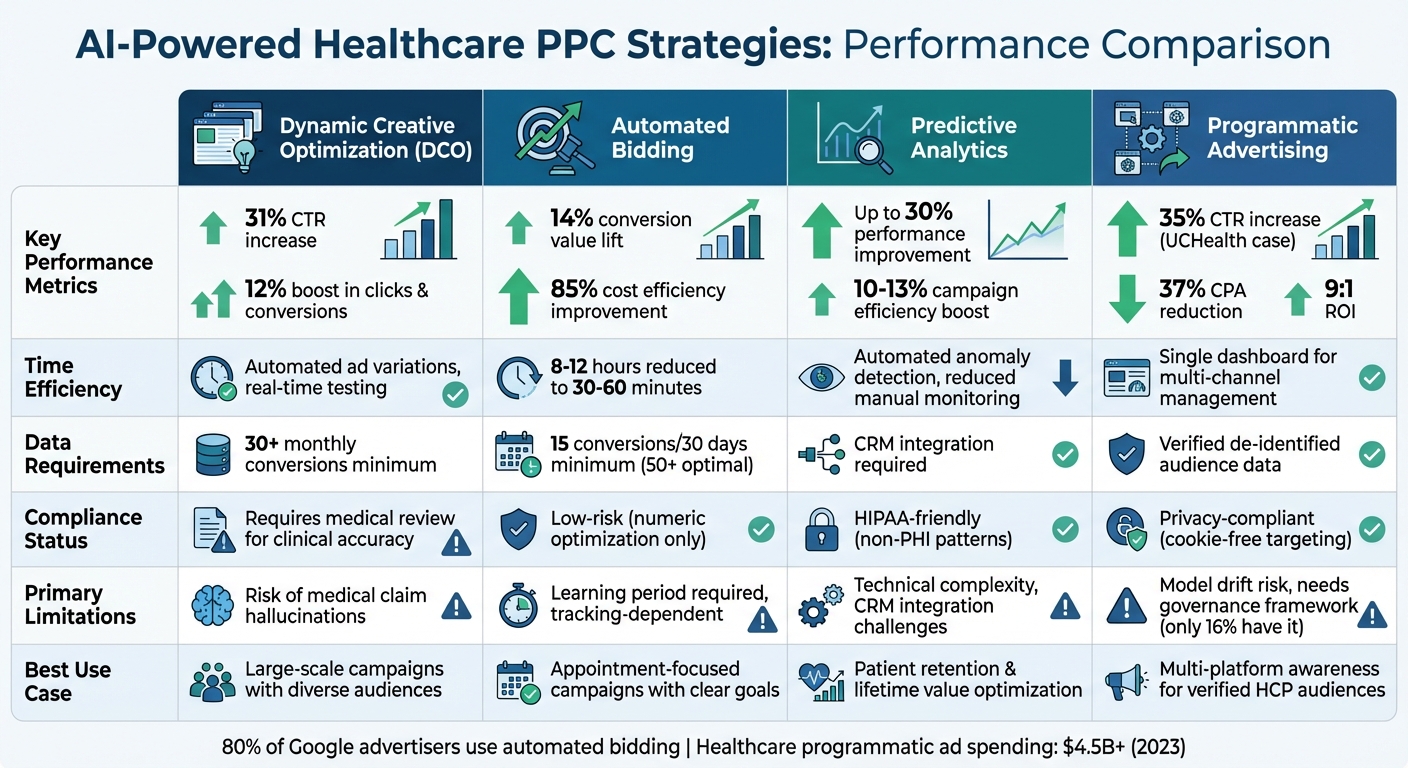
AI Healthcare PPC Strategies Comparison: ROI Impact and Performance Metrics
When it comes to healthcare PPC campaigns, different AI strategies bring distinct advantages and challenges. Here’s a closer look at their strengths and limitations.
Dynamic Creative Optimization (DCO) can significantly improve ad performance, with click-through rates (CTR) increasing by up to 31% thanks to real-time tailoring of ad elements. It also streamlines ad production by automatically generating multiple ad variations. However, DCO isn’t without its flaws. It can sometimes generate "hallucinations" – inaccurate medical claims – making human oversight essential. Additionally, it requires a substantial amount of data to function effectively, such as a minimum of 30 conversions per month.
Automated bidding strategies save time by reducing manual analysis from 8–12 hours to just 30–60 minutes. Over 80% of Google advertisers use these strategies, and those switching from Target CPA to Target ROAS report an average 14% increase in conversion value. These strategies are particularly well-suited for healthcare providers because they focus on optimizing bids and budgets rather than clinical messaging, minimizing compliance risks. However, they do require a learning period to deliver results, and broken conversion tracking can disrupt the entire system.
Predictive analytics helps identify high-value patient segments before they even begin searching, enabling providers to expand their reach through lookalike modeling. This approach works within healthcare compliance by relying on non-PHI patterns. Still, integrating CRM data with ad platforms can be a hurdle, especially for smaller practices.
Programmatic advertising offers the widest multichannel reach, with healthcare and pharma programmatic ad spending projected to exceed $4.5 billion in 2023. By using de-identified targeting methods, it ensures privacy compliance. Dr. Emily Wright, a Healthcare Compliance Consultant, underscores:
"While data can drive more personalized marketing strategies, compliance with HIPAA remains critical".
Despite its benefits, programmatic advertising faces challenges like "model drift", where performance declines without continuous monitoring. Additionally, only 16% of healthcare organizations currently have system-wide AI governance frameworks, which could lead to compliance risks.
Summary of AI Strategies
| AI Strategy | Key Strengths | Primary Limitations | Best For |
|---|---|---|---|
| Dynamic Creative Optimization | 31% CTR increase; automated ad variations | Requires medical review; needs 30+ monthly conversions | Large-scale campaigns with diverse audiences |
| Automated Bidding | 14% conversion value lift; time-saving | Brief learning period; tracking-dependent | Appointment-focused campaigns with clear goals |
| Predictive Analytics | Targets high-propensity users; HIPAA-friendly | Requires CRM integration; technical complexity | Patient retention and lifetime value optimization |
| Programmatic Advertising | Cross-channel reach; privacy-compliant | Model drift risk; needs governance framework | Multi-platform awareness campaigns for verified HCP audiences |
Conclusion
The numbers are in, and they clearly point to a winning formula for healthcare PPC success: automated bidding strategies paired with streamlined campaign structures. Advertisers using Smart Bidding report an average 14% boost in conversion value compared to manual bidding, while consolidated account setups deliver an 11% improvement in reach efficiency. With 30–50 conversions per month, AI can effectively analyze patterns and make real-time optimizations.
This data highlights a critical shift in strategy. The focus is no longer just on cost-per-lead but on genuine patient acquisition. As Alex Kemp from Cardinal Digital Marketing notes:
"The more consolidated you are, the higher chances of smart bidding working for you, versus a highly segmented structure".
This insight emphasizes the need to integrate offline CRM data into AI systems, enabling algorithms to prioritize high-value patients instead of simply chasing form fills.
To implement this strategy effectively, consider a 90-day roadmap. Start with the first 1–4 weeks focusing on establishing HIPAA-compliant guardrails. Use weeks 5–8 to pilot AI on low-risk campaigns, and by weeks 9–12, scale efforts to high-intent service lines once conversion tracking stabilizes. While AI handles bid adjustments and keyword clustering, maintain human oversight for clinical claims. As Single Grain advises:
"AI should optimize how you execute approved strategies, not decide what you are allowed to say or who you are allowed to target."
This approach ensures a balance between compliance and performance, laying the groundwork for a successful patient acquisition strategy.
For healthcare providers seeking results, Medical PPC Agency offers a proven method. By combining AI-powered tools with HIPAA-compliant tracking and service-line segmentation, their clients have achieved a 9:1 ROI on first-time visits. Their strategies include responsive search ads, predictive analytics for seasonal demand, and precise geo-targeting within a 5–25‑mile radius of facilities. Whether you’re working with a small or large budget, a well-structured AI strategy with the right safeguards can deliver measurable outcomes, allowing you to focus on what truly matters: patient care.
FAQs
How does AI help ensure compliance with healthcare regulations in PPC campaigns?
AI streamlines regulatory compliance for healthcare PPC campaigns by actively monitoring ad copy, keywords, and audience targeting to stay aligned with HIPAA, FDA guidelines, and platform-specific policies. It ensures secure tracking methods, highlights prohibited language, and produces documentation that’s ready for audits – keeping everything on the right side of compliance.
By automating these tasks, AI minimizes the chances of violations, saves valuable time, and enables healthcare providers to focus on patient care while meeting the industry’s stringent standards.
How does predictive analytics improve ROI in healthcare PPC campaigns?
Predictive analytics takes healthcare PPC campaigns to the next level by using data to predict which keywords, demographics, and locations are most likely to drive conversions. This means marketers can spend smarter, channeling budgets toward high-value opportunities while cutting back on ads that don’t perform well. The payoff? A lower cost-per-click (CPC) and higher conversion rates, which ultimately boost ROI for healthcare providers.
But it doesn’t stop there. Predictive analytics also powers dynamic audience segmentation and personalized ad strategies. By examining patterns like patient behavior, appointment scheduling trends, and seasonal health needs, AI tools create finely-tuned audience groups. These insights help craft ad copy and landing pages that speak directly to each segment, attracting patients who are ready to take action. The result is better lead quality and more efficient use of every advertising dollar.
How does programmatic advertising help healthcare providers attract more patients?
Programmatic advertising – essentially automated ad buying and placement through real-time bidding – has become a game-changer for healthcare providers. It allows them to deliver highly targeted messages to potential patients exactly when they need them. Instead of relying on broad or cookie-based targeting, this method focuses on context, like medical articles or condition-specific forums, ensuring both relevance and privacy compliance. It’s a smart way to connect patients with the services they’re already searching for.
When paired with AI-powered tools, programmatic platforms take it a step further. They can pinpoint users most likely to take action, fine-tune budgets for top-performing ads, and adjust bids on the fly. This not only improves efficiency but also cuts costs and accelerates patient acquisition – especially for time-sensitive services like urgent care or elective procedures. Medical PPC Agency leverages these cutting-edge strategies to optimize campaigns, tailor ads, and deliver measurable growth for healthcare practices.