A/B testing is a powerful way to improve healthcare PPC campaigns by identifying what works best through data-driven experiments. This method helps healthcare providers optimize ads, landing pages, and calls-to-action to increase conversions and reduce wasted ad spend.
Here’s why it matters:
- Low Click-Through Rates (CTR): Healthcare ads average a 1.79% CTR, below the 3.17% industry average.
- High Costs: Google Ads CPCs for healthcare range from $3 to $5, making every click count.
- Data-Driven Improvements: Small changes – like button colors – can boost form submissions by 25%.
Key Steps for A/B Testing:
- Set Goals: Define metrics like CTR, conversions, or cost-per-lead.
- Test One Variable at a Time: Focus on headlines, CTAs, or landing pages.
- Run Tests for 2-4 Weeks: Ensure statistically significant results.
- Analyze Results: Use metrics like CTR, conversion rates, and ROAS to determine winners.
Challenges:
- Compliance: Follow HIPAA and Google’s strict ad policies.
- Traffic Volume: Smaller practices may need longer test durations for reliable data.
- External Factors: Seasonal trends and platform updates can skew results.
By refining campaigns through A/B testing, healthcare providers can attract more patients, lower costs, and improve ROI. This guide dives deeper into setting up tests, avoiding common mistakes, and turning insights into actionable results.
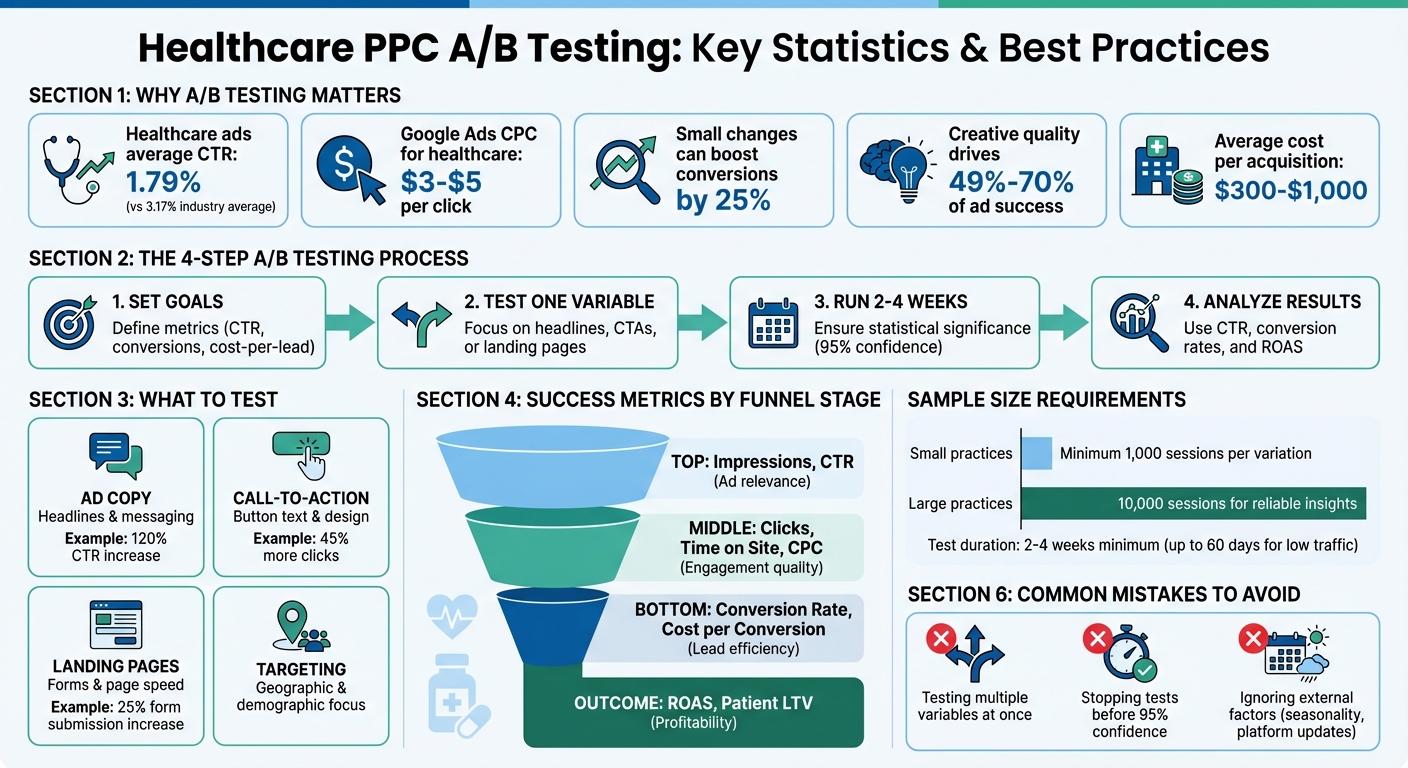
Healthcare PPC A/B Testing Statistics and Best Practices
Google Ads For Doctors | PPC For Medical Clinic – Case Study
How to Set Up an A/B Test for Healthcare PPC
Setting up an A/B test in healthcare PPC demands careful planning. You need a methodical approach that considers patient behavior and adheres to compliance standards. The goal? To gather data that leads to actionable insights.
Define Clear Test Objectives
Start by pinpointing what you want to improve. Are you aiming to increase click-through rates (CTR), boost appointment bookings, or improve your return on ad spend (ROAS)? Each goal requires tracking specific metrics. For instance, if your current CTR is 1.5%, document this as your baseline before testing. This benchmark will help you measure whether your changes deliver better results.
Your objectives should directly address your business challenges. For example, testing a new CTA button color might be tempting, but if your real issue is a high lead abandonment rate, focus on elements like form length or messaging that address patient concerns. Prioritize variables that tackle your most pressing performance gaps.
Create Test Hypotheses
A solid hypothesis gives your test a clear focus and makes the results easier to interpret. Use this format: "Based on [data], changing [element] for [audience] will increase [metric]".
For example, if you notice a high search volume for "urgent care near me", you could hypothesize: "Based on patient search behavior, we believe that changing our headline from ‘Nationally Recognized Experts’ to ‘Urgent Care Appointments in 24 Hours’ for local searchers will increase CTR by 15%, measured by Google Ads CTR data."
True North applied this approach for a healthcare client and saw impressive results. By replacing generic headlines with trending search terms, they achieved a 120% increase in CTR and a 43% boost in conversions within just two weeks.
Before finalizing your hypothesis, consider consulting your contact center staff. They interact with patients daily and can provide insights into common questions or concerns that your data might not reveal.
Select Test Variables and Duration
To get clear results, test only one variable at a time. For example, if you change both the headline and the CTA, you won’t know which adjustment made the impact.
| Variable Category | Examples | Metric |
|---|---|---|
| Ad Copy | "Specialist Appointments in 24 Hours" vs. "Nationally Recognized Experts" | Click-Through Rate |
| Call-to-Action | "Schedule a Consultation" vs. "Speak to a Specialist" | Conversion Rate |
| Landing Page | Short form vs. multi-step (breadcrumb) form | Form Completion Rate |
| Targeting | Broad geographic vs. specific zip codes | Cost Per Lead |
Run your test for two to four weeks to account for daily fluctuations. In the healthcare industry, decision cycles tend to be longer, especially for elective procedures, so you may need a full quarter of data to identify meaningful trends. To ensure unbiased results, split your traffic evenly – 50% to the control and 50% to the variation.
Avoid making other campaign changes during the test period. Adjusting bids or adding new keywords can skew your data. Also, base your test duration on your traffic volume. Smaller practices should aim for at least 1,000 sessions, while 10,000 sessions generally yield more reliable insights.
With your test framework in place, you’re ready to move on to implementing best practices for success.
Best Practices for A/B Testing in Healthcare PPC
To make your A/B testing efforts in healthcare PPC effective, it’s crucial to focus on isolating impactful changes. This involves tailoring your approach to the unique aspects of patient behavior, strict regulatory requirements, and the challenges of medical marketing.
Test One Variable at a Time
Changing too many elements at once can muddy your results. For instance, if you tweak both the headline and the call-to-action button in the same test, you won’t know which adjustment caused the improvement – or if they worked against each other. By isolating one variable at a time, you can gather clear, actionable insights.
"A/B testing is one of the powerful tactics for driving efficiency. We’re constantly asking ourselves, ‘What resonates with our audience more?’ and then using real-world performance data to find out."
- Caitlin Kennedy, Digital Marketing Specialist, True North
Make use of native A/B testing tools to divide traffic evenly – 50/50 – between variations. Always keep your original ad running as the control, as it provides the baseline to measure the impact of any changes. Avoid introducing external variables during the test period, like adjusting bids or launching new promotions, as these can skew your results.
Ensure Adequate Sample Size and Traffic
A small sample size can lead to unreliable conclusions due to random fluctuations. Aim for at least 1,000 sessions per variation, or 10,000 for larger practices, to achieve statistically sound results.
Some healthcare niches, like fertility treatments or orthopedic surgery, naturally attract smaller audiences compared to general primary care. This may require extending your test duration, with a minimum of two weeks being ideal. For services with longer patient decision cycles, be ready to test for even longer periods.
Don’t end your test as soon as you notice promising results. Wait until your data reaches a 95% confidence level to declare a winner. This ensures that your findings are reliable and not just due to chance, providing a solid foundation for making meaningful changes.
Keep Test Messaging Compliant
Regulatory compliance is a non-negotiable aspect of healthcare PPC testing. Every test variation must adhere to HIPAA, FDA guidelines, and platform-specific policies. When creating ad variations, focus on targeting general demographics – like age groups, locations, or insurance coverage – rather than sensitive medical details. For example, you can target "adults aged 45–65 in Texas", but avoid targeting "individuals searching for diabetes treatment."
Pay close attention to your landing pages. Collect only essential contact information, such as name, phone number, and email. Refrain from asking for medical history, symptoms, or treatment details unless you have explicit consent protocols and clear privacy notices in place. Use A/B testing tools that sign a Business Associate Agreement (BAA) and offer data encryption with TLS 1.2 or higher.
Standard tracking pixels can complicate compliance. Configure your analytics to capture only high-level metrics – like session duration or campaign source – while avoiding the collection of sensitive data such as call content or identifiable patient details. This is critical, especially since 33% of executives cite privacy concerns as a major obstacle to using data for optimization.
Finally, document every step of your testing process. Keep timestamped records of campaign decisions, platform certifications, and consent protocols. These records not only ensure compliance during audits but also serve as a valuable resource for refining your approach over time.
Once you’ve established compliant and controlled test conditions, you’re ready to analyze the results and use them to continuously improve your campaigns.
How to Analyze A/B Test Results
After setting up and running your A/B test, the next step is to analyze the results in a way that leads to meaningful improvements. This involves understanding statistical principles, using clear performance metrics, and maintaining a detailed log of past experiments. These steps not only refine future campaigns but also align with patient acquisition goals and regulatory requirements.
Measure Statistical Significance
Statistical significance helps you determine if the difference between your control and variant is real or just a fluke. A key metric here is the p-value, which indicates the likelihood that the observed difference happened by chance. For most cases, a p-value under 0.05 (or a 95% confidence level) is the benchmark for significance. However, when it comes to healthcare PPC, aim for at least 90% confidence – though 95% is the gold standard.
It’s crucial to avoid checking your data too often during the test. Frequent peeking increases the chance of errors and can distort the p-value. Instead, decide on your sample size before starting and stick to it. Tests should generally run for two to eight weeks, but avoid going beyond two months. Why? Cookies might reset or get deleted, which can mess up your data.
"The p-value statistic, which is the basis for claiming statistical significance, is by default applicable only to cases where it is calculated after a predetermined number of observations are completed." – Georgi Georgiev, Managing Owner, Web Focus
Statistical significance is just the beginning. Even if your results are significant, ask yourself if the improvement is meaningful. For instance, a 2% jump in click-through rate might seem exciting, but if it doesn’t lead to more patient acquisitions, it might not be worth acting on.
Once you’ve confirmed the significance, the next step is identifying which variation performed better and why.
Identify Winning Variations
Statistical significance tells you the results are valid, but you still need to figure out which variation actually performed best. Focus on key metrics to make this determination – such as click-through rate (CTR), conversion rate, cost per conversion, return on ad spend (ROAS), and patient lifetime value (LTV).
Here’s a breakdown of how these metrics fit into different stages of the funnel:
| Metric Category | Key Metrics | Purpose in Healthcare PPC |
|---|---|---|
| Top of Funnel | Impressions, CTR | Assess ad relevance to patient searches |
| Middle of Funnel | Clicks, Time on Site, CPC | Measure traffic cost and engagement quality |
| Bottom of Funnel | Conversion Rate, Cost per Conversion | Gauge efficiency in generating patient leads |
| Financial Impact | ROAS, Patient LTV | Evaluate overall profitability and long-term value |
Keep in mind, a high CTR doesn’t always mean success. For example, some keywords might attract users who are just researching rather than booking appointments. That’s why it’s important to analyze performance across the entire funnel to get the full picture.
Document Results for Future Campaigns
Once you’ve identified the winning variation, it’s time to document your findings. A centralized log can help you track insights and avoid repeating mistakes. Use a spreadsheet or dashboard to record test details, including dates, hypotheses, variables, and outcomes. Don’t just focus on the winners – knowing what didn’t work is equally valuable.
Past results can guide future campaigns. For instance, if messaging focused on specific conditions outperformed convenience-focused messaging by 41% in one test, apply that insight to refine messaging in other campaigns. Once you’ve nailed down a winning variation, create a plan to roll it out across all relevant campaigns.
"The more tests you conduct, the longer the list of lessons becomes." – Optimizely
sbb-itb-f6ab3ee
Common A/B Testing Mistakes to Avoid
Once you’ve set up your A/B test and followed best practices, it’s equally important to sidestep some common mistakes that can derail your efforts. Even seasoned healthcare marketers can fall into these traps, wasting both time and budget.
Testing Multiple Variables at Once
Changing too many elements at once – like a headline, image, and call-to-action – creates confusion about what actually drove the results. As PPC.io explains, "As soon as you start changing more than one element, it becomes impossible to know what caused the difference in result". If your test variation outperforms the original, you’ll have no idea which change made the impact.
The solution? Focus on testing one variable at a time. For instance, if you’re testing a headline, keep the image, description, and landing page consistent across all versions. Start with elements that have the most potential to influence performance, such as your offer or landing page layout. Research shows that high-quality ad creative alone can drive up to 49% of incremental sales.
Stopping Tests Too Early
Ending a test too soon – especially when early results look promising – is a big no-no. Without reaching statistical significance (usually a 95% confidence level), your data might not accurately represent audience behavior. Premature conclusions can lead to decisions based on misleading trends.
To avoid this, set clear success metrics and a minimum test duration before you begin. For smaller practices with less traffic, you might need to extend the test up to 60 days to ensure reliable results while accounting for external variables. Patience is key here; stick to the plan.
Overlooking External Factors
A/B tests don’t happen in isolation. Things like seasonal trends, platform updates, or even news events can skew your results. For example, a cardiology clinic might see a rise in conversions during American Heart Month simply due to increased awareness, not necessarily because of the ad copy. Additionally, recent privacy updates from Apple and Google have altered how conversion data is tracked, potentially obscuring the full patient journey.
To minimize these influences, avoid making major campaign changes – such as adjusting budgets or adding keywords – while your test is running. Make it a habit to document your hypothesis, results, and any external factors, so you can compare your findings against historical data. This will help you separate real performance improvements from temporary trends.
| Mistake | Impact | Prevention Strategy |
|---|---|---|
| Testing Multiple Variables | Hard to identify which change drove results | Test one variable at a time (Variable Isolation) |
| Stopping Tests Early | Results may lack statistical significance | Run tests for at least 14–21 days with 5,000+ impressions per variant |
| Ignoring External Factors | Results can be skewed by outside influences | Track seasonality, platform updates, and market changes |
How to Optimize Healthcare PPC Campaigns Using A/B Tests
Once you’ve gathered insights from your A/B tests, the next step is putting them into action to boost patient acquisition and improve your return on investment (ROI).
Improve Landing Page Performance
Your landing page is where the magic happens – it’s where potential patients decide to take the next step. Testing specific elements can significantly increase conversions. Start with your headline. Ensure it mirrors your ad copy to assure visitors they’re in the right place. Try experimenting with benefit-driven headlines like "Get Back to Walking Pain-Free" versus more clinical language.
Focus on your call-to-action (CTA) buttons. Research shows that buttons designed as CTAs can drive 45% more clicks than plain text links. Test urgent language like "Speak to a Specialist Now" against softer alternatives such as "Schedule a Consultation Today." Even small design tweaks can make a difference – adding an arrow icon to a CTA button has been shown to increase click-through rates by 26%. For example, in May 2025, a hospital system working with True North tested more urgent CTAs and saw a 22% increase in clicks. Color also plays a role: red buttons have outperformed green ones by 21%. One healthcare provider switched their button color from blue to orange and saw a 25% increase in form submissions.
Streamline your forms to reduce friction. Shorter forms or multi-step intake forms using the "breadcrumb technique" can make the process less overwhelming. Also, test what appears above the fold – adding white space around your CTA can boost conversions by as much as 232%.
Don’t overlook page speed. Even a one-second improvement in load time can lead to a 2% increase in conversions. Use tools like heatmaps and session recordings to see where users are focusing or dropping off.
| Element to Test | Potential Impact | Best Practice |
|---|---|---|
| Headline | CTR & Relevance | Match ad copy and emphasize benefits |
| CTA Button | Conversion Rate | Test urgent language and design tweaks |
| Form Length | Lead Quality/Volume | Simplify with breadcrumb navigation |
| Social Proof | Trust & Credibility | Add patient reviews and SSL badges |
| Page Speed | Bounce Rate | Aim for faster load times |
Testing these elements can make your landing pages more effective, but your ad copy is just as crucial for engaging patients.
Refine Ad Copy for Patient Engagement
Your ad copy serves as the first impression of your practice.
"Even small tweaks in language can make a big difference in ad engagement. With healthcare, it isn’t just about getting eyes on your ads; it’s about earning trust and inspiring action." – Caitlin Kennedy, Digital Marketing Specialist, True North
Start with your headlines. In May 2025, True North helped a healthcare client whose metrics were declining. By testing trending search terms in headlines against their existing ads, the client saw a 120% increase in click-through rates (CTR) and a 43% boost in conversions over two weeks. This shows the value of testing what patients are actively searching for rather than sticking solely to brand messaging.
Compare condition-specific messaging with convenience-focused messaging. For instance, True North tested social media ads for a hospital system in 2025. One ad emphasized convenience ("Urgent Care Near You"), while another highlighted specific conditions ("Knee Pain Relief, Sprains, and More"). Although engagement was similar, the condition-focused ad increased conversion rates by 41% – from 4.08% to 5.77%.
Your unique value proposition also matters. Test different priorities, like "Specialist Appointments in 24 Hours" (speed) versus "Nationally Recognized Experts" (authority). One of these will resonate more with your audience, but you won’t know until you test.
Use second-person language in descriptions (e.g., "You") and experiment with first-person CTAs (e.g., "Sign Me Up" or "Get My Results"). Additionally, compare benefit-driven phrases like "Recover Faster" to feature-focused ones like "Advanced Robotic Surgery".
Match Campaigns with Patient Intent
After optimizing your landing pages and ad copy, aligning campaigns with patient intent is the next step. A/B testing ensures your messaging matches what patients are searching for, improving both conversion rates and Quality Scores. This alignment boosts ad rankings and reduces cost-per-click.
Ensure your ad and landing page headlines complement each other to build trust and reduce bounce rates. Testing value propositions against patient intent can also yield insights. For example, high-intent searches like "emergency dentist" or "urgent care near me" call for direct, action-oriented language and urgent CTAs. On the other hand, research-based searches like "symptoms of Lyme disease" benefit from educational content that builds trust before prompting action.
The numbers back this up: PPC traffic converts 50% better than organic search traffic. Heatmaps can help you pinpoint focus areas to refine layouts. And with around 70% of search ad impressions in the U.S. coming from mobile devices, ensure your campaigns are mobile-friendly.
Creative quality is key, driving 49%–70% of a digital ad’s success. By continuously testing and refining your landing pages, ad copy, and intent alignment, you can turn your A/B testing insights into measurable gains in patient acquisition and ROI.
Medical PPC Agency applies these data-driven strategies to help healthcare providers engage patients effectively and achieve their goals.
Conclusion: A/B Testing for Healthcare PPC Success
A/B testing is an ongoing process that separates high-performing healthcare campaigns from those that waste money on guesswork. Research shows that creative quality contributes to 49% to 70% of an ad’s success, and even small adjustments – like changing a button color – can increase form submissions by 25%. By relying on statistical evidence, you can identify the most effective headlines, CTAs, and landing page designs that encourage patient actions. These insights are the foundation for continuously improving your campaigns.
As Samuel Edwards, Chief Marketing Officer at PPC.co, puts it:
"Split testing should be a continuous endeavor… there’s always room for improvement and you can always do better." – Samuel Edwards
Healthcare providers who achieve long-term success treat each winning variation as a stepping stone, building a library of testing knowledge over time. With more than 70% of patients researching healthcare providers online before making a choice and about 1 in 20 Google searches being health-related, the potential for refining your messaging is enormous. Incorporating these testing insights into every campaign adjustment ensures you stay ahead of the competition.
To maximize results, focus on elements that greatly influence patient decisions. Test impactful factors like offers, headlines tailored to patient intent, and landing pages designed for smooth user experiences. Make sure to isolate one variable at a time, run tests for at least two weeks to gather statistically significant data, and use tools like heatmaps to identify areas where users drop off. Considering that the average cost per acquisition in this field ranges from $300 to $1,000, these optimizations can significantly improve your ROI without increasing ad spend.
Medical PPC Agency applies these data-driven techniques to help healthcare providers enhance patient acquisition efforts while reducing costs. By prioritizing continuous testing and refinement, your campaigns can achieve measurable, lasting success.
FAQs
How does A/B testing help increase ROI for healthcare PPC campaigns?
A/B testing is a powerful tool for healthcare marketers, offering a way to test variations of ad copy, landing pages, and audience targeting to see which performs better. By pinpointing what resonates most with your audience and cutting out what doesn’t, you can boost click-through rates, appointment bookings, and conversions – all while getting the most out of your PPC budget.
This method ensures your advertising dollars are used wisely, helping you bring in more patients, grow your practice, and minimize unnecessary spending.
What mistakes should healthcare providers avoid when running A/B tests in PPC campaigns?
When running A/B tests for healthcare PPC campaigns, there are a few common mistakes you’ll want to steer clear of to get results you can actually trust:
- Testing too many variables at once: Stick to testing one specific element at a time – like a headline or a call-to-action (CTA). This way, you’ll know exactly what’s responsible for any performance changes.
- Not gathering enough data: Make sure your test collects enough traffic and runs long enough to deliver statistically meaningful results. Without sufficient data, your conclusions might be off.
- Mismatched ad and landing page content: Your ad copy should align seamlessly with the landing page experience. If there’s a disconnect, it can confuse users and mess up your conversion data.
- Ignoring compliance requirements: Be careful not to include prohibited medical claims or share sensitive patient information. Missteps here can lead to ad disapprovals – or worse, HIPAA violations.
By avoiding these pitfalls, you’ll set yourself up for accurate insights that help attract more patients while making the most of your ad budget.
How do healthcare compliance regulations affect A/B testing in PPC campaigns?
Compliance regulations are a cornerstone of A/B testing in healthcare PPC campaigns, ensuring both legal and ethical standards are upheld. Laws like HIPAA and the HITECH Act strictly forbid the use of protected health information (PHI) unless proper safeguards are in place. This means that testing elements involving personal health data – like patient names or medical conditions – is off-limits. Instead, you can safely experiment with aspects such as ad copy, images, call-to-action buttons, or landing page layouts, provided no PHI is involved.
The tools you use for A/B testing must also align with HIPAA requirements. Features like encryption, audit logs, and data segregation are a must. If you’re working with third-party platforms, a Business Associate Agreement (BAA) is essential to ensure compliance. Beyond HIPAA, regulations from the FDA and advertising policies from platforms like Google further limit targeting options, particularly when it comes to medical conditions. To stay compliant, focus on broader demographic or geographic factors, such as age groups, zip codes, or insurance coverage.
When reviewing the results of your tests, it’s important to use de-identified and aggregated data to safeguard patient privacy. Metrics like total clicks, cost-per-lead, and conversion rates can still deliver actionable insights while keeping your campaigns within the bounds of compliance. By following these rules, healthcare providers can refine their PPC strategies effectively, all while maintaining the highest legal and ethical standards.