
Healthcare practices face a key decision: focus on seasonal PPC campaigns to target demand spikes or invest in year-round PPC campaigns for steady patient acquisition. Seasonal campaigns excel during predictable peaks like flu season or year-end elective surgeries, while year-round PPC ensures consistent visibility for services like primary care and chronic condition management.
- Seasonal PPC: Maximizes ROI during high-demand periods but risks reduced visibility during slower months. Best for time-sensitive services like flu shots or weight-loss programs.
- Year-Round PPC: Builds trust and attracts steady patients but requires continuous spending and monitoring. Ideal for services with consistent demand, like primary care or chronic care.
Quick Comparison:
| Aspect | Seasonal PPC | Year-Round PPC |
|---|---|---|
| Primary Goal | Boost short-term conversions | Ensure steady patient flow |
| Budgeting | Variable by demand peaks | Predictable monthly spend |
| Best Use Cases | Elective surgeries, flu shots | Chronic care, family medicine |
| ROI in High Demand | High, but CPCs may increase | Steady, with potential dips during peaks |
| Visibility | Limited during off-peak times | Consistent year-round |
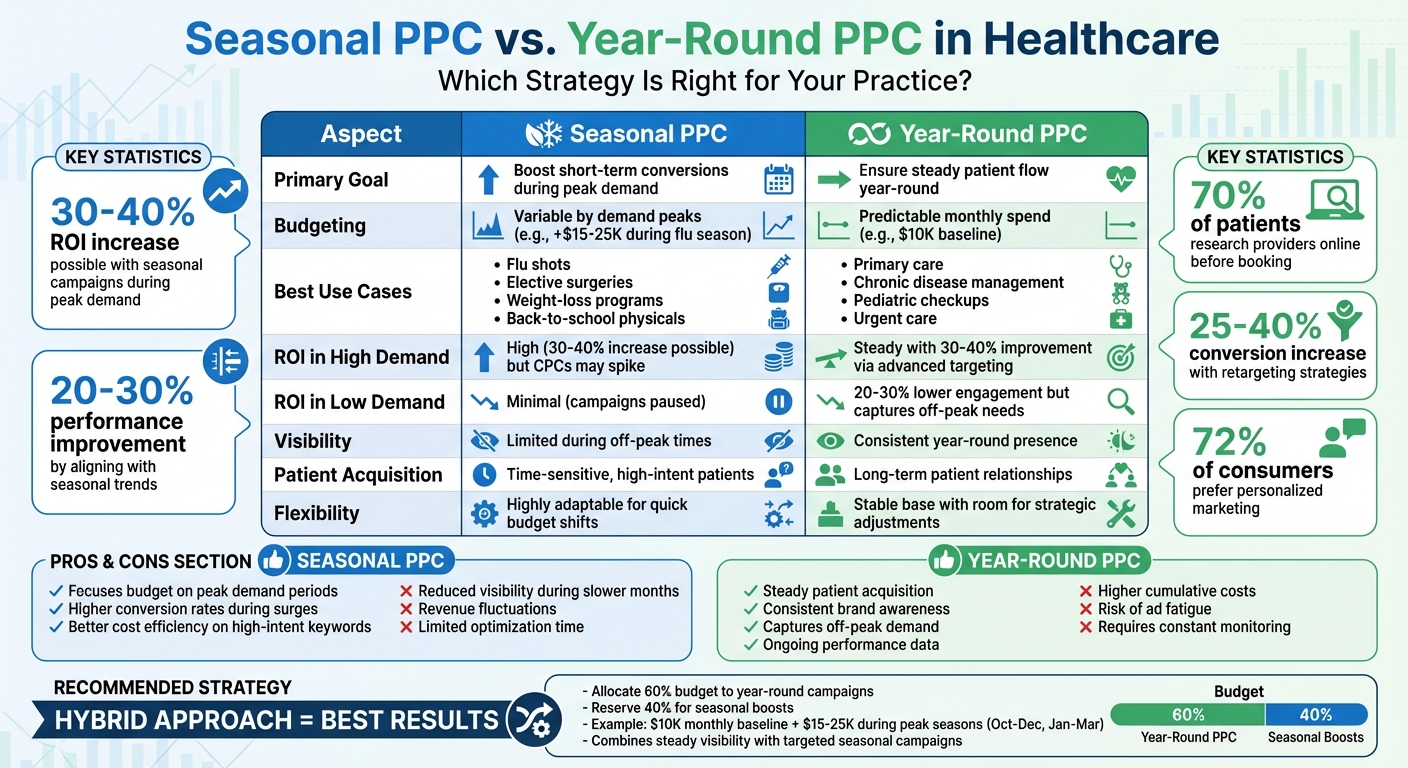
For most practices, a hybrid strategy – combining year-round PPC with seasonal boosts – delivers the best results. This approach balances steady visibility with targeted campaigns during peak demand, ensuring efficient use of your advertising budget.
Seasonal vs Year-Round PPC Campaigns in Healthcare: Complete Comparison Guide
Healthcare PPC Advertising Essentials
Seasonal PPC Campaigns: Benefits and Drawbacks
In a world where healthcare needs ebb and flow, seasonal PPC campaigns focus budgets on periods of peak demand. This strategy ensures your ads appear when patients are actively searching for services like flu shots, allergy treatments, back-to-school physicals, or January weight-loss programs. By concentrating efforts during these high-demand times, businesses can maximize returns while navigating specific operational challenges.
One major upside is the potential to increase campaign ROI by 30–40%. For instance, when someone searches "flu shot near me" in October, they’re often ready to schedule an appointment right away. Even if competition pushes up the cost per click (CPC) during these periods, the overall cost per acquisition tends to drop. Starting campaigns 2–4 weeks ahead of anticipated surges can also help secure a competitive edge before others ramp up their efforts.
That said, seasonal PPC isn’t without its challenges. Pausing campaigns during off-peak times can reduce visibility, potentially steering patients toward competitors. This fluctuation in demand can lead to unpredictable appointment volumes and revenue, making staffing and cash flow harder to manage. Additionally, the increased competition during peak seasons often drives up click costs, and the short time frame for optimization leaves little room for error. A poorly performing ad or landing page could quickly drain your budget.
Pros and Cons of Seasonal PPC
| Advantages | Disadvantages |
|---|---|
| Focuses budget on peak demand periods, boosting ROI. | Reduced visibility during slower months. |
| Reaches patients when they’re ready to take action, improving conversion rates. | Revenue and appointment volumes can fluctuate significantly. |
| Balances higher CPC with better cost efficiency on high-intent keywords. | Intense competition during peaks may require higher budgets. |
| Seasonal messaging enhances ad relevance, increasing click-through rates and quality scores. | Limited time for optimization can lead to wasted spending. |
| Targets niche, long-tail keywords with less competition year-round. | Interrupts continuous brand presence, risking loss of generic search traffic. |
Weighing these pros and cons is crucial when deciding between seasonal and year-round PPC strategies in healthcare.
Blending seasonal campaigns with evergreen PPC can help maintain consistent branding and patient engagement. Up next, we’ll explore how year-round PPC campaigns stack up against this approach.
Year-Round PPC Campaigns: Benefits and Drawbacks
Running PPC campaigns all year ensures your practice stays visible every single day. This approach is particularly effective for services people need regularly, like primary care, pediatric checkups, or managing chronic conditions such as diabetes or heart disease. Whether someone searches for "pediatrician near me" in July or "diabetes specialist" in March, your ads are ready to meet that demand. This continuous presence not only attracts a steady stream of patients but also strengthens your brand’s reputation.
One of the biggest perks of year-round PPC is consistent lead generation. You won’t need to scramble to start campaigns when demand spikes, nor will you lose momentum during slower periods. Over time, this steady visibility builds trust and positions your practice as a reliable option for healthcare. Considering that 70% of patients research providers online before booking, staying visible matters. Advanced targeting can improve ROI by up to 40%, and retargeting strategies can increase conversions by 25–40%.
However, this strategy comes with higher costs since you’re spending on ads continuously. During slower periods, like summer vacations, engagement might drop while costs per click (CPCs) remain steady, potentially reducing ROI by 20–30%. To keep campaigns efficient, you’ll need to frequently update bids, refresh ad copy, and closely monitor performance to avoid overspending or ad fatigue. Using long-tail keywords like "heart surgery recovery time" alongside geo-targeting can help improve efficiency and control costs. For practices focusing on ongoing healthcare needs, year-round PPC ensures you’re not losing patients to competitors during quieter months.
Here’s a quick comparison of the pros and cons to give you a clearer picture:
Pros and Cons of Year-Round PPC
| Advantages | Disadvantages |
|---|---|
| Steady patient acquisition for services like primary care and chronic condition management. | Higher cumulative costs due to continuous ad spending. |
| Keeps your practice top-of-mind with consistent brand awareness. | Requires careful budget management to avoid overspending during slow periods. |
| Captures demand during off-peak times, reducing missed opportunities. | Risk of ad fatigue if campaigns aren’t refreshed regularly. |
| Provides ongoing data for long-term performance improvements. | Engagement may drop during low-traffic periods without bid adjustments. |
| Supports retention efforts, helping to build long-term patient relationships. | Demands constant monitoring and optimization to stay effective. |
Year-round PPC campaigns offer a stable foundation for visibility that seasonal strategies can’t always provide. Up next, we’ll dive into a side-by-side comparison of both approaches to help you decide which strategy – or combination – best suits your practice.
Seasonal PPC vs. Year-Round PPC: Side-by-Side Comparison
When deciding between seasonal and year-round PPC strategies, it’s all about aligning with your practice’s goals and patient needs. Seasonal PPC shines during predictable demand spikes, like flu season or elective surgery periods, while year-round PPC ensures steady visibility for services like primary care, chronic disease management, or urgent care.
Seasonal PPC: A Focused Push
Seasonal campaigns are perfect for short bursts of high patient intent. These campaigns often deliver higher conversion rates during peak times, but they come with increased competition, which can drive up cost-per-click (CPC). The payoff? A surge in patients seeking time-sensitive services. However, these campaigns may not contribute to long-term patient retention, as many leads are focused on immediate needs.
Year-Round PPC: A Consistent Presence
Year-round PPC is all about stability. It keeps your practice visible every day, capturing patients who need care regardless of the season. CPCs are typically more predictable, and you can continuously refine performance. While engagement might slow during off-peak times, strategic adjustments to bids and ad creatives can help maintain momentum. Plus, year-round PPC tends to attract patients who are more likely to return for future visits, boosting lifetime value.
Budgeting and Flexibility
Seasonal PPC allows for quick budget adjustments, letting you ramp up spending during key periods and scale back when demand drops. On the other hand, year-round PPC provides a steady foundation, supporting ongoing tweaks and optimizations. Many practices find success with a hybrid approach, allocating a consistent monthly budget (e.g., $10,000) for core services and layering in seasonal boosts, such as $25,000 from October to December or $20,000 from January to March.
Comparing the Two Approaches
Here’s a breakdown to help you decide which strategy works best for your practice:
| Aspect | Seasonal PPC | Year-Round PPC |
|---|---|---|
| Primary Goal | Maximize conversions during high-demand windows | Maintain consistent patient volume and visibility |
| Budgeting Approach | Variable: higher spend during peaks, low/off-season | Stable: predictable monthly budget with tweaks |
| ROI in High Demand | High, but CPCs may increase | Steady; may dip slightly without bid adjustments |
| ROI in Low Demand | Minimal or none (campaigns paused/scaled down) | Lower engagement but captures off-peak needs |
| Patient Acquisition | Time-sensitive, elective procedures | Chronic care, primary care, and urgent care |
| Flexibility | Highly adaptable for quick shifts | Stable base with room for strategic adjustments |
| Scalability | Scales well during peak periods | Supports long-term growth across services |
| Best Use Cases | Flu shots, weight loss programs, elective surgeries | Chronic disease, family medicine, urgent care |
The Hybrid Strategy Advantage
For practices offering both elective procedures and essential care, blending seasonal and year-round PPC often delivers the best outcomes. By segmenting campaigns by service line and using historical data to forecast demand, you can allocate budgets dynamically. This approach ensures your core services remain visible year-round while capitalizing on seasonal opportunities when patient intent spikes.
Medical PPC Agency specializes in crafting these hybrid strategies, helping practices balance consistent visibility with high-impact seasonal campaigns. Up next, we’ll dive into how to choose the right PPC strategy for your specific needs.
sbb-itb-f6ab3ee
How to Choose the Right PPC Approach for Your Practice
Deciding on the best PPC strategy for your practice depends on its specific characteristics and patient demand patterns. Start by evaluating your practice type and the nature of your services. For instance, urgent care clinics often experience predictable seasonal surges. Flu season, which typically spans from October to February, brings a rush of patients, while back-to-school physicals peak in July and August. Travel vaccine requests, on the other hand, tend to rise during the summer. For these types of practices, seasonal PPC campaigns are a smart choice, focusing ad spend during high-demand periods and scaling back when patient flow naturally slows.
In contrast, primary care practices that focus on services like annual checkups, chronic disease management, or wellness visits often benefit from year-round PPC campaigns. These ensure a steady stream of patients by maintaining consistent visibility throughout the year. Matching your PPC strategy to your service offerings and patient demand is the first step in crafting an effective approach.
Align your strategy with your service offerings. For example, a pharmacy might focus on promoting hay fever treatments in the spring, travel vaccines in the summer, and flu shots in the fall – clearly seasonal services. However, if the pharmacy also provides routine services like prescription refills or ear wax removal, those require constant visibility. In such cases, a hybrid approach works well. This strategy allows you to increase ad spend during peak times while maintaining a consistent baseline for year-round services.
Use data to inform your decisions. Tools like Google Keyword Planner can help you identify search trends and demand spikes. If you notice seasonal patterns – such as a rise in searches for "orthopedic surgery" in November and December as patients aim to use up their insurance benefits before the year ends – seasonal PPC might be the way to go. On the other hand, if search volumes for your services remain steady throughout the year, a year-round PPC strategy may yield better results. Monitor key metrics such as click-through rates, cost-per-acquisition, and conversion rates during a testing phase to refine your approach.
Seasonal PPC offers the flexibility to allocate higher budgets during peak periods and reduce spending during slower times. Meanwhile, year-round campaigns ensure your practice remains consistently visible. Many practices find success with a blended strategy, combining a steady baseline for essential services with increased investment during seasonal demand surges.
For a tailored approach, agencies like Medical PPC Agency specialize in creating data-driven strategies that balance long-term visibility with seasonal demand. Their team evaluates your practice’s workflow, patient acquisition data, and seasonal trends to recommend the right mix of campaigns across platforms such as Google Ads and Facebook Ads. Whether you need AI-driven solutions for continuous growth or geo-targeted seasonal campaigns to handle urgent care spikes, they craft strategies designed to meet your goals and budget – ensuring your practice is visible when patients need you most.
How to Optimize Seasonal and Year-Round PPC Campaigns
To get the most out of both seasonal and year-round PPC campaigns, you need to focus on the right metrics and use smart automation tools. Key performance indicators (KPIs) like cost-per-click (CPC), conversion rate, and return on investment (ROI) are essential for evaluating how well your campaigns are doing. For instance, seasonal campaigns often see a surge in conversion rates during peak times – like flu season in the fall – when patient demand is high, leading to significant ROI increases. On the other hand, year-round campaigns benefit from consistent CPC reductions through ongoing optimization. Advanced targeting, for example, can improve ROI by 30-40% during off-peak times when competition is less intense. Make it a habit to review your Google Ads dashboard weekly so you can adjust bids based on the latest trends. Once you’ve established your KPIs, shift to automated bid adjustments to keep performance steady.
Automated bid adjustments are a game-changer. They help you optimize bids during peak conversion hours or seasonal spikes without the hassle of constant manual changes. Tools like Google Ads’ machine learning algorithms can increase ROI by 25-40%. For seasonal campaigns, enabling enhanced CPC works well for promoting services like flu shots in the fall or hay fever remedies in the spring. For year-round services, such as earwax removal, using target ROAS (return on ad spend) bidding can help you maintain consistent performance while sticking to your budget.
Patient analytics play a crucial role in ensuring that your campaigns are both effective and compliant. Google Analytics, for example, provides anonymized data on search intent, device usage, and demographics, all while adhering to HIPAA regulations. For seasonal campaigns, you can use this data to identify trends like spikes in mobile searches for travel vaccines during the summer and optimize your mobile ads accordingly. Year-round campaigns can benefit from retargeting past website visitors who didn’t book an appointment. However, to stay compliant, avoid service-specific targeting in your retargeting efforts. These insights guide the tactical adjustments needed for both seasonal and year-round campaigns.
When it comes to practical optimization, the strategies differ slightly. For seasonal campaigns, use tools like Google Keyword Planner to find high-traffic keywords such as "flu shots near me" in the fall or "hay fever relief" in the spring. For year-round campaigns, focus on consistent geo-targeting and ad copy for evergreen services, using broad keywords to maintain steady traffic. Regularly A/B test landing pages for services like telehealth bookings, and adjust your bids to account for peak hours and holidays to keep your ROI on track.
Building on the hybrid strategy mentioned earlier, consider allocating 60% of your budget to year-round campaigns while reserving 40% for seasonal peaks. This balanced approach ensures you’re meeting patient needs while staying visible throughout the year. Agencies like Medical PPC Agency utilize AI-driven tools, automated bidding systems, and personalized journey mapping to fine-tune conversion rates during search spikes. This ensures your practice captures patients exactly when they’re actively searching for care.
Conclusion
For most healthcare practices, success lies in finding the right balance. Combining a consistent year-round presence with focused seasonal campaigns allows practices to meet both ongoing patient needs and predictable surges in demand. This approach keeps your practice visible for urgent and chronic care while leveraging high-intent periods, such as flu season or back-to-school checkups.
The numbers speak for themselves: aligning PPC strategies with seasonal trends can improve performance by 20–30%, increase ROI by 30–40% with advanced targeting, and resonate with the 72% of consumers who prefer personalized marketing. These results highlight the value of a strategy that adapts to patient demand cycles.
A well-balanced marketing budget ensures visibility during slower periods while capitalizing on high-conversion opportunities. Achieving this requires ongoing efforts like bid adjustments, seasonal keyword research, and A/B testing – all while maintaining strict patient data security. This dynamic approach not only drives patient acquisition but also supports sustained growth for your practice.
To fully unlock these advantages, partnering with Medical PPC Agency can make all the difference. Their healthcare-specific expertise, AI-driven tools, and automated bidding systems ensure campaigns are optimized for both peak times and quieter months. Whether it’s promoting flu shots during high-demand seasons or maintaining steady appointments for routine care, a carefully crafted PPC strategy – rooted in data and healthcare insights – turns predictable patient needs into measurable growth.
FAQs
How can healthcare providers choose between seasonal and year-round PPC campaigns?
When deciding between seasonal and year-round PPC campaigns, healthcare providers need to think about how patient demand fluctuates and how certain services align with specific times of the year. For instance, flu shots typically see a spike in demand during the winter months, while wellness services often become more popular at the start of the year, like in January.
It’s also important to weigh factors like your budget, return on investment (ROI) targets, and whether concentrating your ad spend during peak periods would deliver better results compared to maintaining a steady presence all year. Taking a data-driven approach – such as running tests with both strategies – can help determine the most effective way to meet your practice’s patient acquisition goals.
What are the benefits of combining seasonal and year-round PPC strategies in healthcare?
Combining seasonal and year-round PPC strategies can significantly boost healthcare providers’ marketing efforts by addressing both immediate and ongoing patient needs. Seasonal campaigns are perfect for targeting specific high-demand periods, like flu season or the surge in wellness goals at the start of the year. These campaigns tap into time-sensitive patient interests and create opportunities to connect when demand is at its peak.
Meanwhile, year-round campaigns ensure your practice stays visible consistently, fostering trust and keeping patients engaged no matter the season. When these two approaches work together, they not only enhance conversions but also improve ROI and help your practice grow steadily over time.
How can combining seasonal and year-round PPC campaigns boost ROI in healthcare marketing?
A well-rounded PPC strategy enables healthcare providers to make the most of their marketing budget by combining seasonal campaigns and year-round efforts. For example, during high-demand times like flu season or allergy months, targeted seasonal campaigns can attract more patients when interest is at its peak. Meanwhile, year-round campaigns ensure steady visibility, keeping patient inquiries consistent and ad spend optimized.
This blend of approaches strikes a balance between short-term results and long-term growth. By aligning advertising efforts with patient needs and seasonal trends, healthcare practices can boost conversion rates while lowering the cost-per-acquisition, leading to more efficient and impactful marketing.