Running healthcare PPC campaigns is tricky but essential. Missteps can drain your budget, hurt your reputation, and fail to attract patients. Here’s what you need to know upfront:
- Broad Keywords Waste Money: Targeting terms like "orthopedic surgeon" attracts irrelevant clicks. Use specific, location-based keywords to reach ready-to-book patients.
- Non-Compliant Ads Get Rejected: Claims like "guaranteed results" can lead to ad bans. Stick to evidence-backed language and ensure compliance with regulations.
- Landing Page Mismatches Lose Patients: Ads promising "same-day appointments" must lead to pages with that exact offer. Ensure mobile-friendly, compliant pages.
- Wrong Audience Costs You: Avoid broad targeting. Use geotargeting, negative keywords, and audience filters to focus on potential patients.
- Neglecting Campaigns Wastes Budget: Regularly monitor performance, refine keywords, and test ad elements to stay effective.
- Ignoring Platform Rules Risks Suspension: Each platform has strict healthcare ad rules. Stay updated to avoid penalties.
Takeaway: Precision, compliance, and regular optimization are key to healthcare PPC success. Avoid these mistakes to save money and attract the right patients.
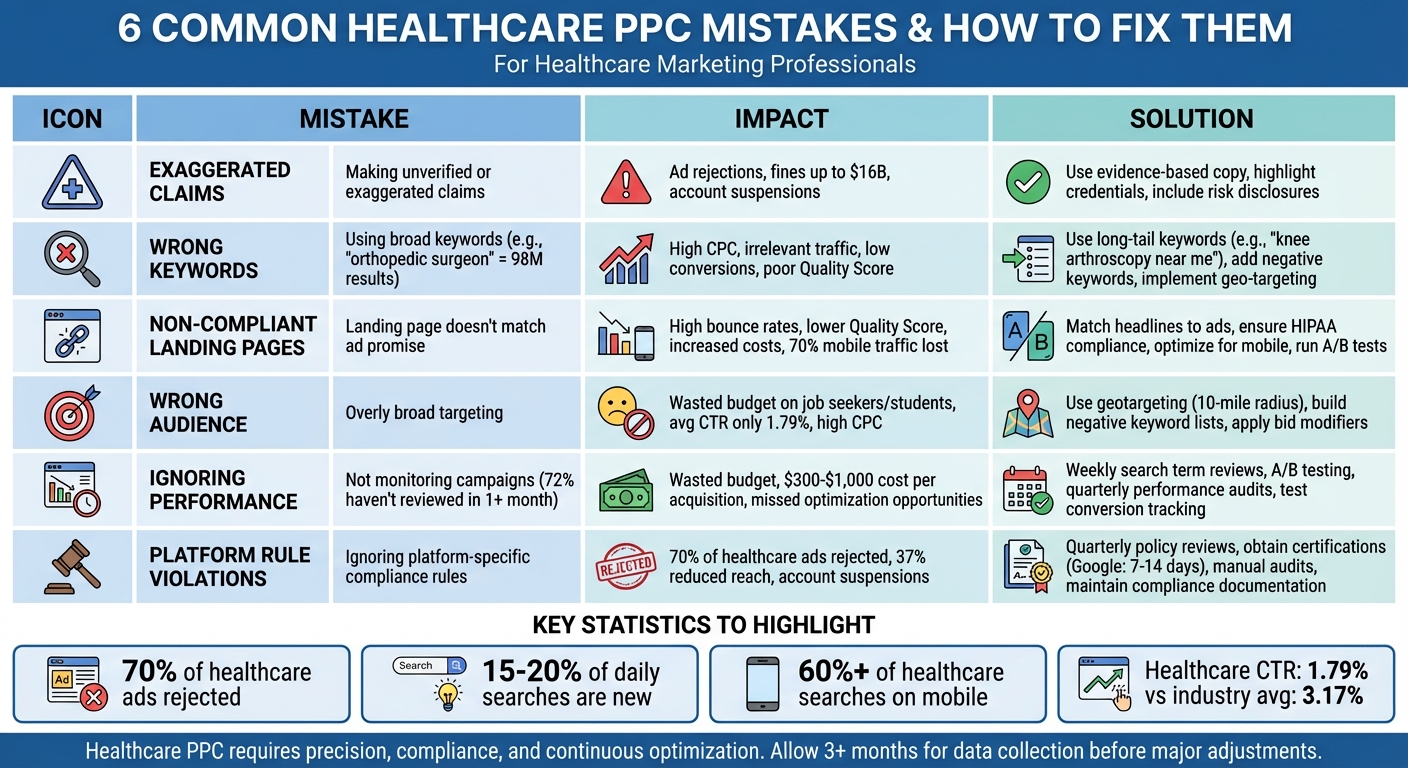
6 Common Healthcare PPC Mistakes and Solutions Guide
5 Biggest PPC Fails in Elective Healthcare Marketing
Mistake 1: Making Exaggerated or Unverified Claims
When it comes to medical advertising, honesty isn’t just a virtue – it’s a legal requirement. Regulatory bodies like the FDA and FTC, along with platforms such as Google and Meta, demand that all medical ads stick to verified facts. Claims that promise miracles or guarantee outcomes are strictly prohibited. The consequences of breaking these rules can be severe.
Violating these standards can lead to ad rejections, account suspensions, and even fines that can exceed a staggering $16 billion. Beyond the financial penalties, making unverified claims can destroy the trust that healthcare marketing relies on. As Active Marketing puts it:
"One misstep in patient data handling or misleading health claims can trigger investigations that devastate both finances and reputation." – Active Marketing
Some common mistakes include promising guaranteed results, claiming exclusivity for a treatment, or using terms like "cure" without proper clinical evidence. For instance, saying "eliminate your pain permanently" could get your ad banned, while a statement like "experienced in pain management" is far more acceptable. The FDA also requires that ads for prescription drugs include a "major statement" outlining the drug’s key risks, which must be clearly integrated into both the ad itself and any associated landing pages.
Solution: Use Evidence-Based Ad Copy
The key to staying compliant is sticking to verifiable facts and practical benefits. Highlight credentials such as board certifications, extensive experience, professional affiliations, or patient-friendly features like "accepting new patients" or "same-day appointments available". Instead of making promises, use calls to action like "schedule a consultation" or "learn about your options." If you’re advertising specific treatments or medications, make sure to include space for proper risk disclosures and disclaimers, both in your ad and on your landing page.
It’s also wise to have all ad copy reviewed by legal experts and to routinely audit your ads to ensure they align with the latest platform policies. Rules can change quickly, and what was acceptable last month might not be today. Staying proactive can save you from unnecessary headaches – and hefty penalties.
Mistake 2: Using the Wrong Keywords
Picking the wrong keywords can quickly deplete your PPC budget without delivering results. For example, using broad terms like "orthopedic surgeon" might seem like a good idea, but with over 98 million search results, your ad could easily get lost in the sea of options. Broad keywords often attract people searching for information, job opportunities, or free services – none of which translate to appointment-ready patients. This means you might see a surge in traffic, but with minimal conversions to show for it. Clearly, a more targeted approach is needed.
Search behavior is constantly shifting – Google reports that 15% to 20% of searches every day are completely new. If you’re not regularly updating your keyword strategy, your once-effective terms may become irrelevant. Worse yet, irrelevant keywords can damage your Quality Score, increasing your cost-per-click and pushing your ads lower on the results page. Leslie Lee, Senior Media Strategist at Healthcare Success, highlights this issue:
"It is frustrating going into a campaign and seeing all this money wasted. When you look at the search query of what people are actually typing in, you can see the client may be missing the mark because they haven’t actually adjusted the match types."
Her point underscores the importance of regularly refining your keyword match types to avoid wasting ad spend.
Solution: Build a Focused Keyword List
To avoid these pitfalls, shift your focus to long-tail keywords that directly address patient needs. Instead of generic terms like "orthopedic surgeon", try more specific phrases like "knee arthroscopy near me", "orthopedic surgeon in New Haven", or "orthopedic surgery for young athletes". These targeted terms not only face less competition but also attract users who are further along in their decision-making process. The result? Lower costs and better ad placement.
Another critical tool in your arsenal is negative keywords. These help filter out irrelevant traffic by excluding searches that don’t align with your goals. For instance, adding terms like "free", "jobs", "salary", "training", or "how to become" to your negative keyword list can prevent your ads from appearing in searches that clearly don’t indicate intent to book an appointment. As Leslie Lee puts it:
"Negative keywords… can be your only line of defense against irrelevant searches coming in."
To keep your campaigns sharp, regularly review your search term reports. This will help you identify irrelevant queries and expand your negative keyword list as needed.
Geo-targeting is another powerful strategy. For example, a Dallas-based practice should use keywords like "primary care doctor in Dallas" rather than broad, location-agnostic terms. With mobile devices now accounting for over 60% of healthcare-related searches, concise and intent-driven keywords such as "urgent care near me" or "same-day appointment" are essential.
Lastly, make it a habit to audit your keyword list quarterly. This allows you to track which terms are driving real appointments and adjust your active and negative keyword lists accordingly. By staying proactive, you can ensure your PPC campaigns remain effective and cost-efficient.
For expert guidance on optimizing healthcare PPC campaigns, consider consulting with Medical PPC Agency for tailored strategies.
Mistake 3: Creating Non-Compliant Landing Pages
A poorly designed landing page can derail your entire campaign. One of the most common issues is a mismatch between the ad’s promise and the landing page’s content. For instance, if your ad promotes "affordable dental implants", but clicking it leads to a generic homepage, potential patients will likely leave immediately. This disconnect not only frustrates users but also negatively impacts your Google Ads Quality Score, increasing your costs. Such misalignment can hurt ad performance while introducing additional compliance and design challenges.
Healthcare landing pages come with their own set of hurdles. Missing risk disclosures for prescription drug ads or failing to explain how patient data is handled can violate compliance guidelines, leading to ad disapproval or even suspension. Alex Membrillo, CEO of Cardinal Digital Marketing, emphasizes the importance of alignment between ads and landing pages:
"When searchers click through to your landing page, they want the offer that lured them to you in the first place. If they see something different, then they are likely to bounce right out of your site… This will reduce the quality of your ads and it means you’ll pay more to advertise."
The financial impact is hard to ignore. With digital ad spending in the U.S. healthcare sector expected to hit $19.66 billion by the end of 2024, each wasted click adds up. Irrelevant landing pages not only increase your cost-per-click but also lower your conversion rates. Additionally, with around 70% of search ad impressions coming from mobile devices, a page that isn’t mobile-friendly will lose most of its audience before they even engage.
Solution: Audit Landing Pages Regularly
Matching your landing page content to your ad promise is just as critical as choosing the right keywords and audience. To avoid these mistakes, follow these steps during your landing page audits:
- Match headlines to ad promises. If your ad says "same-day appointments available", ensure that exact phrase is prominently displayed on the landing page. Use dedicated landing pages tailored to specific services to minimize confusion and keep visitors focused on taking action.
- Ensure compliance with regulations. Make sure all lead capture forms are HIPAA-compliant, encrypted, and include required risk disclosures. Clearly display links to your Privacy Policy and Terms.
- Optimize for mobile. Test your page’s load speed and navigation on smartphones, as slow or clunky pages can significantly hurt conversions.
- Use analytics and A/B testing. Tools like Google Analytics can help identify where users drop off. Run A/B tests on elements like headlines, form lengths, and call-to-action buttons to find what works best.
Regular audits can help you catch compliance issues and performance gaps before they start affecting your campaign results.
Mistake 4: Targeting the Wrong Audience
Spending your ad dollars on people who are unlikely to become patients is one of the quickest ways to drain your PPC budget. Many healthcare practices fall into this trap by using overly broad targeting instead of narrowing in on specific demographics. The result? Campaigns that reach everyone but convert almost no one. For example, your ads might attract job seekers searching for "orthopedic surgeon salary", students looking up "free medical services", or people who live hundreds of miles outside your service area. None of these clicks are likely to turn into appointments, but they’ll still cost you money.
The financial stakes are high. With over 70,000 health-related searches happening every minute – adding up to more than a billion each day – casting too wide a net means you’re competing for clicks that won’t lead to actual patients. Garrick Gaffney, Senior Digital Strategist at Healthcare Success, sums it up well:
"It’s really twofold when it comes to PPC programs. In all the years of doing this, we see clients wasting their investment and not getting the proper attention to their accounts".
Broad targeting creates several problems. For starters, bidding on general terms like "orthopedic surgeon" pits you against 98 million search results. This not only drives up your cost-per-click (CPC) to unsustainable levels but also attracts irrelevant traffic. Users outside your service area or those who don’t need your specific services are likely to click and bounce immediately. This lowers your Quality Score and raises your future CPC. And with healthcare ads already seeing an average click-through rate of just 1.79% – far below the industry average of 3.17% – every irrelevant click further drags down your campaign performance.
The rise of mobile searches compounds the issue. More than 60% of healthcare searches now happen on smartphones, meaning it’s easier than ever to reach the wrong audience at the wrong time. A user searching from 50 miles away during their lunch break isn’t going to drive to your practice, no matter how enticing your ad copy is. To avoid these pitfalls, you need precise targeting strategies.
Solution: Use Precise Audience Targeting
To avoid wasting your budget and improve campaign performance, start by narrowing your audience with geotargeting. Focus your ads on specific geographic areas where patients are likely to visit your practice. For instance, set a 10-mile radius for an urgent care center or target specific zip codes for a specialized surgery center. This simple adjustment can save you from paying for clicks that won’t convert.
Next, build a negative keyword list to block irrelevant searches before they cost you money. Include terms that indicate non-patient intent, such as "salary", "free", or "training." Leslie Lee, Senior Media Strategist at Healthcare Success, highlights the importance of this step:
"It [negative keywords] can be your only line of defense against irrelevant searches coming in".
Regularly review your search query reports to find new irrelevant terms and update your negative keyword list accordingly.
Use intent-driven long-tail keywords to attract users who are closer to making a decision. These more specific phrases help you reach people who are actively looking for the services you provide.
Lastly, apply bid modifiers to optimize your spend based on when and how your ideal patients are searching. For example, if your data shows that mobile users searching during business hours are more likely to convert, increase your bids for those segments. At the same time, reduce spending during less effective times or for less relevant demographics. Use filters to target specific age groups, income levels, or other characteristics that match your ideal patient profile. This level of precision helps ensure your ad spend goes toward reaching the right audience.
sbb-itb-f6ab3ee
Mistake 5: Ignoring Campaign Performance
Overlooking the performance of your PPC campaigns can lead to wasted budgets and disappointing results. Shockingly, 72% of companies haven’t reviewed their ad campaigns in over a month, which often results in significant overspending. For healthcare providers, where the average cost per acquisition ranges from $300 to $1,000, this kind of neglect can quickly rack up thousands of dollars in unnecessary expenses.
But the problem isn’t just about money. Search behaviors change daily, making it essential to keep a close eye on your campaigns. Keywords that once worked well can suddenly start driving irrelevant traffic or even run afoul of updated platform policies. In a regulated industry like healthcare, failing to monitor campaigns could lead to ad disapprovals or even legal trouble. Agencies like the FDA require that ads strike a "fair balance" between benefits and risks, so neglecting compliance can have serious consequences.
Another issue is ad fatigue. In specialized medical fields with smaller audiences, showing the same ad repeatedly can cause engagement to drop over time. And while you’re stuck in a rut, competitors are refining their strategies, and platform algorithms are evolving. This can lower your Quality Score and hurt your click-through rates.
Leslie Lee, Senior Media Strategist at Healthcare Success, sums up the frustration of neglected campaigns:
"It is frustrating going into a campaign and seeing all this money wasted. When you look at the search query of what people are actually typing in, you can see the client may be missing the mark because they haven’t actually adjusted the match types."
The "set it and forget it" strategy is a recipe for failure. Without regular adjustments, your campaigns will fall out of sync with patient needs and search trends.
Solution: Monitor and Optimize Campaigns Regularly
To avoid these pitfalls, consistent monitoring and optimization are non-negotiable. Start by reviewing your budgets weekly instead of waiting for a monthly check-in. Pull search term reports every week to spot irrelevant queries and add them to your negative keyword list immediately.
Combat ad fatigue with A/B testing. Test different headlines, descriptions, and landing pages to find out what resonates most with your audience. Even small tweaks can make a big difference. As Leslie Lee points out:
"Even if you increase the conversion rate by 1% by testing or creating more compelling copy, over time, this can make a significant impact on your conversion volume."
The numbers back this up. In April 2018, Georgia Eye Associates improved their click-through rate from 0.95% to 2.8% and reduced their cost-per-click from $4.90 to $2.31 by refining their targeting and bids.
Don’t forget to test your conversion tracking. Use sample forms and phone calls to ensure your automated bidding is based on meaningful actions, like appointment bookings, instead of random clicks.
Daily monitoring is especially important in healthcare, where decisions often take weeks or months. Quarterly performance reviews can help you make strategic adjustments, reallocating funds from underperforming keywords to those that generate quality leads. This process not only boosts performance but also ensures compliance in a tightly regulated industry.
At Medical PPC Agency, we specialize in data-driven, tailored campaign management. Our approach helps healthcare providers maximize ROI while staying compliant with ever-changing regulations and market demands.
Mistake 6: Ignoring Platform-Specific Rules
Every advertising platform comes with its own set of compliance rules, and healthcare advertising is among the most tightly regulated. Overlooking these rules can result in ad rejections, account suspensions, and even legal troubles.
Here’s a sobering statistic: about 70% of healthcare-related ads are rejected, and 63% of medical marketers encounter policy violations. These issues can shrink your audience reach by up to 37%, and in severe cases, lead to immediate account suspension.
For example, Google mandates certification for certain healthcare services, like prescription drugs, addiction recovery programs, and health insurance. This process takes 7–14 business days and requires documentation such as medical licenses and evidence of HIPAA training. Similarly, Meta requires verification of business registration and healthcare documentation.
Both platforms also enforce strict content guidelines. Google bans ads for unauthorized pharmacies, unapproved substances (like hCG for weight loss), and prescription opioids – with very few exceptions for public health campaigns. On the other hand, Meta’s 2024 policy updates have significantly restricted retargeting based on a user’s medical history or health-related behaviors. Targeting options are now limited to general attributes like age, location, and interests. Additionally, both platforms prohibit targeting or personalizing ads based on inferred or declared medical conditions, diseases, or mental health information.
Stewart Gandolf, CEO of Healthcare Success, emphasizes the risks:
"Account lockouts, steep fines, or even federal investigations may follow a single misstep – I’ve seen organizations sidelined in hours due to minor oversights."
With such stringent platform rules, a proactive approach to compliance isn’t just helpful – it’s essential.
Solution: Stay Updated on Platform Policies
To avoid costly mistakes, make it a habit to review platform policies every quarter. Don’t wait for your ads to be flagged – stay ahead by regularly checking updates to medical advertising guidelines. Both Google and Meta frequently revise their policies, meaning what was acceptable last month might not be today.
Manual reviews are crucial. While automated tools can help, they often miss nuanced compliance issues, especially those related to medical claims or sensitive subjects. Interestingly, 43% of rejected healthcare ads are flagged due to landing page issues rather than ad copy. This highlights the importance of auditing not just your ads but also your landing pages on a regular basis.
Here’s a quick breakdown of key compliance requirements for major platforms:
| Platform | Key Compliance Requirement | Common Reason for Rejection |
|---|---|---|
| Google Ads | Healthcare Advertiser Certification | Landing page issues (43% of cases) |
| Meta (Facebook) | Documented patient consent for data | Violations in sensitive interest targeting |
| FDA/FTC | Evidence-based claims | Using "miracle cure" or "guaranteed" language |
| HIPAA | No PHI in tracking pixels | Capturing appointment details in conversion pixels |
To stay compliant, consider using tools like a Policy Compliance Scorecard to identify risks in your ad copy and landing pages before launching campaigns. Also, review search term reports weekly to catch potential policy violations, and keep documentation like platform certifications and HIPAA training logs up to date.
If your practice offers telemedicine, ensure medical licenses are documented for every state you target. Additionally, for addiction services or telemedicine providers, securing LegitScript certification is often a prerequisite for advertising on platforms like Google and Meta.
Comparison Table: Common PPC Mistakes and Solutions
Below is a handy table highlighting frequent PPC mistakes, their effects on campaigns, reasons they occur, and practical solutions. Use this guide to fine-tune your campaigns and tackle common pitfalls effectively.
| Mistake | Impact on Campaign | Why It Happens | Recommended Solution |
|---|---|---|---|
| Exaggerated or Unverified Claims | Ads get rejected, compliance issues arise, and patient trust erodes. | The need to stand out in a crowded market. | Write evidence-backed ad copy and stay informed about healthcare advertising rules. |
| Using Wrong or Broad Keywords | Leads to high CPC, irrelevant traffic, low conversions, and competing against 98+ million results. | The urge to target the largest audience possible. | Focus on long-tail, intent-driven keywords with geo-specific modifiers; maintain a strong negative keyword list. |
| Non-Compliant or Generic Landing Pages | Causes high bounce rates, user confusion, and lower Quality Scores. | Linking ads to the main homepage for convenience. | Develop specific landing pages tailored to ad intent, and audit them regularly. |
| Targeting Wrong Audience | Attracts low-quality leads that don’t convert into patients. | Casting too wide a net instead of narrowing focus. | Refine targeting based on demographics, location, and patient interests. |
| Ignoring Campaign Performance | Results in wasted ad budgets, missed optimization opportunities, and declining returns over time. | A "set it and forget it" approach. | Regularly track CTR and ROI, run split tests, and set clear, measurable goals. |
| Ignoring Platform-Specific Rules | Leads to non-compliance, account suspensions, and lower quality scores. | Overlooking frequent updates to platform policies. | Review platform policies quarterly, perform manual audits, and keep compliance documentation up to date. |
These points underscore the importance of running PPC campaigns with precision, compliance, and a focus on performance. Unlike e-commerce, healthcare PPC campaigns often follow longer decision cycles. Allow at least three months of data collection before making significant adjustments. Also, keep in mind that healthcare ads average a 1.79% CTR, much lower than the 3.17% all-industry average – so every tweak can make a big difference.
Conclusion
Running a successful healthcare PPC campaign takes more than just setting up ads – it requires careful planning and consistent oversight. The six common mistakes discussed here, from making unverified claims to overlooking platform rules, don’t just waste money – they can harm your practice’s reputation and limit your ability to reach the patients who need you most. Missteps like these lead to compliance headaches, poor-quality leads, and missed chances to grow your practice.
To avoid these pitfalls, focus on three key areas: staying compliant with healthcare regulations, targeting the right audience, and continuously refining your campaigns. As Garrick Gaffney, Senior Digital Strategist at Healthcare Success, puts it:
"It’s really twofold when it comes to PPC programs. In all the years of doing this, we see clients wasting their investment and not getting the proper attention to their accounts."
This highlights why a hands-off approach won’t cut it. With about 15–20% of daily Google searches being entirely new terms, healthcare PPC demands expertise in navigating regulations, managing bids, and keeping up with ever-changing algorithms. Success hinges on staying proactive and precise.
For healthcare providers looking to avoid these common mistakes, Medical PPC Agency offers tailored, data-driven solutions. Their team focuses on compliance, strategic keyword management, and ongoing optimization to maximize conversions and protect your investment. By partnering with specialists, you can transform these insights into actionable strategies that drive real results.
FAQs
How can I make sure my healthcare PPC ads follow regulations?
To keep your healthcare PPC ads compliant, it’s crucial to familiarize yourself with key U.S. regulations. These include FTC guidelines to ensure truthful advertising, HIPAA rules for safeguarding patient privacy, and FDA standards when promoting medical products or services. Stick to accurate claims, avoid misusing patient data for ad targeting, and don’t make unapproved statements about diagnoses or treatment outcomes.
Maintain a detailed record of your campaign process. This should cover everything from ad copy reviews and keyword approvals to consent procedures, ensuring a solid audit trail. Use HIPAA-compliant tools for tracking and focus on broader demographic targeting instead of honing in on specific medical conditions. Also, make it a habit to review advertising policies on platforms like Google and Microsoft regularly, as these guidelines can change.
If managing compliance feels overwhelming, consider partnering with specialists like Medical PPC Agency. They bring expertise in crafting campaigns that not only meet regulatory standards but also effectively target the right audience. By blending compliance with strategic targeting, you can run successful ads while maintaining patient trust and protecting your practice.
How can I effectively target the right audience in healthcare PPC campaigns?
To connect with the right audience in healthcare PPC campaigns, start by prioritizing compliance with HIPAA regulations and platform-specific rules. Once compliance is ensured, focus on audience segmentation. Consider factors like urgency (e.g., immediate care versus elective procedures), location (such as city, ZIP code, or "near me" searches), and demographic details like age or gender – always staying within privacy guidelines. Align these audience segments with the patient journey to measure outcomes like patient lifetime value effectively.
Some proven tactics include using long-tail, location-specific keywords (e.g., “urgent care in Dallas”) to target users with high intent, building negative keyword lists to eliminate irrelevant traffic, and employing precise geo-targeting to reach patients in your service area. Additionally, customize ad copy and landing pages to address specific patient needs, such as highlighting “same-day appointments” for urgent care services.
Medical PPC Agency specializes in refining these strategies using AI-powered tools, helping U.S. healthcare providers attract more qualified patients while improving ad performance.
Why should I regularly monitor and optimize my healthcare PPC campaigns?
Regularly keeping an eye on your healthcare PPC campaigns and fine-tuning them is key to making sure your ad spend works hard for you and delivers a solid return on investment (ROI). By routinely analyzing your campaigns, you can tweak bids, fine-tune keywords, refresh ad copy, and sharpen your targeting to reach the right patients when they need your services most.
Skipping this step can lead to wasted budget on underperforming strategies or missed chances to engage with potential patients. Staying on top of your campaign management helps you sidestep these challenges, boost ad performance, and steadily grow your healthcare practice.